By the time the sun reached the western ridge, Elias Thorne had already planed the same section of timber three times.
He knew it.
Martha Bell knew it.
Even the dog sleeping beneath the porch knew it, judging by the irritated way the animal opened one eye every time another curl of cedar fell onto its back.
Martha leaned against the unfinished railing and watched him.
“You’re going to plane straight through that beam.”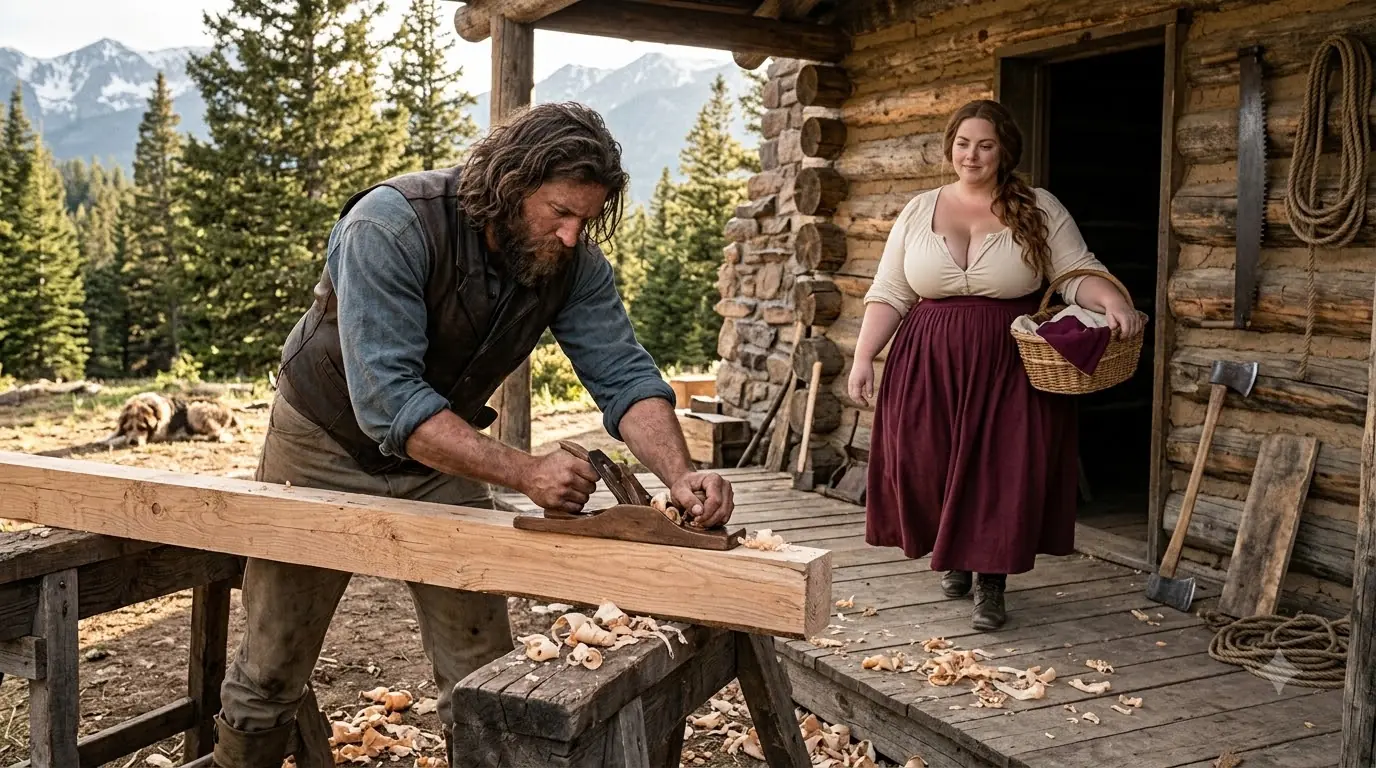
Elias did not look up.
“No.”
“Yes.”
“It needs smoothing.”
“It needed smoothing an hour ago.”
He ran the hand plane forward again.
A pale ribbon of wood curled away.
Martha smiled.
The man could lie convincingly about most things.
Weather.
Pain.
Money.
Whether he was hungry.
Whether the scar running from his left shoulder toward his ribs bothered him in winter.
But he had never learned how to lie with his hands.
They became too careful.
Too deliberate.
Too occupied.
For the last three days, every time Martha stepped too close, Elias found something that desperately required fixing.
A gate hinge.
A loose floorboard.
A saddle strap.
The chimney.
The porch.
Yesterday he had spent half an hour repairing a chair that had not been broken.
Martha understood.
He was frightened.
Not of her.
That would have been easier.
He was frightened of wanting her.
She looked toward the mountains beyond the cabin.
The September light had turned the pines almost copper at their edges.
Below the ridge, a small settlement smoked quietly beside the river.
Far enough away to feel unimportant.
Close enough that gossip still reached them.
Martha had been in that settlement only six weeks.
That was long enough.
Long enough to learn that frontier towns could measure a woman before they knew her name.
Her body always entered rooms before the rest of her did.
At nearly three hundred kilograms, she had never possessed the privilege of being unnoticed.
Men stared.
Women whispered.
Children occasionally asked honest questions their mothers answered with embarrassed cruelty.
Storekeepers watched chairs when she sat.
Hotel clerks looked at staircases.
Stagecoach drivers examined suspension springs.
Everyone had an opinion about what her body meant.
Lazy.
Indulgent.
Unhealthy.
Unmarriageable.
Desperate.
Some people tried to disguise judgment as concern.
Those were often worse.
Martha had learned to survive by becoming agreeable before anyone demanded it.
She apologized when passing through narrow spaces.
She volunteered to stand.
She refused second helpings in public even when hungry.
She laughed before other people could laugh at her.
Elias had noticed all of it within two days.
He had never commented.
That mattered more than compliments.
He simply adjusted the world around her.
The first week, he widened the step beside the cabin because he said the old one was rotten.
It was not.
Then he reinforced the kitchen bench.
“Bad joinery,” he claimed.
The bench had survived twenty years.
He raised the worktable two inches after noticing how difficult it was for Martha to bend.
“Back was bothering me.”
His back never bothered him.
She let him lie.
There are forms of kindness that become embarrassed if named.
Elias pushed the plane again.
Martha walked closer.
The floorboards creaked beneath her heavy boots.
He heard.
His shoulders tightened slightly.
She stopped beside the workbench.
The timber smelled clean and sharp.
Fresh cedar.
Elias’s skin shone with sweat despite the cool air.
His fur vest hung open over a broad chest marked by old scars and newer scratches.
Martha looked perhaps a second too long.
He noticed.
His hand stopped.
Neither spoke.