The bus stopped so smoothly that several passengers did not realize anything had changed until the parking brake released its long mechanical hiss. Outside, snow swept sideways across Route 42, swallowing the yellow centerline and turning the canyon beyond the guardrail into a gray-white emptiness. Inside, fifty-eight-year-old Elias Boone unfastened his seat belt and placed both hands on the steering wheel for one quiet second.
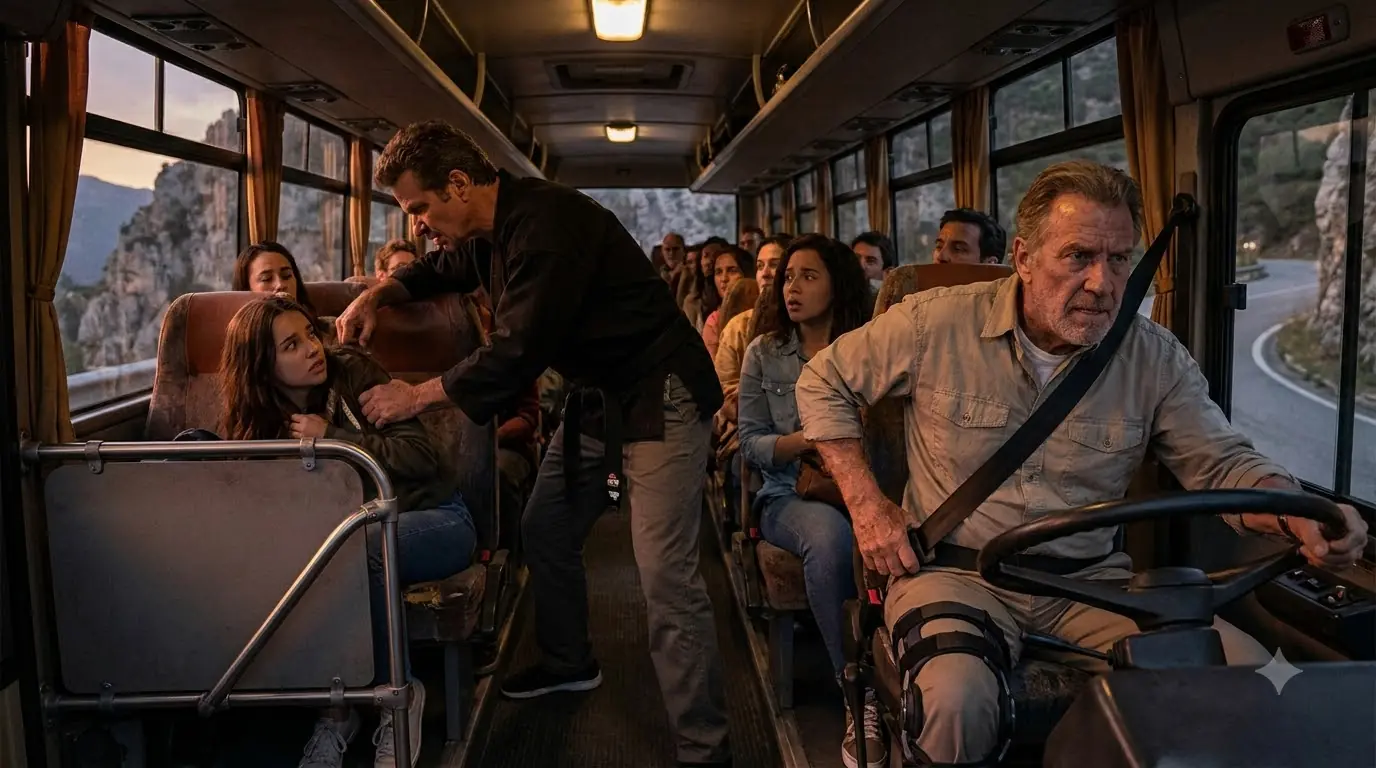
Then he picked up the public-address microphone.
“Gentleman in the black sweatshirt, step away from the young woman and take your seat.”
His voice filled the bus without anger, yet something in it caused every passenger to look up.
Twenty-four-year-old Trent Lawson slowly turned from the nineteen-year-old resort employee he had trapped against the window. Trent was six foot two, about two hundred ten pounds, heavily tattooed, and built like someone who regarded every mirror as an audience. Around his waist there was no black belt that evening, but everyone in Oak Creek knew he had one.
Trent owned Apex Striking and Grappling three blocks from the transit center. He competed regularly, had won several regional grappling tournaments, and possessed the kind of legitimate skill that should have made him careful around violence. Instead, success had convinced him that being able to control another trained fighter on padded mats meant ordinary people existed beneath him.
The young woman, Hannah Morales, still held the loose headphone cord Trent had pulled from her phone. Her back pressed against the window while his right arm remained across the top of the seat, blocking the aisle. His friends Greg Porter, Liam Cross, and Cody Benton watched from the rear seats with expressions ranging from amusement to discomfort.
Trent smiled toward the front. “You stopped a bus in a blizzard because I’m talking to somebody?”
Hannah spoke before Elias could. “I told you to leave me alone.”
Trent glanced down at her as though she had interrupted him. “Nobody asked you.”
Elias returned the microphone to its cradle. “Move away from her.”
The smile left Trent’s face.
Three weeks earlier, nobody in Oak Creek had known much about Elias Boone. He had arrived at the municipal transit depot with a clean driving record, an old knee injury, a commercial license, and references strong enough that the operations manager hired him after a single interview. He never volunteered stories about himself, and because small towns dislike empty spaces in biographies, people filled his.
Some passengers decided he had been a truck driver. Others thought he was an unemployed mechanic waiting for Social Security. Mrs. Higgins, who rode Route 42 every Tuesday, believed he had probably been military because he folded his lunch bag too neatly.
She was closer than anyone realized.
Elias had spent twenty-four years in the United States Army, most of them in infantry and training assignments. During the later part of his career, he became an instructor responsible for teaching soldiers close-quarters defensive skills, restraint, weapons retention, and decision-making under stress. He did not consider himself some secret master, and he particularly disliked men who described fighting as though it were magic.
Training was simply training. It gave a person options, and if it was good training, it also taught when not to use them.
An explosion during his final deployment damaged Elias’s left knee and lower leg badly enough that reconstructive surgery ended his field career. He retired as a first sergeant, spent several years teaching safety and defensive tactics to government contractors, then stopped after his wife became ill. When she died, Elias discovered that retirement gave grief far too much empty time.
Driving a bus was supposed to be simpler. Stay on schedule, keep people safe, handle mountain weather, go home at the end of the shift. Nobody cared what rank he once held, and Elias liked it that way.
Until Trent Lawson stepped across the yellow line that Tuesday afternoon.
The problem had begun at the Fourth Street Transit Center when Trent climbed aboard with his three training partners. He dropped one dollar into the fare box despite the posted fare being two-fifty, then walked toward the rear without waiting. Elias called him back once.
“Fare is two dollars and fifty cents.”
Trent looked around to make sure his friends were watching. “That dollar is more than this bus is worth.”
“The fare is two-fifty.”
“You going to throw me off over a buck fifty?”
Elias studied him for a moment. Then he removed six quarters from the change tray he kept for elderly passengers who occasionally came up short and dropped them into the box himself.
“Take a seat.”
Trent laughed. “That’s what I thought.”
Elias did not answer.
Mrs. Higgins had watched the exchange from the priority seats. Later, she would tell police that the driver did not look intimidated. He looked disappointed, which she believed was much more insulting.
For the next twenty minutes, Elias drove north as the storm thickened. Snow accumulated quickly along the shoulders, and wind pushed loose powder across the road in shifting sheets. Every curve demanded concentration, especially where Route 42 narrowed beside the canyon.
Behind him, Trent and his friends became progressively louder. They argued about submissions from the afternoon seminar, mocked another competitor, and reenacted portions of a sparring round in the aisle until Elias told them once to remain seated while the vehicle was moving. They obeyed for approximately three minutes.
Then Trent noticed Hannah.
She worked evenings at a ski lodge near the upper end of the route and wore a navy resort jacket over her uniform. She was exhausted after a double shift and had headphones in, hoping everyone would understand the universal language of someone who did not want conversation. Trent apparently regarded that as an invitation.
He called to her. She ignored him.
He called louder.
She turned the volume up.
That was when he leaned across the aisle and pulled the headphone cable from her phone.
Hannah stared at him. “Please don’t.”
Trent smiled. “Relax.”
“I said please leave me alone.”
“I’m talking to you.”
“I don’t want to talk.”
Greg laughed nervously. Liam looked toward the floor. Cody, the largest of the three friends, stopped smiling completely.
Trent stood and placed one hand on the seat in front of Hannah and the other behind her. It was not technically a strike. It was not yet a fight. But every person on the bus understood what the position meant.
You cannot easily leave unless I decide you can.
Elias saw it in the mirror.
He also saw the road widening into a maintained turnout two hundred yards ahead.
That was when he stopped the bus.
He took off his seat belt.
Now Trent stood in the aisle staring toward the driver. “You want to come back here and make me move?”
Elias glanced through the windshield. The bus sat completely outside the travel lane, hazard lights flashing. He had already pressed the silent operator-assistance switch beside the steering column, sending their location and a priority request to dispatch.
“I want you seated,” Elias said.
Trent laughed. “That wasn’t my question.”
“Move away from her.”
Hannah slipped sideways while Trent’s attention was on Elias. She moved two rows toward the front and sat beside Mrs. Higgins. The older woman immediately placed an arm around her shoulders.
That should have ended the immediate danger.
Instead, losing his audience made Trent angrier.
He walked toward the front.
Cody said, “Trent, let it go.”
Trent looked back. “Stay out of it.”
“I’m serious.”
“So am I.”
Elias remained beside the driver’s seat. His limp was more visible when he stood, and Trent noticed it immediately.
The young fighter’s expression changed.
Confidence returned.
“Look at you,” Trent said. “You can barely walk.”
Elias said nothing.
“You think because you drive a bus you get to order people around?”
“On this bus, when passenger safety is involved, yes.”
Trent crossed the yellow line.
Elias raised one hand. “Stop there.”
Trent took another step.
“Return to your seat.”
“Or what?”
Elias looked at him. “Police are on the way.”
That made Greg stand.
“You called cops?”
Elias did not look away from Trent. “Dispatch did.”
Greg swore.
Liam whispered, “We should get off.”
The front door remained closed because the turnout opened toward traffic and the snowbank made an uncontrolled exit unsafe. Elias had already requested officers meet the bus before passengers were released.
Trent stepped closer. “You think you can hide behind cops?”
“No.”
“You think I’m scared of some transit security guy?”
“I’m not transit security.”
“Clearly.”
Trent looked toward the passengers. “Anybody here think this old man is going to do something?”
Nobody answered.
Trent grinned.
Elias recognized that moment.
He had seen it in young soldiers, inexperienced security contractors, and men who confused adrenaline with courage. Trent was no longer reacting to a transportation dispute. He was performing.
That made him unpredictable.
It also made him easier to read.
Elias lowered his voice. “Trent, you have already frightened a passenger. You threatened me at the terminal, interfered with service, and crossed the safety line after being instructed not to. Sit down, wait for the deputy, and this evening ends with paperwork.”
Trent’s face tightened. “You remember my name.”
“You announced it when you boarded.”
A couple of passengers almost smiled.
Trent heard them.
His ego heard them louder.
He shoved Elias with both hands.
The bus erupted in gasps.
Elias moved backward one step and caught the fare barrier with his right hand. Pain shot through his damaged knee, but he remained upright.
“Do not touch me again.”
Trent spread his hands. “What are you going to do about it?”
Cody stood now. “Trent.”
“Shut up.”
“You’re screwing this up.”
Trent turned just enough to look back at him.
That was when Mrs. Higgins said, loudly and with perfect elderly contempt, “Young man, you have already screwed it up.”
Several passengers laughed.