Thirty-two-year-old Amara Wilson arrives at Sterling Crest Motors, one of the most exclusive exotic-car dealerships in Southern California, dressed with unmistakable sophistication but without an entourage, driver, or visible sign that she intends to spend nearly a million dollars before lunch.
Amara is there to collect a custom-built deep-red limited-production supercar she ordered eight months earlier. She has already paid in full. The dealership owner personally told her to arrive early, sit inside the car, and inspect every detail while final paperwork is prepared.
Senior sales manager Vanessa Cole knows none of that.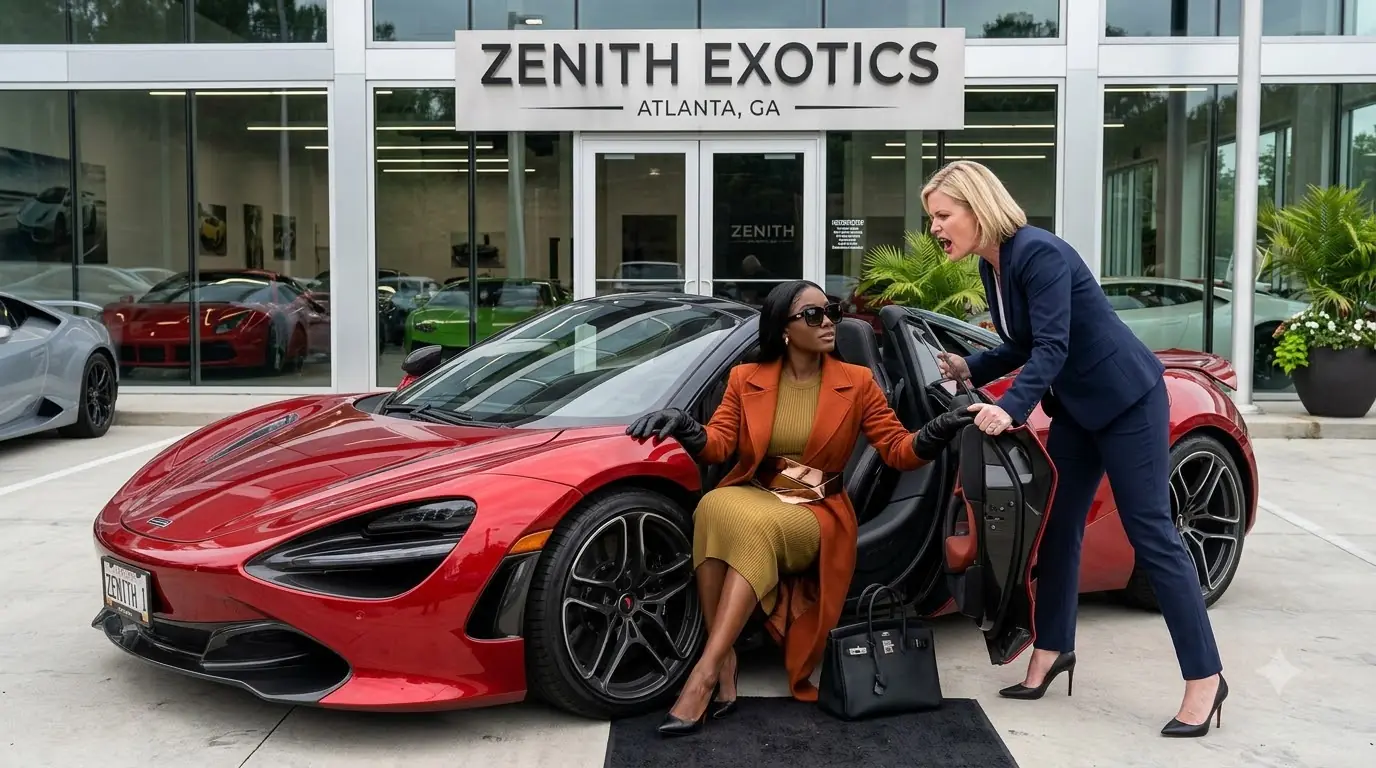
She sees only a woman sitting inside the dealership’s most expensive vehicle without one of Vanessa’s salespeople beside her.
Instead of checking the purchase file, Vanessa storms outside, orders Amara out of the car, snatches the showroom brochure from her lap, throws it onto the pavement, and begins wiping the leather seat as though Amara has contaminated it. In front of wealthy customers and employees watching through the showroom windows, Vanessa announces that the car is reserved for “serious buyers” and tells security to remove Amara before she scratches something she could never afford.
Amara does not yell.
She simply asks Vanessa whether she always decides who belongs in the showroom before learning their name.
Vanessa laughs.
Then dealership owner Charles Sterling rushes outside carrying a black presentation case.
He walks straight past Vanessa.
Inside are two keys.
The title.
The registration.
And confirmation that Amara’s $842,000 payment cleared the previous afternoon.
The car is already hers.
But the embarrassment in the driveway becomes only the beginning.
Amara is not simply a wealthy customer. She is founder and CEO of Wilson Meridian, a rapidly expanding investment and manufacturing company currently negotiating a multimillion-dollar fleet and technology partnership with Sterling Crest’s parent automotive group. Vanessa has not merely mistreated one buyer. She has exposed a culture inside the dealership that Amara had quietly been evaluating before deciding whether her company should trust the group with a much larger contract.
Charles immediately offers apologies, gifts, and even Vanessa’s job.
Amara refuses all three.
She tells him removing one employee will not fix a system that trained everyone else to stand behind glass and watch.
That observation starts an internal investigation.
The results are worse than Charles expects.
Customers who arrived in work clothes were repeatedly redirected away from premium inventory. Younger buyers were ignored until they demonstrated financial status. Women asking technical questions were often handed to junior sales staff while male companions were addressed first. Employees had even created a private messaging thread mocking customers they considered unlikely to purchase.
Vanessa becomes the most visible face of the scandal, but Amara refuses to let the dealership pretend the problem began and ended with her.
Meanwhile, one young salesman who almost intervened that morning, Ethan Parker, admits why he stayed silent: Vanessa controlled commissions, schedules, and promotion recommendations. His confession forces Amara to confront a harder question than whether Vanessa deserves consequences.
What happens when decent people recognize something wrong but believe speaking will cost them everything?
Amara eventually completes the purchase of her car, but she suspends the corporate partnership until Sterling Crest rebuilds its customer and employee practices from the ground up.
Months later, she returns to the same showroom.
This time no one rushes toward her because of the car she drives.
No one judges the clothes of the mechanic who arrives behind her.
And when a teenage girl in an inexpensive hoodie begins staring through the glass at a supercar, the newest salesperson does something Vanessa never would have done.
He opens the door.
“Want to sit inside?”
Because by then Sterling Crest has learned what Vanessa discovered too late:
A customer should never have to prove they can afford respect.
Amara Wilson knew the car was hers before she ever touched the door handle.
The title already carried her name.
The insurance policy had activated at midnight.
The final transfer had cleared at 4:17 the previous afternoon.
Eight months of engineering consultations, color samples, interior options, production delays, shipping notices, and customs paperwork had finally ended.
Her car had arrived.
Yet for almost five minutes, Amara simply stood on the sidewalk outside Sterling Crest Motors and looked through the glass.
The dealership occupied an entire corner of an affluent shopping district north of Los Angeles.
Glass walls.
Pale stone.
Steel.
No visible price tags.
Nothing as ordinary as balloons or promotional banners.
Inside were vehicles arranged almost like museum pieces.
White.
Silver.
Black.
A green coupe under spotlights.
A limited-production hypercar sitting on a rotating platform.
And outside, positioned near the main entrance beneath the morning sun, waited Amara’s deep-red supercar.
She smiled.
Not broadly.
Amara was not the type to clap over purchases.
But this one mattered.
Her father would have loved it.
That thought arrived before she could stop it.
She removed her oversized sunglasses for a moment and looked at the car differently.
Eight years earlier, Amara had still been working in a small industrial office in Oakland, negotiating supply contracts during the day and building Wilson Meridian at night.
Her father, Marcus Wilson, would occasionally call after midnight.
“You still awake?”
“Yes.”
“Go home.”
“I am home.”
“That is worse.”
He had been an aircraft mechanic for thirty-seven years.
Loved machines.
Never cared much about luxury.
He drove the same pickup for seventeen years and complained when Amara replaced it after the transmission failed.
But supercars fascinated him.
Not because of status.
Engineering.
Materials.
Aerodynamics.
Combustion.
“How does a group of people make something that fast and still convince it to turn?” he once asked while watching a documentary.
Amara remembered laughing.
Then he died two years later.
Heart attack.
Sudden.
She had never bought the car while he was alive.
Too busy.
Too practical.
Too focused on growing a company.
The first time she configured this model online, she nearly closed the page.
Then she remembered him.
So she ordered it.
Deep metallic red.
No giant exterior logos.
Black wheels.
Cream-and-charcoal interior.
Bronze stitching inspired by the color of the old aviation tools her father kept in a wooden chest.
Some purchases were not about needing something.
Sometimes they marked distance traveled.
Amara placed the sunglasses back over her eyes.
She wore a burnt-orange tailored coat over an olive-gold ribbed dress, a sculpted bronze waist piece, black leather gloves, pointed heels, and a structured black handbag.
She looked expensive.
But not in the conventional quiet-luxury way the dealership usually saw.
No beige cashmere.
No understated watch chosen specifically to be recognized only by other wealthy people.