Clara Whitlock spent an entire Texas summer digging shallow basins into a meadow her neighbors had already given up on. Four farmers came to her fence to laugh at the work, certain the next storm would wash away both her plan and what remained of her farm. But Clara was not watching the same parts of the field they were. She was watching Basin Twelve—and when its outer wall began to move, every man at the fence suddenly needed an answer only she could give.
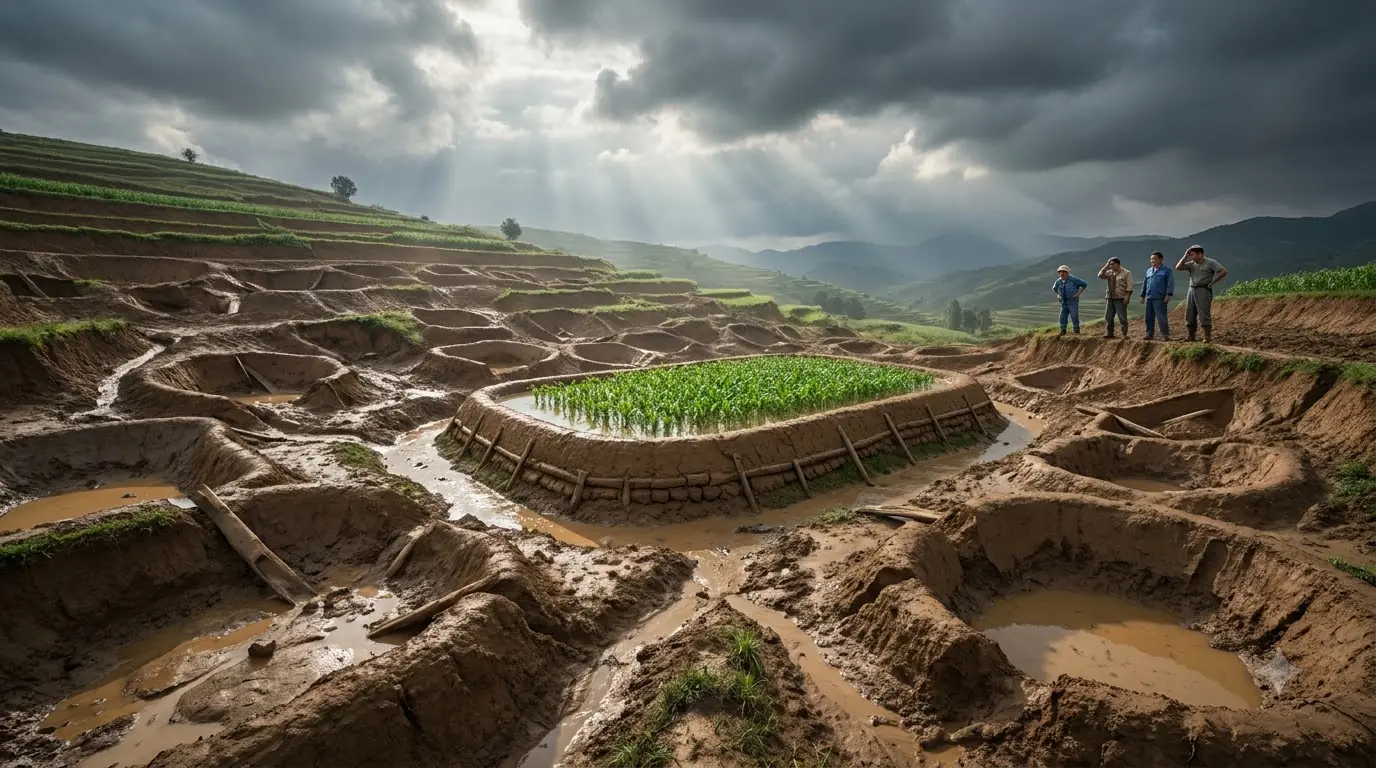
“Well, Clara,” Hank said, resting his forearms on the fence. “Guess we’re finally going to find out whether you built a water system or a hundred and twenty pig wallows.”
Roy laughed first.
Ellis followed, looking across the meadow as though the effort alone offended his sense of how a farm should work. Ben, the youngest of the four, smiled without quite joining them.
Clara stood on the other side of the fence with a shovel in her hand.
Her shirt clung to her shoulders. Dirt had worked into the seams of her gloves, and the heel of one boot had rubbed a raw place she could feel whenever she stopped moving.
Behind her, 120 shallow depressions lay across the slope.
Some were twenty feet wide. Others were barely half that size. They followed the land in a pattern the men could not understand from the road.
Or did not want to.
Clara looked past them toward the western ridge.
Clouds had swallowed the pale strip of sky above it.
“You ought to go home,” she said.
Hank turned to follow her gaze.
“Afraid we’ll see what happens?”
“No. I think you’ve got things of your own to check.”
“Checked them this morning.”
“Then check them again.”
Roy shifted his weight against the fence.
“You always this friendly with people showing an interest?”
Clara looked at him.
“You’re showing an interest now?”
The smile left his face.
Ellis glanced at the shovel.
“You can’t dig your way out of every problem.”
She looked toward the lower field, where a thin trail of pale dust marked the old erosion scar.
“No,” she said. “Just this one, if I’ve done it right.”
A gust crossed the meadow.
The cattle near the trough lifted their heads. One turned toward the shed, and the others began to follow.
Clara watched them move before looking back at the men.
“Stay off the banks.”
Hank laughed.
“We’re not going anywhere near those holes.”
She nodded once.
That was good.
At least one part of the afternoon was going according to plan.
The first heavy drop struck beside her boot.
Then another hit the fence rail.
Within seconds, rain darkened the dust in scattered spots. The spots joined. The wind changed direction, carrying a smell Clara had waited for all summer.
Wet ground.
She closed her eyes for one brief moment.
Then she opened them and looked uphill.
The water was coming.
In spring, before she dug the first basin, Clara had watched a storm waste itself.
It lasted less than an hour.
Thunder moved over the farm, rain struck the meadow, and for a few minutes she thought the season might finally turn.
Then she went outside.
Water raced over the hard surface instead of settling into it.
The upper meadow shed rain the way a tilted roof did. Small streams gathered into larger ones, carrying loose soil toward the fence.
By the time the storm passed, the ditches held muddy water.
The field did not.
Two days later, the ground was hard again.
Clara stood near the old erosion scar and pressed a shovel into the surface. It entered only after she put her weight on it.
She looked toward the ditch.
The water there had already begun to disappear.
It had crossed her land without doing the work she needed it to do.
For years, she had heard the same sentence from people around her.
We need rain.
She needed rain too.
But standing there with the shovel, she began to wonder whether that was only half the problem.
If the next storm behaved like the last one, more rain might mean more soil leaving the meadow.
The field needed time with the water.
It needed the rush broken into something slower.
That evening, Clara took an old notebook to the kitchen table.
She drew the slope.
Not neatly.
She marked the fence, the service track, the upper ground, the low corner, and the scar that had widened during the last storm.
Then she drew one shallow bowl.
Her first thought was simple enough to seem foolish.
What if the water had to stop before it could leave?
She slept badly that night.
By morning, the bowl had become several.
She went outside with the notebook and walked the meadow, looking for the small changes in height she had crossed for years without studying.
A ridge barely higher than her ankle.
A natural hollow beside a patch of dead grass.
A line where runoff already preferred to travel.
The land was not flat.
It only looked flat when she was thinking about cattle instead of water.
At breakfast, she opened the notebook beside the unpaid bills.
The largest envelope came from the bank.
She had read it twice the day before.
The farm had survived poor seasons by delaying repairs, reducing expenses, and selling cattle she would rather have kept. Those decisions bought time, but they also made the next season harder.
Fewer animals meant less future income.
Older equipment meant slower work.
Deferred maintenance became another problem waiting to happen.
The bank’s warning did not say she would lose the farm that week.
It said the room for another failed season was disappearing.
Clara folded the letter and put it beneath the notebook.
She did not need to look at it again.
She could feel it there.
The county notice arrived four days later.
It concerned runoff and erosion from the upper meadow.
The road below had already needed cleanup after the spring storm. Mud reached a neighboring drainage area, and another severe event could carry more of the remaining soil toward other properties.
Clara read the notice on the porch.
A truck passed on the road.
She watched the dust rise behind it.
For months, she had been trying to prevent the land from dying of thirst.
Now she also had to keep a storm from carrying it away.
She was not choosing between drought and flood.
Both could hurt the same field.
Both had begun using the same weakness.
The first basin took longer than she expected.
That was how most things started on a farm.
She measured the area, marked the edge, and began digging. The ground resisted every stroke.
By noon, her shoulders hurt.
By midafternoon, one glove had split.
She stopped beside the trough and drank water while the cattle watched her as though she had joined them in a habit they understood.
The first hollow looked unimpressive.
A person walking past could have mistaken it for unfinished work.
Clara walked around it several times.
Then she adjusted the low point through which excess water would leave.
The basin could not simply trap everything.
It needed to hold what it could and release the rest without creating a new destructive channel.
That was the part people missed when she explained the idea.
They heard ponds.
She meant pauses.
She meant a series of places where rushing water lost some of its hurry.
The aging mule stood near the scraper, flicking an ear.
Clara had spent the morning shaping by hand and used the old equipment for work it could still manage. The tractor needed repairs she could not justify while buying feed and paying for water.
The mule-drawn scraper was slow.
It was also hers.
It did not require a new loan.
She walked over and rested a hand against the animal’s neck.
“One,” she said.
The mule lowered its head.
It was not impressed either.
By the end of the week, one basin had become five.
Clara began to see the connections more clearly.
The places where overflow needed to travel.
The ridges that had to remain untouched.
The low areas that could receive water without sending it toward the road.
She made mistakes.
A channel she thought would carry water gently turned too sharply at one end.
A basin positioned according to the view from the track made less sense when she walked the ground beyond it.
She corrected both.
The notebook became stained and difficult to close.
Numbers crowded the margins.
Some were crossed out.
She did not erase the mistakes completely because she wanted to remember why she changed things.
When Roy stopped at the gate, five basins were visible.
He leaned out of his truck.
“What are you doing?”
“Trying to slow the runoff.”
He looked over the shallow bowls.
“With holes?”
“With places for the water to spread.”