The first sign that something was wrong was not the roses. It was the water bill, and the particular silence with which Arthur Mitchell received it.
He stood at the kitchen counter in the thin gold that comes to a countryside kitchen only after the fog has lifted off the lower field and before the heat has settled into the porch boards. The envelope was ordinary. White. Bent at one corner where the carrier had forced it through the slot. Arthur opened it with the butter knife he kept in the spoon drawer, because tearing paper with his thumb had always struck him as careless. He unfolded the statement. He looked at the number for a long time, the way a man looks at a face he almost recognizes and does not yet want to name.
His house barely used water. It was only him, a narrow vegetable garden along the south fence, and a sprinkler he ran on the worst afternoons for the tomatoes alone. He did not believe in watering a lawn that had no business pretending it was a golf course. His showers were short. The dishwasher waited until it was full. He had lived alone long enough to know the shape of his own usage the way he knew the idle of his truck. The figure in his hand was nearly three times the ordinary amount. It sat on the page with the calm of a fact that had not asked permission to be true.
At first he assumed a mistake. Utilities wandered. Decimal points slipped. Meters were read by people already thinking of the next driveway. He set the statement beside his coffee and read it as he used to read irrigation specifications for the county, line by line, as if politeness might correct the arithmetic. Usage. Days in the cycle. Rate. The math was sound. The volume was not. Between the last reading and this one, the property had drunk three times what it usually drank, and Arthur had not been the one holding the glass.
He put on his shoes and went out to the meter.
The box sat at the edge of the drive, half hidden by daylilies he had never quite divided. He lifted the lid. The dial was spinning. Not the shy creep of a leaking toilet, but a steady, confident turn, the movement of water traveling in volume. He stood with the lid in his hand and listened to the house. No tap. He had shut the kitchen faucet himself. The bathroom was silent. The hose bib at the garage was closed, and he checked it anyway, because a man who has just watched a dial turn does not trust his memory of a handle. Every faucet was off. The dial kept turning.
Somewhere, water was flowing.
He followed it the way a careful man follows a problem, with his eyes before a shovel. The irrigation line ran along the side of the yard, a shallow trench he had dug himself two summers after he bought the place, marked at the turns with stakes he had painted white so the mower would spare them. It served the vegetable beds and a short run to the porch spigot. It was not a system built for anyone else. At the property line it disappeared beneath the wooden fence that separated his ground from the neighboring house.
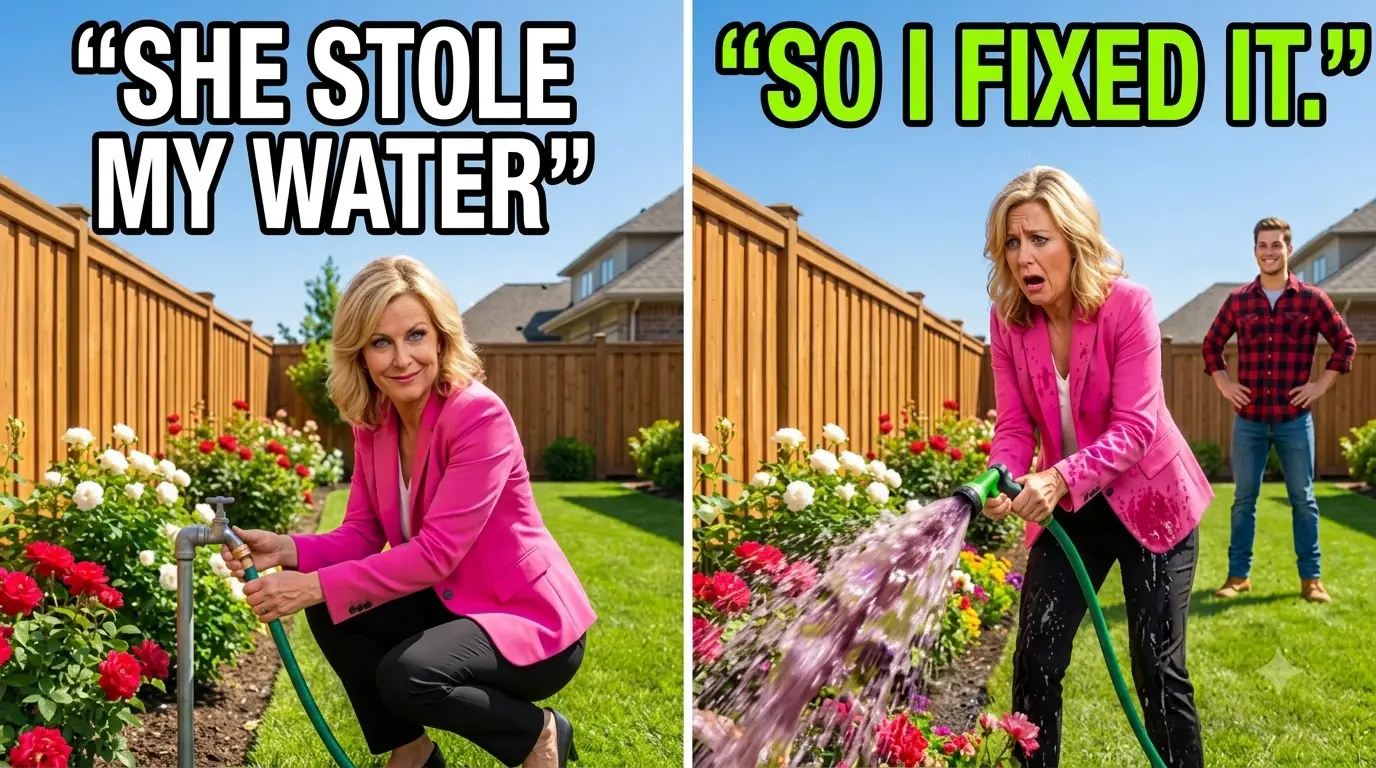
That neighbor was the newest and most vocal member of the Cedar Ridge HOA board. Her name was Brenda Kensington.
She was known for two things. Enforcing the rules with a zeal that treated every subsection as a personal possession. And her roses. Arthur had watched both reputations arrive, not all at once, but in the steady way a new board member makes herself felt. A letter about trash cans that cited a section number. A note on a windshield about a boat trailer that had spent one weekend in a driveway. A spring-meeting speech on standards, delivered as if the word itself had been entrusted to her keeping. Behind her house, visible from the small rise near his compost, the roses stood in rows. Every shade of red and pink. Hybrid teas in tight formation. Climbers trained up a trellis painted the approved cream. From a distance it looked like a brochure someone had persuaded to take root.