The first thing the Farm Girl learned about drought was that adults became quieter before they became afraid.
At the beginning of the summer, her father still complained loudly about the heat.
He complained about the clouds that gathered on the western horizon every afternoon and disappeared without giving them rain.
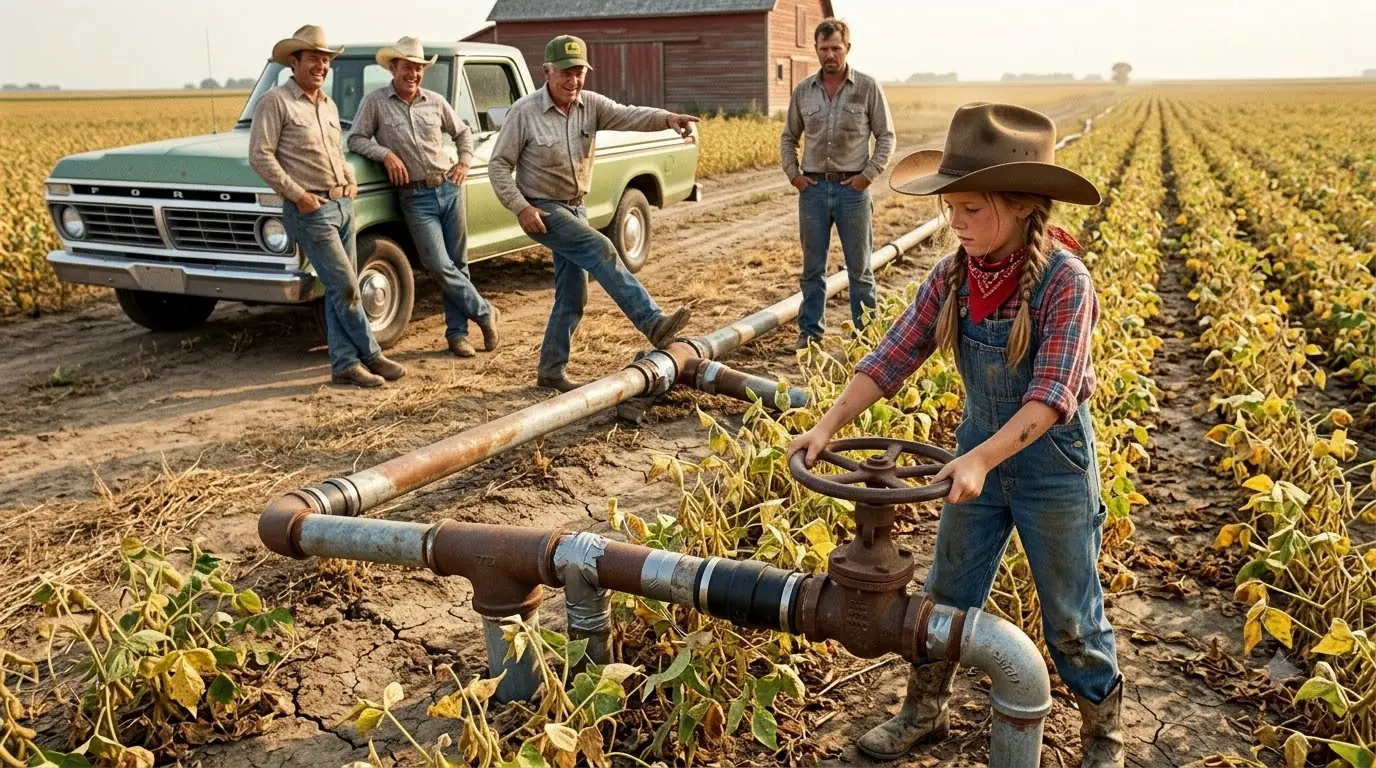
He complained about the radio forecasters.
He complained about the price of diesel.
He complained about the soybean leaves turning their undersides toward the sky.
Then July arrived.
The complaining stopped.
That frightened her more than anything.
Her father began walking the fields before breakfast.
He would leave the farmhouse while the eastern sky was still pale, cross the yard carrying a coffee cup, and disappear between the rows.
When he returned, he rarely said anything about what he had seen.
He simply sat at the kitchen table and looked at the farm ledger.
The Farm Girl was ten years old.
She did not understand every number in that ledger.
She understood enough.
There was a bank loan.
There was money owed on seed.
There was money owed on fertilizer.
There were repair bills for the tractor.
There was a payment due on the farm itself.
And almost every one of those debts expected to be paid after harvest.
Harvest required soybeans.
Soybeans required water.
The sky had stopped providing it.
Their farm sat in central Kansas where the land rolled gently enough that people from farther west sometimes joked it was practically flat.
The Farm Girl knew better.
She had ridden every fence line with her father.
She knew the south field dipped toward the creek.
She knew the old cattle pasture climbed sharply behind the windbreak.
She knew the farmhouse sat slightly lower than the abandoned barn.
She knew there was a ridge beyond the north soybean field where her grandfather once kept cattle.
And she knew something her father had stopped thinking about years ago.
There was water up there.
Not much.
Not anymore.
But there was some.
The old livestock reservoir had been dug before she was born.
Her grandfather used it to collect runoff and spring seepage from the ridge.
A dirt berm held the water in a shallow basin lined with clay.
When cattle still grazed the upper pasture, an old iron line carried water downhill to a trough.
The cattle were gone.
The trough was cracked.
The line had been disconnected.
Brush had grown around the reservoir.
Nobody called it a reservoir anymore.
Her father called it “the old pond.”
Most years it was half mud.
That summer, strangely, it still held water.
The Farm Girl had noticed in June while searching for a missing barn cat.
She had crouched beside the cattails and watched dragonflies move over a dark patch of water beneath the cottonwoods.
At the time she thought only that it was cooler there.
She did not think of soybeans.
Not yet.
The idea began behind a neighboring barn.
The Farm Girl had gone with her father to borrow a hydraulic hose.
The Neighbor Farmer owned more acreage than they did and better machinery.
His barnyard was full of equipment her father could never afford.
Newer tractor.
Larger planter.
Two irrigation pumps mounted on trailers.
Rows of aluminum pipe stacked along a fence.
Behind the machine shed lay another pile.
That pile was different.
Rusted steel pipe.
Galvanized sections.
Bent fittings.
Old gate valves.
Broken couplers.
Lengths of pipe with dents large enough to make an adult call them worthless.
The Farm Girl stopped.
Her father kept walking.
She crouched beside the pile.
One pipe had rust around the coupling but no hole.
Another was straight for almost twelve feet before a crushed end.
She touched a valve wheel.
It did not move.
The Neighbor Farmer appeared behind her.
“Careful.”
She looked up.
“That junk bites.”
She wiped rust from her fingers onto her jeans.
“What are you doing with it?”
“Scrap man’s supposed to haul it.”
“All of it?”
He laughed.
“You want some?”
The Farm Girl looked at the pile again.
“Yes.”
The Neighbor Farmer stared at her.
Behind him, another Farmer stepped from the barn carrying the hydraulic hose.