“Stop.”
The word cut across the shoulder of Highway 19 like a blade.
The Black driver kept both hands exactly where the officer could see them.
Ten and two on the steering wheel.
Dome light on.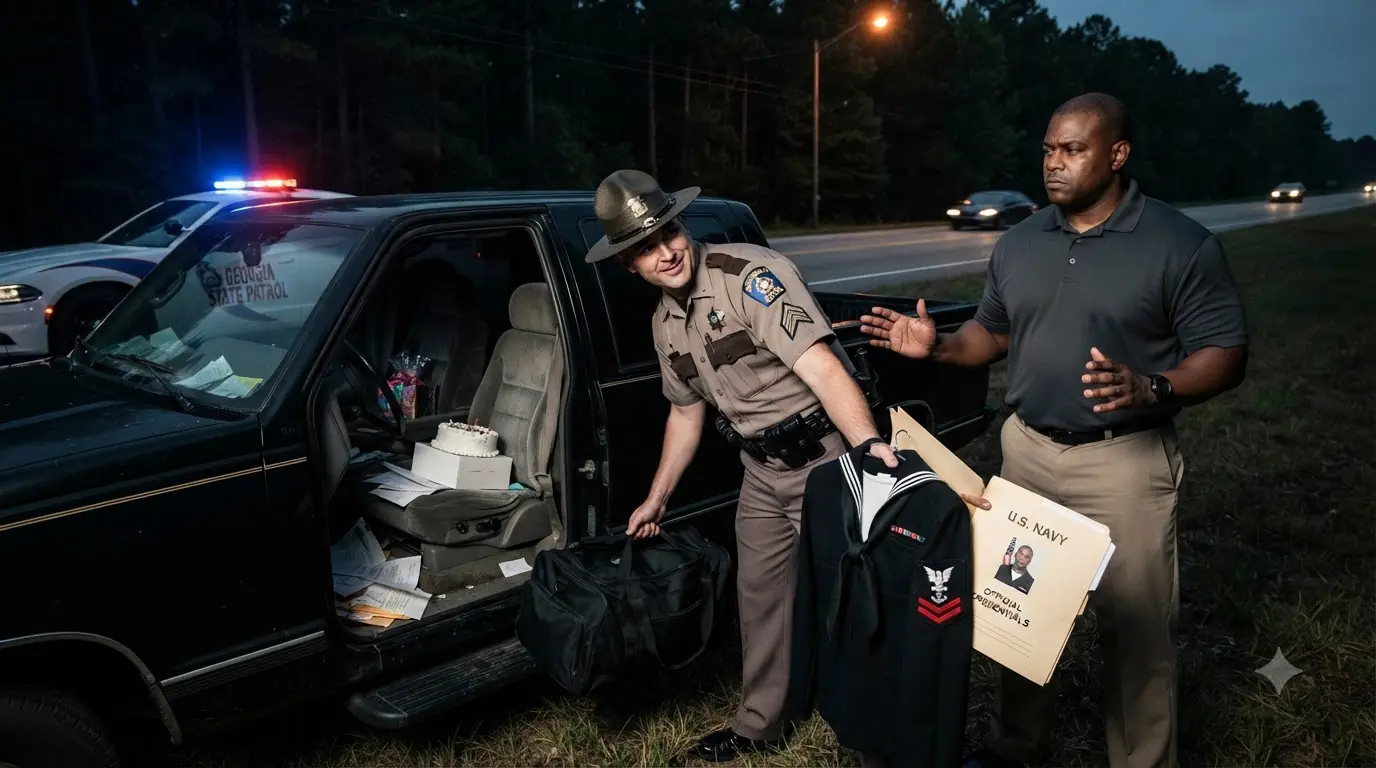
Engine off.
Window down.
Outside, the last orange edge of sunset had already vanished behind the Georgia peach orchards, leaving only the gray-blue darkness of early night and the rhythmic flash of red and blue lights against the rear of the pickup.
The driver could smell warm asphalt.
Fresh-cut grass.
And faintly, from the passenger seat, vanilla frosting from the half-eaten birthday cake he was taking home.
He looked into the side mirror.
The officer stood beside the open window with a flashlight aimed unnecessarily into his face.
“Officer,” the driver said calmly, “may I ask the reason for the stop?”
The officer’s jaw tightened.
“License.”
“I’ll give it to you.”
“Then give it to me.”
“My wallet is in my back pocket. I’m telling you before I reach.”
The officer leaned closer.
“I know how wallets work.”
The driver said nothing.
He moved slowly.
Two fingers toward the pocket.
Wallet out.
License removed.
Hand extended.
The officer snatched it.
His flashlight dropped briefly toward the registration sticker on the windshield.
Then toward the interior.
Clean dashboard.
Coffee cup.
Folded jacket.
Cake box.
One dark travel bag resting behind the passenger seat.
“Registration.”
“Glove compartment.”
“Get it.”
The driver turned his head slightly.
“My hands are going to the glove box.”
The officer exhaled.
“Man, just do what you’re told.”
The driver opened the compartment.
Insurance card.
Registration.
Maintenance receipts.
He handed over the documents.
The officer studied the license.
Then looked at the driver.
Then back at the license.
“You’re a long way from home.”
“Visiting family.”
“Where?”
“Albany.”
“Doing what?”
“My mother’s birthday.”
The officer looked toward the cake.
“How old?”
The driver paused.
“My mother?”
“You got another mother in there?”
The driver slowly breathed out.
“Seventy-two.”
The officer gave the cake another glance.
Then looked into the rear of the pickup.
“You carrying anything illegal?”
“No.”
“Weapons?”
“There is a legally secured firearm in a locked case behind the rear seat.”
The officer immediately stepped backward.
His right hand dropped toward his own weapon.
“Why didn’t you tell me that first?”
“You asked me just now.”
“Hands on the wheel.”
“They are.”
“Don’t move.”
“I’m not moving.”
The officer backed toward his cruiser.
The driver remained still.
He had been stopped before.
Not often.
Enough.
He knew the choreography.
He also knew that nervousness could be interpreted as suspicion.
Calm could be interpreted as arrogance.
Questions could become defiance.
Silence could become evasiveness.
There was no perfect performance.
Only choices.
He chose stillness.
In the mirror, the officer stood beside his patrol car speaking into the radio.
The driver could not hear the words.
A minute later, the officer returned.
“Step out.”
The driver looked at him.
“For what reason?”
The officer’s expression sharpened.
“Because I told you to.”
“I’m asking why.”
“Step out of the truck.”
The driver looked toward the dark road.
Few cars.
No nearby businesses.
No visible houses.