At 7:12 on a Monday morning, nobody at Halcyon Meridian Holdings noticed the woman pushing a gray cleaning cart through the employee entrance.
That was exactly what she wanted.
The headquarters rose forty-two stories above downtown Chicago, all steel, glass, marble, and money.
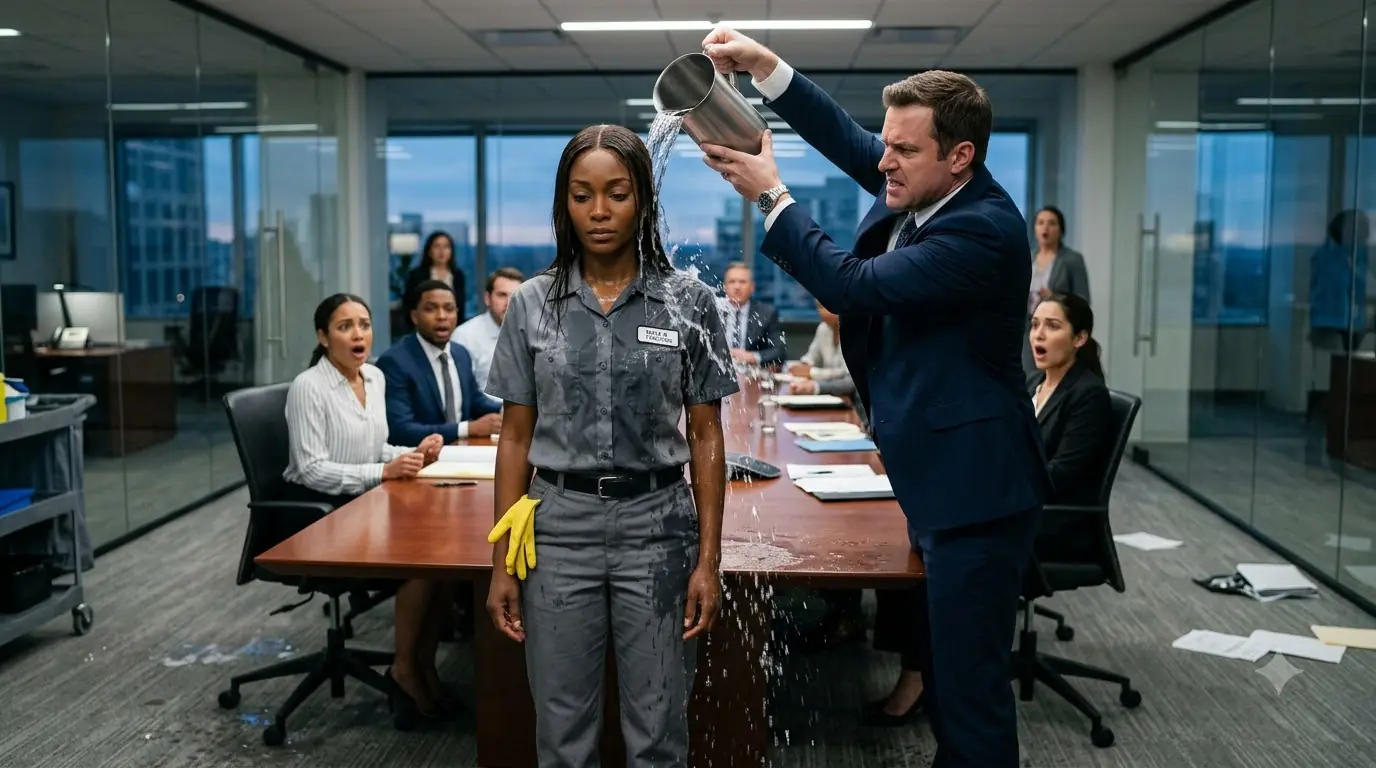
By eight in the morning, the lobby would be filled with consultants in tailored suits, attorneys carrying leather portfolios, senior vice presidents balancing coffee against tablets, and assistants moving with the permanent urgency of people whose calendars had been weaponized.
But at 7:12, the building belonged to people who were usually invisible by the time executives arrived.
Security.
Maintenance.
Catering.
Custodial crews.
Delivery drivers.
The young Black woman in the gray janitor uniform blended among them easily.
Her name tag read:
MAYA
That was not her name.
Not the one printed on corporate filings, anyway.
Her real name was Amara Wilson.
Thirty-two years old.
Founder and majority owner of Halcyon Meridian Holdings.
Chief Executive Officer.
And, as of that morning, almost nobody in the building knew she was there.
Amara had built the company from a logistics software startup with six employees into a multinational services group employing more than eighteen thousand people.
For years, magazines described her as brilliant.
Investors called her disciplined.
Competitors called her ruthless.
Employees who had actually worked near her tended to use a different word.
Observant.
Amara noticed things.
Who interrupted whom.
Who took credit.
Who stopped talking when a senior executive entered.
Who was polite to assistants only when they believed the assistant mattered.
Who looked directly at cleaners.
Who looked through them.
Those details mattered to her more than most performance dashboards.
That morning, she had come to the building because a dashboard had started bothering her.
Employee complaints at Halcyon Meridian's Central Division had fallen dramatically.
On paper, that looked excellent.
Thirty-six percent reduction in formal grievances over twelve months.
Forty-two percent reduction in workplace conduct complaints.
Nearly zero complaints involving managers above director level.
At the quarterly board review, Regional Manager Richard Harlan had presented the numbers personally.
“Culture improvement,” he called it.
He had smiled as the slide appeared.
Engagement.
Efficiency.
Accountability.
All green.
Amara had watched from the end of the table.
Then she asked one question.
“Why did anonymous reporting drop at the same time?”
Richard had paused.
Only slightly.
“We simplified escalation pathways.”
“What does that mean?”
“We encourage direct resolution.”
“Before formal reporting?”
“Yes.”
“Who handles direct resolution?”
“Immediate management.”
Amara had looked down at the report.
“So employees are encouraged to resolve concerns with the same managers they may be complaining about.”
Richard had smiled.
“That’s an unnecessarily cynical interpretation.”
Amara had not smiled back.
Two weeks later, she asked the legal department to quietly audit the complaint system.
What they found was not illegal.
That made it worse in some ways.
Nothing dramatic.
Nothing obvious.
Just pressure.
Anonymous complaints were technically still available, but employees had been repeatedly told that “professional adults communicate directly.”
Supervisors were instructed to resolve interpersonal issues “at the lowest possible level.”
Complaint forms were routed through department heads before human resources.
Temporary workers were told that complaints could affect renewal decisions, though nobody put that threat in writing.
Custodial and catering contractors had no direct internal channel at all.
Their complaints went through vendor supervisors.
If the vendor supervisor decided something was minor, Halcyon Meridian never saw it.
On paper, complaints went down.
In reality, employees had learned to stop filing.
Amara wanted to know whether the culture matched the data.
She could have ordered an external investigation.
She eventually would.
But first she wanted to see the building without the gravitational effect of her title.
So at 6:45 that morning, she arrived through the vendor entrance wearing a gray custodial uniform supplied by the legal department.
Only four people knew.
Chief Legal Officer Thomas Reed.
Chief Operating Officer Elena Pierce.
Head of Security Daniel Cho.
And Amara’s executive assistant, who had strongly advised against the idea.
“People will recognize you,” the assistant said.
“Some will.”
“You’ve been on magazine covers.”
“Most people do not spend their mornings memorizing magazine covers.”
“You were on CNBC last week.”
“For seven minutes.”
“You have distinctive hair.”
“So does half the city.”
The assistant sighed.
“This is a terrible idea.”
“That is what legal said.”
Thomas Reed had actually said:
“This is legally survivable but operationally stupid.”
Amara considered that a form of approval.
Now she pushed a cleaning cart toward the service elevator.
A security guard held the door for her.
“Morning.”
“Morning.”
He looked tired.
No suspicion.
No artificial politeness.
Just morning.
Amara smiled.
“Long night?”
“Elevator alarm on thirty-seven kept triggering.”
“Fixed?”
“Maintenance says yes.”