The temperature reached one hundred and three degrees before noon.
By twelve fifteen, the galvanized steel irrigation pipe beside Emily Carter’s soybean field had become too hot to touch with a bare palm.
She touched it anyway.
Only for a second.
Enough to feel the vibration running through the metal.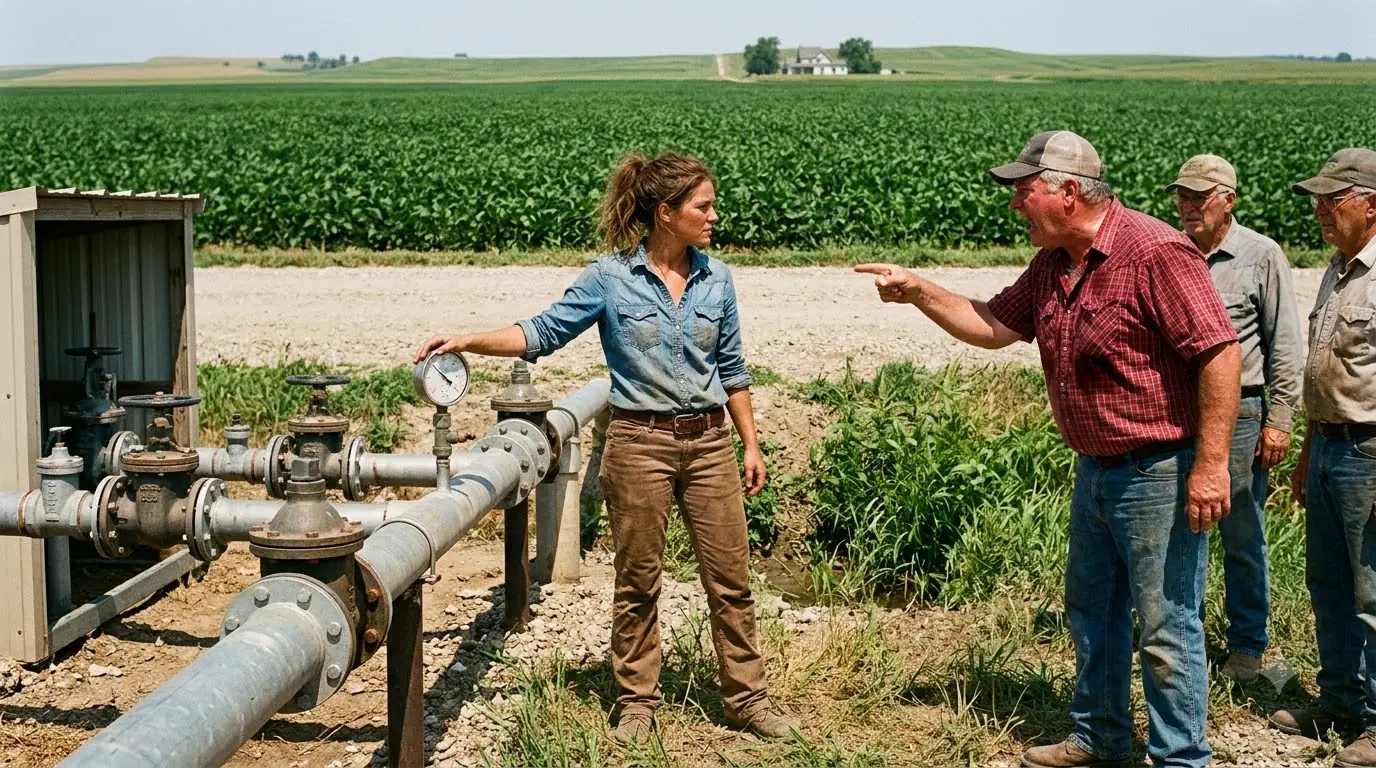
Water was moving.
Emily crouched beside the pressure gauge and wiped dust from the glass with the cuff of her faded blue denim shirt.
The needle sat at seventy-two pounds per square inch.
She frowned.
It should have been closer to fifty-eight.
Maybe sixty.
Not seventy-two.
She checked the smaller gauge mounted farther downstream.
Sixty-nine.
Then the meter.
Flow normal.
Allocation normal.
Pump cycle normal.
Nothing made sense.
Emily stood slowly.
Beyond the junction, rows of soybeans stretched toward the western fence, leaves dark green despite a summer that had burned nearly everything else in Lincoln County.
Across the gravel road, Harold Mercer’s corn looked like paper.
Leaves folded inward.
Stalks yellow.
The ground beneath them cracked into hard plates.
Two miles farther north, several irrigation ponds had shrunk so badly that dark rings marked where the water had once reached.
The drought had not arrived dramatically.
It had simply stopped raining.
April had been dry.
May worse.
June produced three thunderstorms, but only one dropped enough moisture to reach the roots.
By July, the county water board imposed restrictions.
Every farm connected to the irrigation network received reduced allocations.
Nobody liked it.
Nobody argued with the arithmetic.
There was only so much water.
Except, apparently, on the Carter farm.
Emily stared across her soybean rows.
She should have been pleased.
Instead, she felt watched.
She had felt watched for nearly three weeks.
At first, it came through jokes.
Men at the feed store.
Farmers at the diner.
Neighbors leaning against truck beds.
“How'd you sweet-talk the clouds, Emily?”
“You bury a rainmaker out there?”
“Carter beans got their own private weather?”
Emily smiled the first few times.
Then Harold Mercer stopped joking.
That changed everything.
Harold had farmed in Lincoln County for thirty-eight years.
He had inherited his first eighty acres from his father and expanded until he controlled nearly nine hundred.
He knew machinery.
Weather.
Soil.
Cattle.
Water rights.
At county meetings, other farmers listened when Harold spoke.
He was not chairman of anything.
He did not need to be.
His reputation gave him authority.
When Harold began saying Emily was drawing more than her legal allocation, rumors hardened into suspicion.
The first direct accusation came at Wilson Feed and Grain.
Emily walked inside carrying a box of hydraulic fittings.
Harold stood near the register with two other farmers.
He looked at her.
Then at the box.
Then said loudly:
“Must be nice having enough water to still need fittings.”
Emily stopped.
Everyone heard.
She turned.
“Something you want to ask me, Harold?”
He gave a humorless smile.
“Already did.”
“When?”
“County meeting.”
“You asked why my beans were green.”
“Exactly.”
“And I told you.”
“Better soil management.”
Emily nodded.
“Cover crop.”
“Reduced tillage.”
“Organic matter.”
“Shade between rows.”
Harold laughed.
“Pretty speech.”
Emily placed the box on the counter.
“You think I'm stealing water?”
“I think water doesn't appear from nowhere.”
That sentence followed her home.
Because Harold was right about one thing.
Water did not appear from nowhere.