The man who promised to marry Evelyn walked away without saying goodbye.
That was what she remembered most clearly.
Not the train.
Not the dust.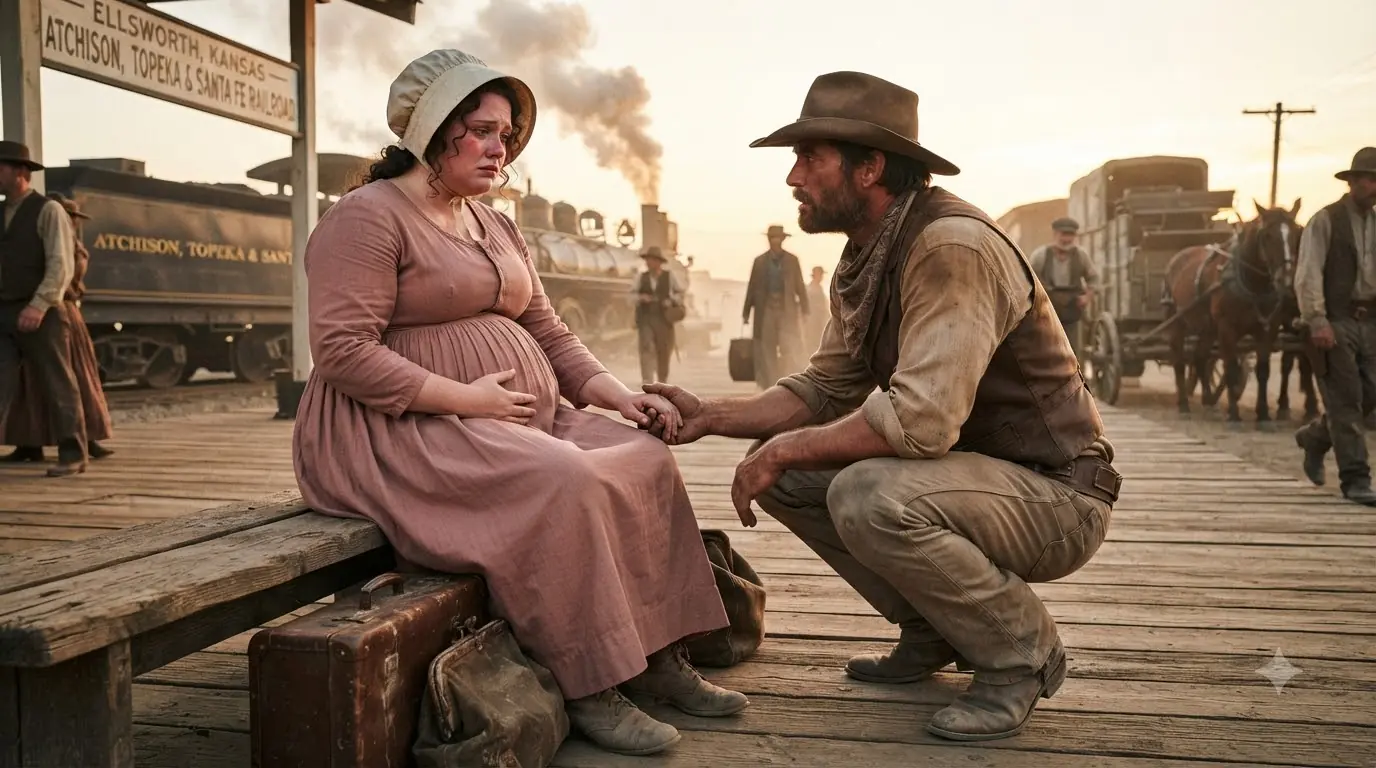
Not the Kansas heat pressing down on the platform like the lid of an iron stove.
The absence of goodbye.
Caleb Mercer simply looked toward the street beyond the station, adjusted his coat, and walked.
Evelyn watched him disappear between a freight wagon and two traveling salesmen.
At first, she assumed he was going to find transportation.
They had arrived after noon.
The ranch where he claimed they would live was supposedly several hours west.
He had told her there would be a wagon waiting.
Perhaps the driver had gone somewhere for water.
Perhaps Caleb was asking directions.
Perhaps he would return carrying lemonade and complaining about the heat.
Evelyn remained seated on the wooden bench.
One hand rested over her belly.
The baby shifted slowly beneath her palm.
“Your father will be back,” she whispered.
She did not know whether she was reassuring the child or herself.
Twenty minutes passed.
Then forty.
At one hour, Evelyn stood.
Her ankles hurt.
Her lower back ached.
Her cotton traveling dress stuck to the skin beneath her arms.
She searched the station building.
No Caleb.
The street.
No Caleb.
The general store.
No Caleb.
A hotel clerk said a man matching his description had purchased a ticket on the afternoon coach heading east.
Evelyn stared at him.
“East?”
“Yes, ma’am.”
“You’re certain?”
“Gray jacket?”
“Yes.”
“Brown valise?”
“Yes.”
“Mustache?”
“Yes.”
The clerk looked uncomfortable.
“He left about thirty minutes ago.”
Evelyn did not remember walking back to the station.
She remembered sitting.
That was all.
Her broken suitcase stood beside the bench.
One corner had split during the journey.
A sleeve from her second-best dress protruded through the gap.
She pushed it back inside mechanically.
The child moved again.
This time harder.
Evelyn looked down.
Seven months pregnant.
Thirty-nine years old.
Forty-one dollars in her purse.
No destination.
No husband.
No family close enough to help.
She laughed once.
The sound frightened her.
Then she began to cry.
Not dramatically.
No wailing.
No collapse.
Tears simply continued falling while she sat beneath the brutal Kansas sun.
Travelers passed.
Some looked.
Some stared longer than politeness permitted.
A young mother with three children glanced at Evelyn’s stomach, then at the abandoned suitcase, and hurried her family away.
Two men near the freight platform whispered.
Evelyn could not hear every word.
She heard enough.
“Her age.”
“Poor thing.”
“Some man got smart.”
One laughed.
Evelyn stared at the dust between her shoes.
She had spent most of her life being told what men supposedly wanted.
At sixteen, she was already larger than the other girls.
At twenty, an aunt told her she had “a pretty face if only she would lose the rest.”
At twenty-four, a church woman suggested fewer biscuits might improve her prospects.
At thirty, a cousin announced at Christmas dinner that Evelyn needed to be realistic.
“Men notice youth.”
The cousin said it gently.
That somehow made it worse.
By thirty-five, people stopped trying to help.
They simply assumed marriage would never happen.
Evelyn built a life anyway.
She worked.
Sewed.
Cooked.
Cared for an aging mother until the woman died.
Then spent two years helping a sister recover from illness.
When Caleb appeared, Evelyn had nearly stopped considering romance.
He was charming in a practical way.
Not handsome enough to make her nervous.
Not wealthy enough to make her suspicious.
He was forty-two, widowed once, supposedly established on a small Kansas property.
He told her he did not care about fashionable figures or young girls.
He wanted maturity.
Companionship.
A woman who understood work.
Evelyn had almost laughed the first time he said it.
Then he began writing.
Letters.
Long ones.