“Fifteen dollars for all sixty sacks?”
Emma Walker held the folded bills between two gloved fingers and looked from the feed dealer to the enormous pile beside his loading shed.
The man laughed so loudly that three farmers standing beside a pickup truck turned to see what had happened.
“All sixty,” he said. “And if you’re smart, girl, you’ll keep the fifteen dollars.”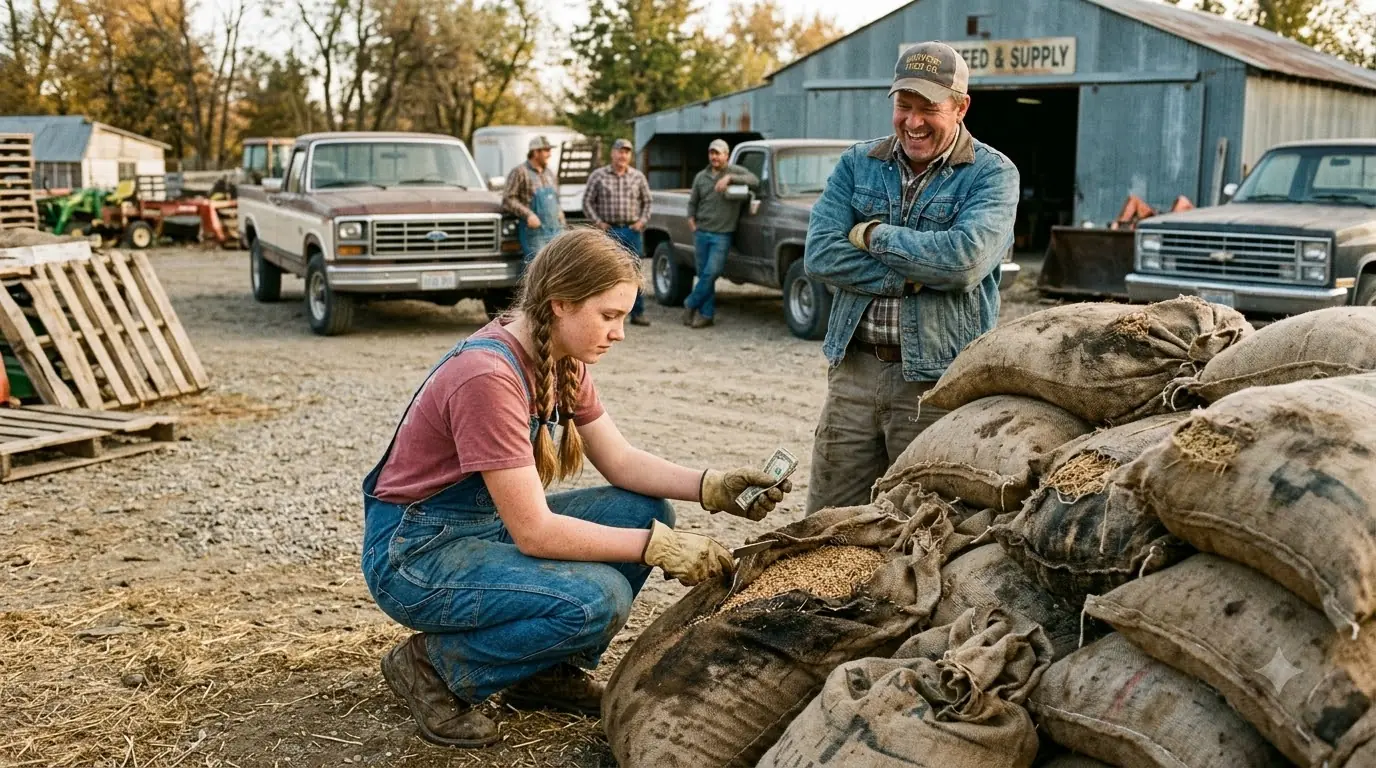
Emma glanced back at the pile.
The burlap sacks looked terrible.
Some were darkened by rain.
Others had split along the seams.
Yellow grain had spilled onto the dirt and mixed with straw, mud, and tire tracks.
One sack near the bottom had a greenish stain along one edge that made even Emma hesitate.
The feed dealer noticed.
“Exactly.”
He slapped one hand against his faded denim jacket.
“That grain is ruined.”
Emma did not answer.
Behind her, somebody chuckled.
A second voice said, “She’ll learn.”
The feed dealer leaned against the stack and folded his arms.
His name was Earl Mercer, and he had sold livestock feed in Pawnee County for nearly twenty-three years.
He was fifty-four, rough-faced, permanently sunburned around the neck, and famous for knowing exactly how much a desperate farmer would pay during a dry year.
He had known Emma’s father.
That made the laughter sting more than she wanted it to.
Earl nodded toward the sacks.
“Warehouse roof leaked during the September storm.”
“How long were they wet?” Emma asked.
Earl smirked.
“Long enough.”
“That isn't an answer.”
One of the farmers laughed again.
Earl’s smile narrowed.
“Three days before we found the leak.”
Emma crouched.
She pulled a small folding knife from the pocket of her overalls.
Earl frowned.
“What’re you doing?”
“Checking.”
“For what?”
Emma cut one thread near the torn corner of a sack.
She pushed aside the damp grain at the surface.
Her gloved fingers went deeper.
The outer handful was discolored.
The next layer smelled stale.
Then her fingers reached grain that was dry.
She brought several kernels to her nose.
No sour odor.
No obvious mold.
She broke one between her thumbnails.
Firm.
The men behind her stopped laughing quite as loudly.
Emma moved to another sack.
Then another.
Some were worse.
Some were nearly dry except along one side.
A few had been protected by the bags stacked above them.
Earl shook his head.
“You planning to inspect all sixty?”
“If I buy them.”
He laughed.
“You’re actually serious.”
Emma stood.
She looked sixteen because she was sixteen.
There was no hiding it.
Freckles.
Two long brown braids.
Dusty red farm shirt beneath worn denim overalls.
Mud on her knees.
Work gloves too large because they had belonged to her father.
But the way she looked at the sacks was not childish.
Earl had seen that expression before.
On her father.
That made him slightly uncomfortable.
He covered it with another laugh.
“Girl, even if half of it’s dry, you don’t know what contamination is in there.”
“I know enough not to feed anything until I sort it.”
“Sort it?”
“Yes.”
“You have any idea how much work that is?”
“Yes.”
“You got equipment?”
“Some.”
“Drying floor?”
“I can build one.”
“You got moisture meters?”
Emma paused.
“One.”
Earl smiled triumphantly.
“Cheap little handheld thing?”
“Yes.”
“Then you don’t know anything.”
Emma looked toward the sacks again.
Maybe he was right.
That possibility did not frighten her as much as it should have.
She had been wrong before.
Farmers were wrong constantly.
Weather made sure of that.
The trick was being wrong cheaply.
Fifteen dollars was cheap.
She looked back at Earl.
“Put the price in writing.”
His smile vanished slightly.
“What?”
“You said fifteen dollars for all sixty.”
“I did.”