The first coin hit the wooden counter and spun in a tight silver circle.
The second rolled toward the tip jar.
The third dropped over the edge and struck the polished concrete floor.
The Older Customer watched all three.
He did not bend down immediately.
Behind the counter, the Blonde Cashier gave him a smile that was technically polite and emotionally cruel.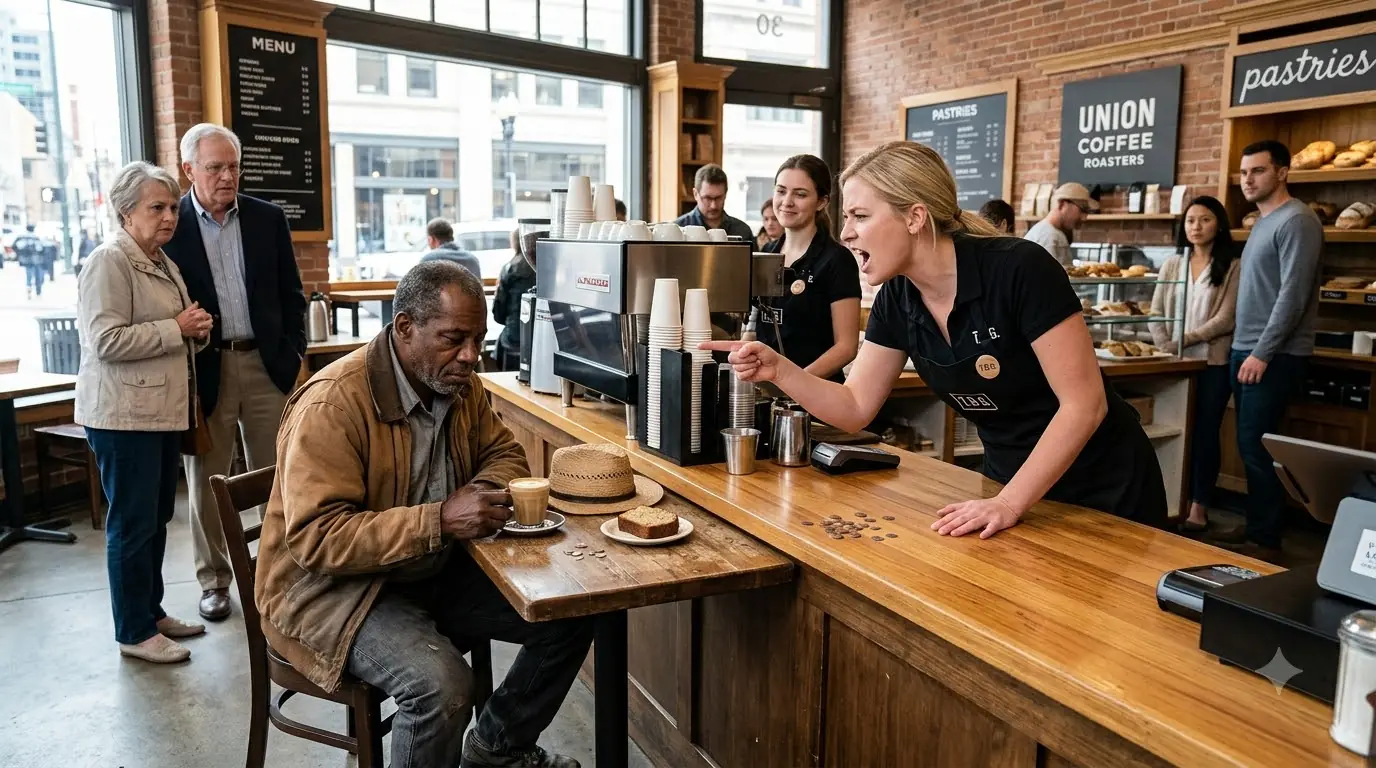
“Your change.”
The Older Customer looked at her hand.
Empty.
Then at the coins.
“You dropped it.”
The cashier shrugged.
“Looks like it.”
A second employee beside the espresso machine turned her face away to hide a grin.
The Older Customer said nothing.
He placed one weathered hand on the counter, lowered himself carefully, and picked the coins up one at a time.
Nobody offered to help.
That was the first thing he wrote down.
Not on paper.
Not visibly.
Inside his head.
8:17 a.m. Change deliberately dropped. Second employee observed. No intervention.
He stood again.
At fifty-three, getting down to the floor was easy enough.
Getting up reminded him of the years.
Twenty-nine years since the first shop.
Twenty-nine years since he had painted the original sign himself because he could not afford a professional.
Twenty-nine years since one borrowed espresso machine, three mismatched tables, a secondhand grinder, and a coffee roaster who gave him thirty days to pay an invoice had somehow become a company with sixty-eight stores across four states.
Nobody in the café knew that.
That was deliberate.
He wore a faded gray shirt beneath a brown work jacket with frayed cuffs.
Dark jeans.
Scuffed leather shoes.
An old straw hat he had purchased from a roadside stand outside Santa Fe nearly fifteen years earlier.
His beard had grown unevenly gray.
His hair had not seen a barber in six weeks.
The clothes were not a costume.
That distinction mattered to him.
They were his clothes.
He simply chose the ones nobody associated with corporate ownership.
The cashier pushed the receipt toward him.
He picked it up.
“Cortado.”
“Yes.”
“Banana bread.”
“Yes.”
She looked him over once more.
“Anything else?”
“No.”
“Good.”
The word landed harder than necessary.
The Older Customer looked at her name badge.
Then at the café.
Morning light came through floor-to-ceiling windows facing downtown Denver.
Everything looked exactly like the photographs in the quarterly design report.
Natural wood.
White tile.
Black steel shelving.
Plants positioned to soften the industrial lines.
A pastry case filled with laminated croissants and thick slices of banana bread.
A large wall sign carried the company motto in clean white letters.
GOOD COFFEE. BRIGHTER PEOPLE.
Another smaller sign near the pickup counter displayed the phrase from the original shop.
EVERYONE DESERVES A SEAT.
The Older Customer stared at it.
Then at the cashier.
Something bitter moved behind his ribs.
He carried the receipt to a small table near the counter.
His banana bread arrived three minutes later.
The cortado took seven.
Too long for a quiet morning.
He noted that too.
Not because he planned to punish anyone for slow coffee.
Because delays often revealed staffing problems.
Systems problems.
Training gaps.
The company had been receiving complaints.
Not many.
That had been the problem.
If fifty complaints arrived, executives reacted.
If six arrived across three months, they became isolated incidents.
One customer said a cashier laughed at his clothing.
Another said staff made her prove she could afford a drink before placing an order.
An elderly man wrote that an employee suggested the senior center down the street served cheaper coffee.
A delivery driver reported being told the restroom was for customers even though he was delivering twelve cases of oat milk.
A young mother said she had been rushed out after her toddler cried.
Individually, each complaint sounded small enough for management to explain.
Miscommunication.
Tone issue.
Busy shift.
Customer misunderstanding.
The Founder had built a company long enough to know that patterns usually hid inside language like that.
So he had started visiting stores.
Quietly.
No corporate car.
No assistant.
No regional director preparing staff.
No message announcing the founder was coming.
Just a man walking through a door.
Most locations passed easily.
Not perfectly.
But humanly.