At 10:17 on a Tuesday morning, Evelyn Carter walked into the Madison Avenue branch of Crown Meridian Private Bank carrying a structured beige handbag and a folded envelope containing a fifty-thousand-dollar hospital reimbursement check.
Nobody opened the door for her.
Nobody recognized her.
That was exactly what she wanted.
Evelyn was thirty-eight, elegant without being loud about it, with smooth deep-brown skin, a sleek low bun, small gold earrings, layered necklaces, and the kind of posture that made tailored clothing look even more expensive than it already was.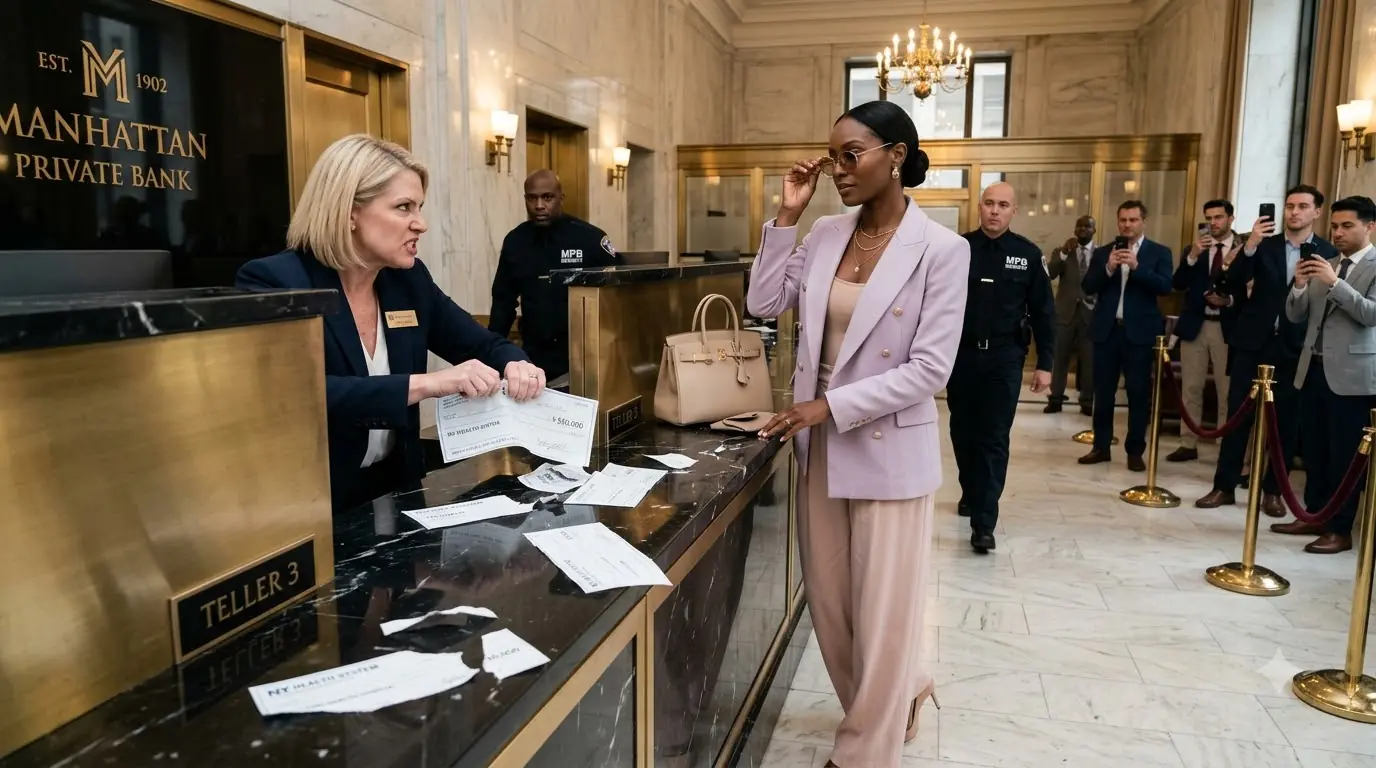
Her pale lavender double-breasted blazer had been designed specifically for her, but there was no visible label.
Her blush wide-leg trousers skimmed the marble floor above pointed nude heels.
A pair of lightly tinted glasses rested on her face.
The handbag in her left hand cost more than some people earned in a month, but Evelyn had deliberately chosen one without recognizable logos.
Nothing about her appearance suggested struggle.
Nothing about it announced who she was either.
That distinction mattered.
Crown Meridian Financial Group controlled thirty-one private banking offices, a commercial lending division, two regional investment firms, and a rapidly growing medical-finance subsidiary.
Evelyn was its Chief Executive Officer.
Almost nobody working inside the Madison Avenue branch had ever met her in person.
Her photograph appeared in annual reports, but the photographs were formal, highly polished, and usually taken with her hair loose rather than pulled back.
Employees knew the name.
They did not necessarily know the face.
Evelyn had discovered that this made unannounced branch visits unusually useful.
The moment people knew the CEO was coming, carpets were cleaned twice.
Coffee stations were restocked.
Supervisors suddenly remembered employees' names.
Compliance manuals appeared on desks that had not been opened in months.
People performed.
Evelyn did not want a performance.
She wanted to know what happened when the institution believed nobody important was watching.
The Madison Avenue location had caught her attention because of a strange pattern.
Revenue was excellent.
Complaint numbers were almost nonexistent.
Client retention appeared strong.
Employee turnover was terrible.
Those numbers did not belong together.
Evelyn had spent long enough running organizations to know that a branch with exceptionally low complaints and unusually high staff departures could mean one of two things.
Either the branch was almost unbelievably well managed.
Or people had learned that complaining was useless.
She had decided to find out which.
The hospital check gave her a perfect excuse.
Three months earlier, Evelyn's mother had undergone a complicated procedure at a private medical center.
The hospital had mistakenly collected a large deposit even though the insurance authorization had already been approved.
After several reconciliations, the hospital issued a reimbursement check for $50,000.
Evelyn could have deposited it electronically.
She deliberately did not.
The check was legitimate.
The issuing institution was legitimate.
The account could be verified within minutes.
The name on the check matched her legal identification.
She wanted to see how the branch handled an ordinary high-value transaction.
More specifically, she wanted to know how they handled it when they did not know she owned the building through the corporate group above them.
The lobby was beautiful.
Black-and-cream marble stretched from the entrance to a long brass-trimmed counter.
Tall windows faced the avenue.
A three-tier chandelier reflected against polished stone.
White orchids sat in enormous arrangements beside dark leather seating areas.
Everything whispered wealth.
That was intentional.
Private banks did not simply sell financial services.
They sold reassurance.
The message was supposed to be simple.
Your money is safe here.
Your privacy is safe here.
You will be treated seriously here.
Evelyn crossed the lobby.
A young receptionist looked up.
"Good morning. How can I help you?"
"I'd like to deposit a check."
"Of course. Do you have an account with us?"
"Yes."
The receptionist smiled.
"May I have your name?"
"Evelyn Carter."
The receptionist typed.
Her expression changed slightly.
Not because she recognized Evelyn as CEO.
Because the account record on her screen was unusual.
There were several layers of restricted access.
The receptionist tried another screen.
Then another.
"One moment, please."