By the time Bradford Cross climbed onto the roof of his dead electric truck, the tide had erased the road behind him.
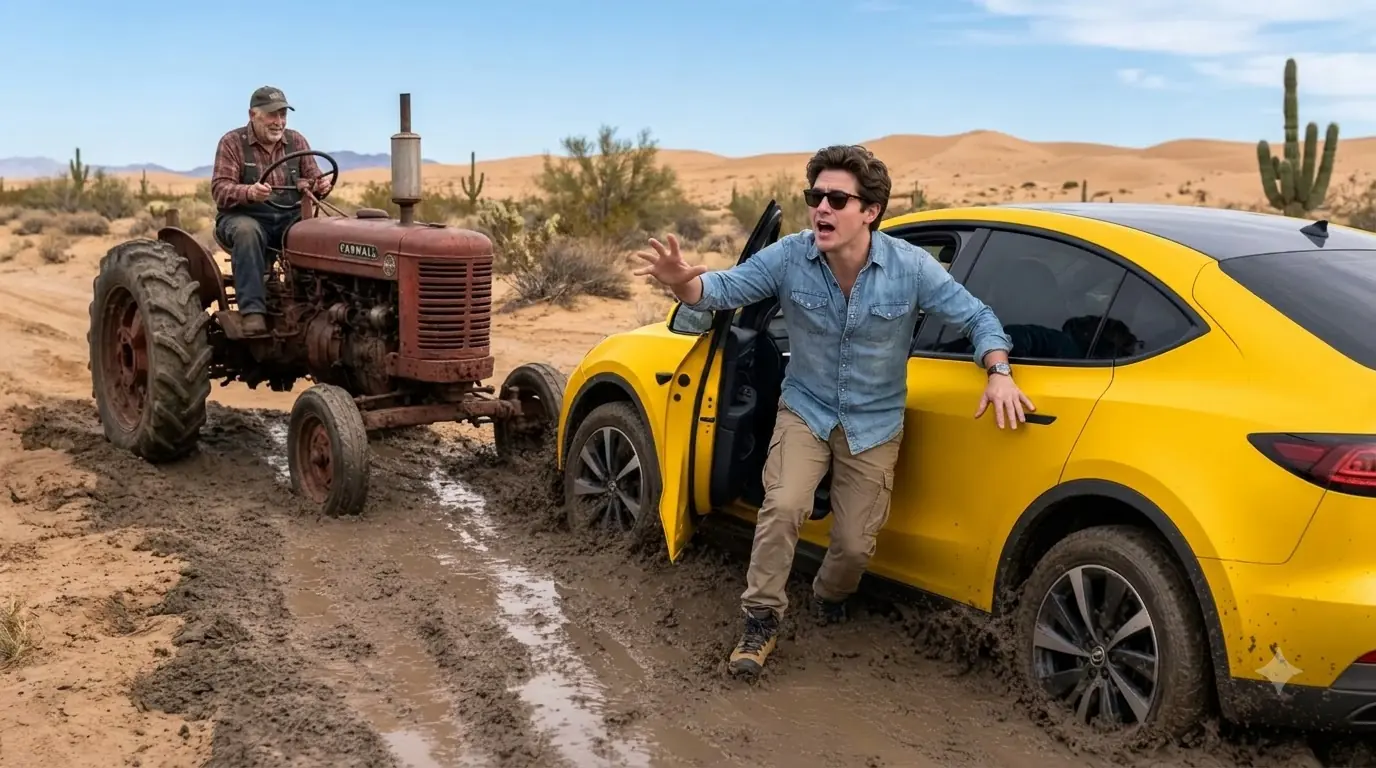
Twenty minutes earlier, he had been sitting inside a climate-controlled cabin surrounded by screens, cameras, sonar-style depth graphics, traction displays, suspension readouts, and enough computing power to make his new Aegis Gladiator one of the most sophisticated privately owned off-road vehicles on the East Coast. Now every screen inside the truck was black. A warning tone had sounded once after the underbody struck something beneath the water, the high-voltage system isolated itself, and the nearly four-ton machine became an expensive island in the middle of Pelican County’s Black Mud Estuary. Brown-green tidal water moved around the doors while gray marsh mud swallowed the tires to the hubs.
Bradford stood on the roof in soaked trousers and stared toward shore.
There, crawling down an old shell road at perhaps six miles an hour, came the machine he had laughed at.
A faded red 1948 Farmall H.
The tractor was not charging heroically into four feet of saltwater. It was staying exactly where its seventy-two-year-old driver had told Bradford to stay in the first place—on a narrow ridge of oyster shell and packed sand marked by three weathered cedar stakes. Behind the Farmall rolled a small cable cart carrying two hundred feet of bright synthetic recovery line, several shackles, a tree-protection sling, and a spool of light messenger rope.
Abner Hale sat on the metal seat with one hand resting loosely on the steering wheel.
Bradford shouted across the water, “Get this thing out!”
Abner looked toward him.
Then toward the rising tide.
Then back at the three cedar stakes Bradford had ignored.
“Working on it.”
There was no urgency in his voice.
That infuriated Bradford almost as much as being stranded.
“You understand what this vehicle costs?”
Abner stopped the tractor on dry shell and set the brake.
“No.”
“Four hundred and eighty thousand dollars.”
Abner climbed down.
“That supposed to make it lighter?”
Bradford opened his mouth.
Nothing useful came out.
The morning had begun differently.
Pelican County lay along a fictional stretch of South Carolina’s Lowcountry where roads narrowed gradually until pavement became crushed shell, then packed dirt, then sometimes nothing at all. Salt marsh stretched between fingers of higher land, green in summer, brown-gold in winter, cut by tidal creeks that changed shape with every season. People new to the coast often looked across those flat expanses and assumed flat meant simple.
It did not.
The landscape possessed invisible boundaries more reliable than fences.
Mean high water.
Spring tide.
King tide.
Fresh mud.
Old shell.
Creek edge.
Storm cut.
Abner Hale had spent seventy-two years learning those boundaries.
His family farm covered eighty-three acres of higher sandy ground, woodland, pasture, and marsh edge on the north side of Black Mud Estuary. The Hales had never been wealthy. For most of Abner’s childhood, the farm produced vegetables, hogs, a few cattle, and whatever his father could catch, repair, or barter. Over time, the market garden disappeared, the hog lot became pasture, and most of the cattle went after Abner’s knees began objecting to winter mud. What remained was fifteen acres of vegetables leased to a younger farmer, a small herd of beef cows, three barns, one old farmhouse, and a collection of machinery that seemed to prove Abner had never willingly thrown away anything made before 1970.
His favorite was the Farmall H.
It was not powerful by modern standards. A current compact utility tractor could embarrass it in hydraulic capacity, comfort, braking, lighting, safety features, and convenience. The Farmall had no cab, no rollover structure from the factory, no four-wheel drive, no power steering, and a gasoline engine producing a fraction of what modern agricultural equipment could deliver.
Abner knew all of that.
He also knew exactly what it weighed.
Exactly where its rear wheels fit on the old shell causeway.
Exactly how much trailer it could safely pull.
Exactly where not to take it.
That last skill was the one Bradford Cross lacked.
Bradford had arrived in Pelican County six months earlier after purchasing sixty-seven acres adjoining Abner’s southern boundary. He was thirty-eight, founder and chief executive of NovaGrid Dynamics, a company that built battery-management software, grid-storage systems, and power electronics. Forbes estimated his wealth above two billion dollars, although Abner had never read Forbes and would not have cared if he had.
Bradford intended to build what his architect described as a “net-zero coastal retreat.”
The drawings showed a long glass house raised above the ground, solar roofing, geothermal cooling, rainwater recovery, native landscaping, and a private dock projecting into the estuary. The renderings were beautiful.
They also showed a broad lawn where salt marsh currently grew.
That detail had already created problems with Pelican County planning officials.
Bradford regarded those problems as paperwork.
Abner regarded them as the marsh saying no.
Their first conversation had occurred beside the property line three months earlier. Bradford arrived with an architect, two engineers, a survey consultant, and a drone operator. Abner was repairing fence.
Bradford introduced himself politely enough.
Then he pointed toward a faint track running from Abner’s side of the road toward the estuary.
“That access connects to my parcel?”
“No.”
Bradford looked surprised.
“My GIS map shows a road.”
“Shows a line.”
“Marked Marsh Track.”
“That’s what people call it.”
“So it’s public?”
“No.”
Bradford glanced toward his survey consultant.
The man looked uncomfortable.
Abner continued, “Old Hale farm lane. My grandfather laid oyster shell through the high part in the thirties. County never maintained it.”
Bradford smiled.
“We’ll verify that.”
“You should.”
That answer irritated him more than an argument would have.
The problem was that ordinary online property maps made the route appear more official than it was. The county GIS layer displayed an old path recorded on aerial photography decades earlier. But a GIS map was not a boundary survey, and the county website said so in large letters nobody read. The actual recorded plats showed no public right-of-way across Abner’s marsh edge and no vehicular easement benefiting Bradford’s parcel.
Bradford had legal access to his new land from the opposite side through a paved county road.
That route added nearly nine miles to trips between his temporary rental house and the construction staging area.
Marsh Track cut the distance dramatically.
So Bradford kept looking at it.
On the morning everything went wrong, Abner was replacing three cedar markers along the old shell causeway.
They were not decorative.
His father had put the first versions there in the 1960s.
The three posts marked the only section where the packed shell base remained broad enough to carry farm equipment during low water. East of the posts lay deceptively firm-looking gray mud over deep silt. West of them was a narrow drainage cut that could become waist-deep during high tides.
Abner had driven tractors through the area hundreds of times.
Never at high tide.
Never without checking the tide table.
And never with something weighing almost eight thousand pounds.
He was tamping the second post when the Aegis Gladiator approached.
Abner heard it before he turned, not because the EV was loud but because its tires made a different sound over shell than his farm trucks did.
The vehicle stopped nearby.
It looked extraordinary.
Low, wide, angular, matte gray, sitting on massive all-terrain tires. Bradford had purchased it as an early limited-production flagship model, then spent almost another hundred thousand dollars on reinforced underbody protection, upgraded suspension, communications equipment, and interior customization.
Abner looked at the truck.
Then at the tide.
Bradford lowered the window.
“Morning.”
“Morning.”
“You still keeping this road blocked?”
Abner looked at the new posts.
“Marking it.”
“My survey team says that track reaches the estuary crossing.”
“It does.”
“And the crossing reaches my land.”
“At dead low water.”
Bradford smiled.
“That’s all I needed.”
“No.”
Bradford frowned.
Abner rested both hands on the post driver.
“Water’s turning.”
Bradford looked toward the estuary.
The exposed mudflat still appeared broad.
“Low tide was twenty minutes ago.”
“That’s why water’s turning.”
“I’ve got wade mode.”
Abner stared at him.
Bradford tapped the center screen.
“This truck is engineered for deep-water crossings. Adjustable suspension. Sealed pack. Individual wheel torque control.”
Abner nodded.
“Sounds expensive.”
“It is.”
“Does it make mud harder?”
Bradford gave a short laugh.
“This isn’t 1948.”
Abner looked toward the Farmall parked beside the barn road.
“No.”
Bradford followed his gaze.
“That thing still runs?”
“Yes.”
“Why?”
Abner considered.
“Starts.”
Bradford laughed again.
He did not mean the laugh cruelly.
Not entirely.
That distinction mattered later.
He was used to environments in which newer usually meant measurably better. Newer batteries stored more energy. Newer processors performed more calculations. Newer inverters lost less power. Software improved after deployment. Hardware generations leapfrogged one another.
An old tractor looked to him like inefficiency preserved through sentiment.
He pointed toward the Farmall.
“My truck has more computing power in one door module than that thing has in the entire machine.”
“Probably.”
“And you trust that more?”
“For what?”
Bradford hesitated.
Abner nodded toward the fence post.
“That tractor pulls this little trailer. Cultivates sweet corn. Runs an auger sometimes. Your truck does any of those?”
“No.”
“Then we don’t have a contest.”
Bradford smiled tightly.
“I’m crossing.”
Abner’s expression changed.
“Wouldn’t.”
“Why?”
“Because you’re too late.”
“There’s ten inches of water.”
“Now.”
Bradford looked toward his dash.
“I’ll be across in three minutes.”
Abner pointed toward the cedar markers.
“If you insist, stay left of those three posts and stop before the last one. Shell ends there.”
“My navigation shows the track straight across.”
“Your navigation is wrong.”
Bradford laughed softly.
“Satellite imagery says otherwise.”
Abner tapped the ground with his boot.
“Satellite can’t feel bottom.”
That sentence almost stopped him.
Almost.
Bradford looked toward the marsh.
Then at the enormous display inside his truck.
Blue route line.
Depth estimate.
Traction control.
Ride height.
Vehicle attitude.
The technology was not fake.
The Aegis genuinely could ford significant water under specified conditions.
What Bradford ignored was that wading ability described water depth over a suitable bottom.