The red fire hydrant had been standing at the edge of the sidewalk for longer than most of the houses around it.
Nobody paid much attention to it.
Children rode bicycles past it.
Dog walkers stepped around it.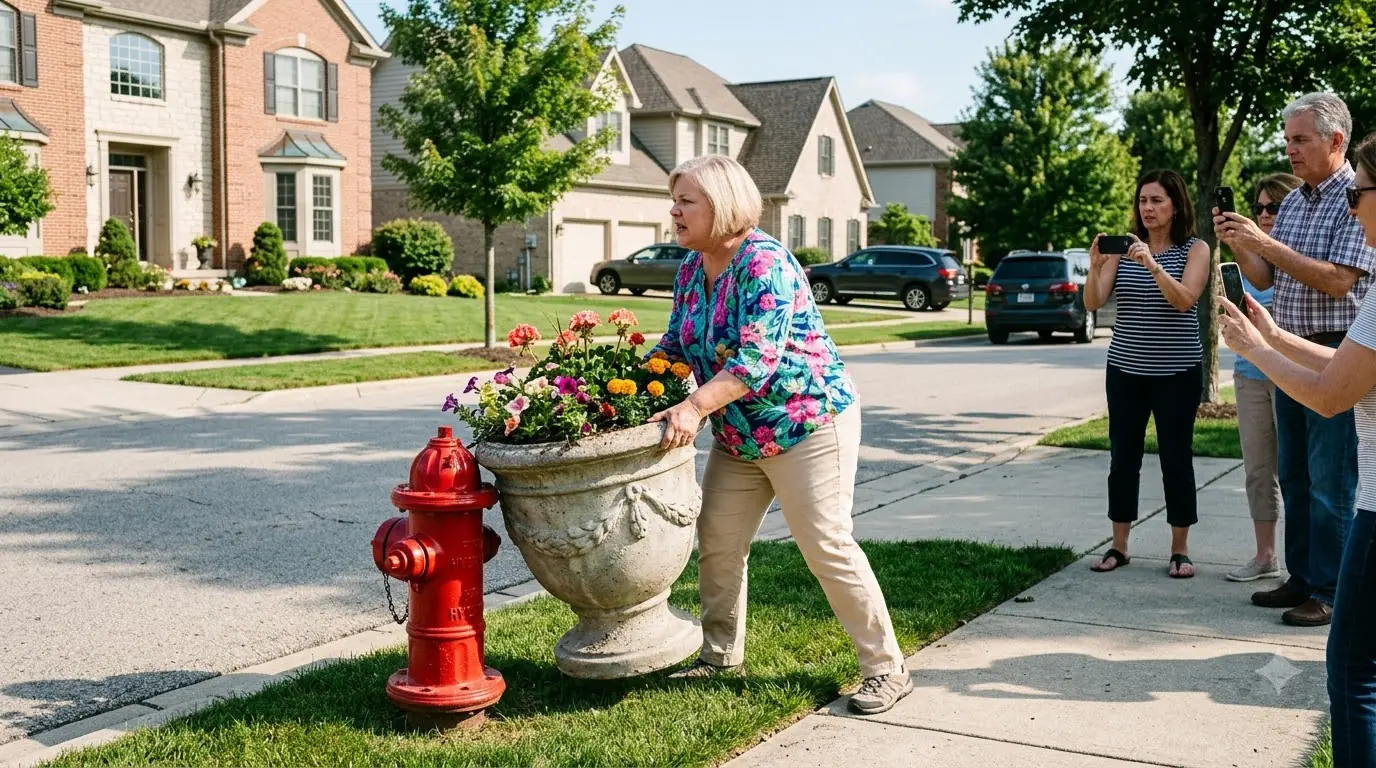
Delivery drivers occasionally used it as a landmark.
Residents planting flowers near the curb knew to leave the surrounding area open.
It was simply part of the street.
Bright red.
Functional.
Uninteresting.
Until one Saturday morning, the blonde neighborhood president decided it was ugly.
She stood on the sidewalk beneath a cloudless blue sky with both hands on her hips, staring at the hydrant as though someone had deliberately placed it there to offend her.
The woman was in her late fifties.
Short blonde hair framed a round face that normally carried the confident expression of someone accustomed to being listened to.
She wore beige pants, white walking shoes, and a brightly colored floral blouse covered in blue, pink, and green flowers.
Beside her sat a massive decorative planter.
It was nearly waist high.
Gray concrete.
Heavy enough that two landscapers had used a dolly to position it near the community entrance the previous year.
The planter had been filled with yellow, purple, and red flowers.
The neighborhood president wanted it somewhere else.
Directly in front of the hydrant.
A man watering flowers outside the neighboring house noticed what she was doing.
He set down the hose.
“Where are you moving that?”
She did not look at him.
“Here.”
The neighbor followed the direction of her hand.
“You mean in front of the hydrant?”
“Yes.”
He stared.
“You can’t do that.”
That finally made her turn.
“Excuse me?”
He pointed toward the hydrant.
“You can’t cover a fire hydrant.”
“I’m not covering it.”
The planter was already blocking almost half of it.
The neighbor looked from the planter to her.
“You’re literally putting a concrete pot in front of it.”
She rolled her eyes.
“The fire department has maps.”
“That doesn’t mean they should have to move a flower pot before using it.”
“It’s not a flower pot.”
The neighbor stared.
She corrected him.
“It’s an architectural planter.”
He almost laughed.
“Fine.”
He pointed at it.
“You can’t put your architectural planter in front of a fire hydrant.”
The woman turned back to the planter.
“The hydrant is visually disruptive.”
The neighbor blinked.
“What?”
“It ruins the landscaping.”
“It’s a fire hydrant.”
“I know what it is.”
“Then you know why it’s there.”
She exhaled loudly.
The neighbor had heard that exhale many times before.
It meant she had decided the conversation was no longer between two adults.
Now she was explaining something to someone she considered difficult.
“The street was redesigned two years ago.”
She pointed toward the entrance.
“We upgraded the landscaping, replaced the mailbox structures, standardized curb planting, and spent nearly forty thousand dollars improving the public-facing appearance.”
The neighbor crossed his arms.
“And?”
“And that bright red hydrant sits in the middle of the entire design.”
He stared at her.
“It’s supposed to be easy to see.”
She shook her head.
“No one is making it impossible to see.”
The neighbor looked again.
From the street, the flowers already covered most of the red metal.
Once the planter was positioned fully in front, a driver passing quickly might see almost nothing.
“You’re hiding it.”
She pushed against the concrete rim.
The planter moved perhaps half an inch.
The woman grunted.
Then pushed harder.
The neighbor took a step forward.
“Don’t.”
She glared.
“I don’t need assistance.”
“That isn’t what I meant.”
He reached for his phone.
“I’m telling you not to move it there.”
The woman stopped.
“Are you recording me?”
“Yes.”
Her face changed.
“Why?”
“Because this conversation is getting ridiculous.”
She straightened.
“You need my permission.”
“No, I don’t.”
“This is community property.”