Seven boys stared at Mercy Calloway as though supper might be a trick.
The youngest sat nearest the end of the table with both hands wrapped around an empty bowl.
The oldest remained standing.
He was sixteen, tall for his age, narrow through the shoulders, and already wearing the hard expression of a man who had learned too early that disappointment usually arrived wearing a pleasant face.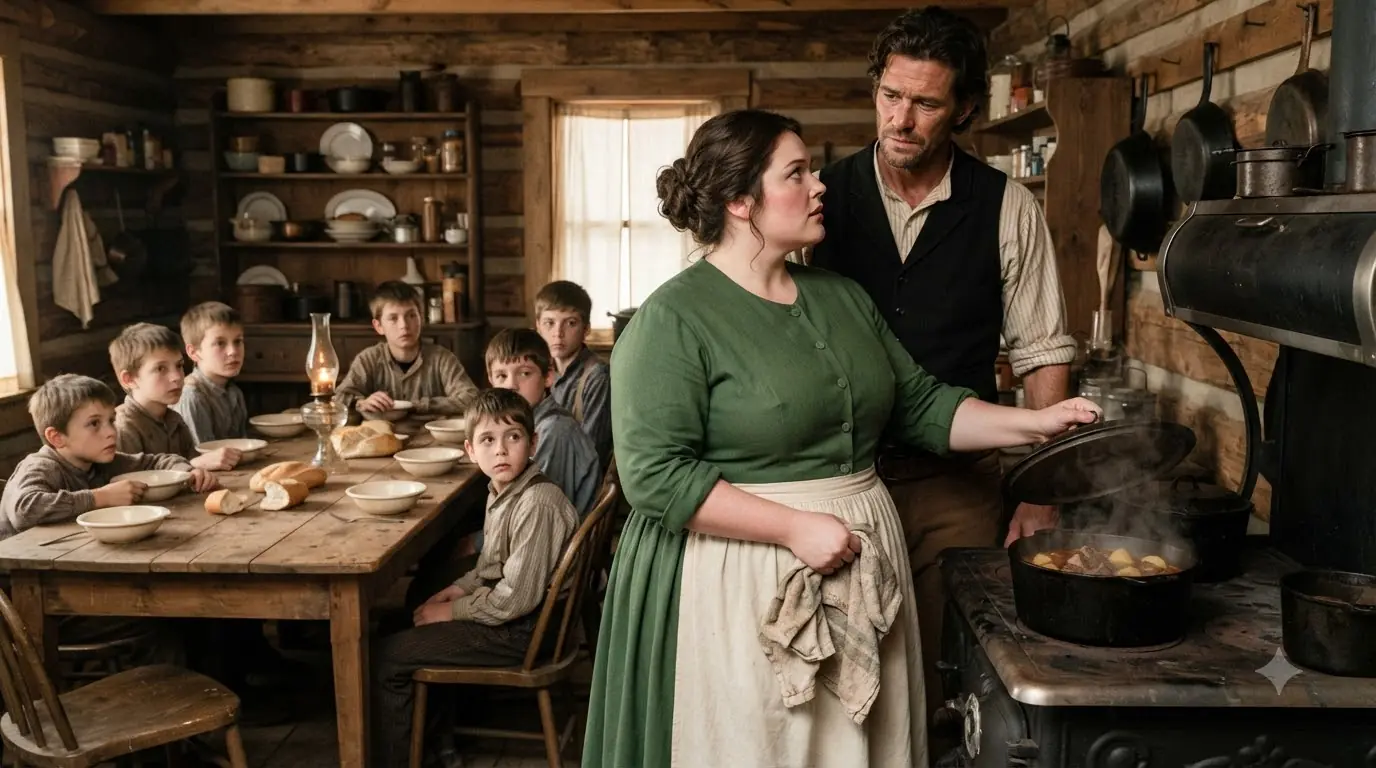
Mercy stood beside the black iron stove.
Steam rolled from the stew pot.
Behind her, fresh bread cooled beneath a folded cloth.
Nobody moved.
She looked around the table.
Seven boys.
Seven suspicious pairs of eyes.
And one exhausted father standing near the doorway as though he had forgotten whether he was supposed to join them.
Mercy lifted the ladle.
“Well?”
The oldest boy narrowed his eyes.
Mercy pointed toward the bowls.
“I can admire my own cooking for another hour if necessary, but it seems inefficient.”
One of the younger boys almost smiled.
The oldest did not.
He sat.
Mercy filled his bowl first.
Beef.
Potatoes.
Onion.
Carrots.
A little dried thyme she had found forgotten in the back of a cupboard.
Then the next.
And the next.
When every bowl was filled, the boys still waited.
Mercy frowned.
“Is there a prayer?”
The father finally spoke.
“Usually.”
He removed his hat.
The boys did the same.
He bowed his head.
Mercy followed.
His prayer was short.
Mostly thanks.
No grand promises.
When he finished, Mercy looked toward the oldest boy.
He lifted his spoon.
Tasted.
Stopped.
Mercy pretended not to watch.
The boy took another spoonful.
Then he tore a piece of bread.
A brother copied him.
Then another.
Within a minute, the long ranch table filled with the sounds of eating.
Spoons scraping.
Bread tearing.
Someone breathing through his nose because the stew was too hot and he refused to wait.
Mercy turned back toward the stove.
She had cooked for families before.
Boardinghouses.
Church suppers.
A logging camp once, briefly.
She had never seen children eat like men coming home from war.
The youngest boy finished first.
He stared into his bowl.
Then toward the pot.
“Is there more?”
Mercy swallowed.
“Yes.”
His entire face changed.
Not happiness exactly.
Relief.
She filled his bowl again.
Then two others.
The father watched from the end of the table.
His name was Thomas Bell.
Forty-two.
Widower.
Ranch owner.
Father of seven boys.
A man whose advertisement had contained fewer words than most merchants used to sell soap.
Widower. Seven sons. Working ranch. Household manager required. Marriage considered with capable woman.
Mercy had reread it three times.
Not because it was romantic.
Because it was honest.
At thirty, she had grown suspicious of men who described themselves beautifully.
Thomas Bell did not appear interested in beauty.
That suited her.
Six hours earlier, he had met her at Larkspur Crossing.
The November wind cut directly through her coat.
Mercy stood beside one battered trunk, attempting to keep her hat pinned while passengers scattered toward wagons and waiting relatives.
She recognized Thomas immediately.
Tall.
Broad.
Dusty coat.
Dark hair beginning to gray near the temples.
Face weathered by sun and cold.
He approached slowly.
“Mercy Calloway?”
“Yes.”
He looked at her once.
Not rudely.
Still, she knew that look.
People always had one.
Mercy was a large woman.
Very large by the standards of women around Larkspur.
Full arms.
Wide hips.
Heavy waist.