The sound that woke the Black homeowner that Tuesday afternoon was not a doorbell, a phone call, or even the familiar growl of a lawn mower somewhere down the block.
It was concrete breaking.
At first, he did not understand what he was hearing.
He had been in the upstairs office of his two-story suburban home, reviewing invoices on a laptop while sunlight spilled across the hardwood floor.
Then came another violent crack.
The whole front side of the house seemed to shudder.
He pushed back from the desk.
A third impact followed.
This time, he heard the unmistakable scrape of heavy steel against concrete.
He crossed the office, looked through the front window, and froze.
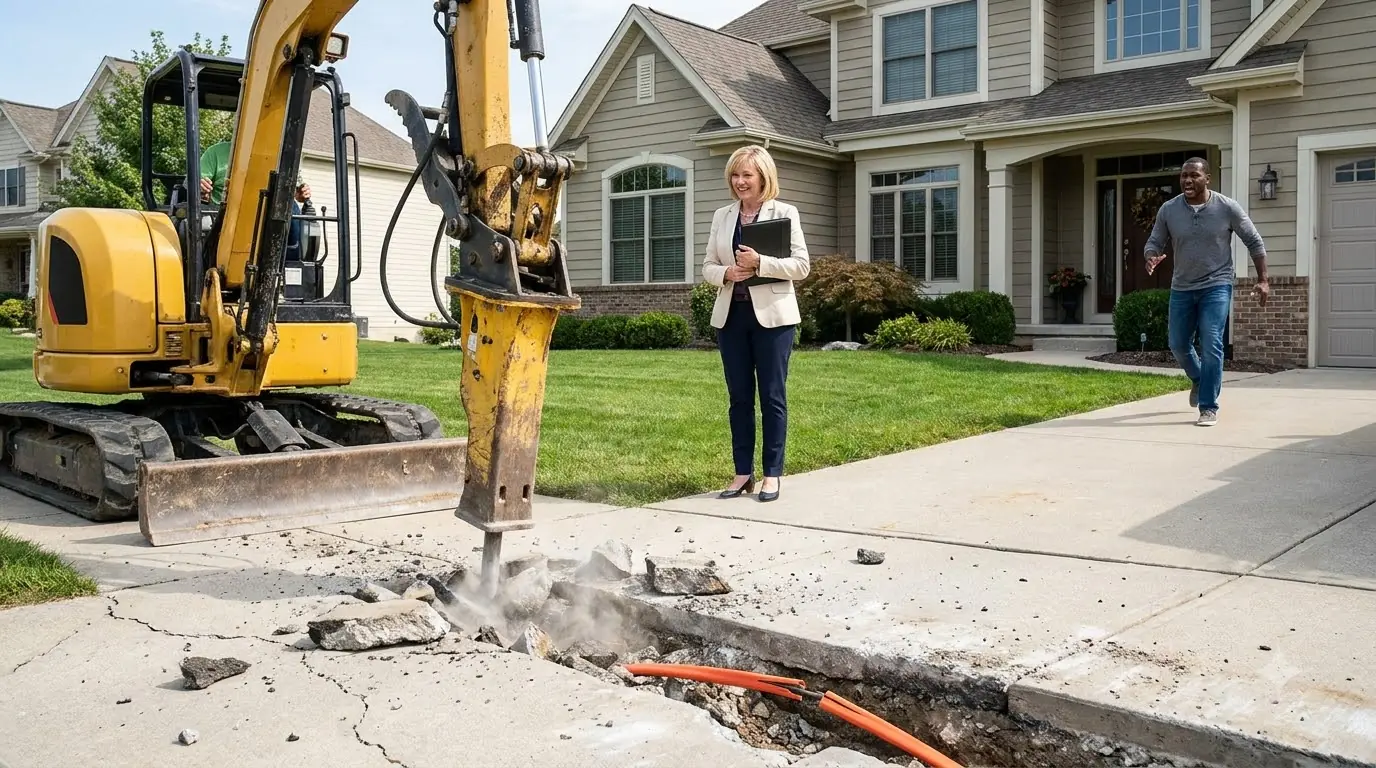
A compact excavator was sitting in the middle of his driveway.
Its bucket was already buried beneath one of the concrete slabs.
A man in a safety vest sat behind the controls while the hydraulic arm lifted.
The slab rose.
Then it snapped in half.
The homeowner stared at the destruction for perhaps two seconds before running downstairs.
By the time he threw open the front door, another section of his driveway had been broken apart.
And standing beside the machine, holding a black folder against her chest as calmly as if she were supervising landscaping work, was the HOA president.
Middle-aged.
Blonde bob.
Cream blazer.
Navy pants.
Perfectly polished shoes.
She watched the excavator tear into the concrete with a faint smile.
The homeowner stepped off the porch.
"What the hell are you doing?"
The excavator operator glanced toward him.
The HOA president did not.
She opened her folder instead.
"Correcting a violation."
The homeowner stared at her.
"You have ten seconds to shut that machine off."
Now she looked at him.
Her expression was not nervous.
It was almost pleased.
"We sent you three notices."
"You sent me three pieces of paper claiming my driveway extension violated HOA rules."
"And you ignored them."
"Because the driveway is permitted."
She gave a short laugh.
"Not by the association."
"The city approved it."
"The city does not control architectural standards inside this community."
"The city controls permits."
She shifted the folder under one arm.
"I am not going to debate this with you again."
The excavator bucket slammed downward.
Concrete exploded beneath it.
The homeowner turned toward the operator.
"Turn it off."
The operator hesitated.
The HOA president raised her voice immediately.
"Keep going."
The homeowner took two steps closer.
"I am telling you right now, you are trespassing on private property."
The operator looked between them.
"Ma'am, maybe we should stop until—"
"No."
Her voice was sharp enough to cut him off.
"We have written authorization."
The homeowner looked at her.
"From who?"
"The HOA board."
"That is not authorization to enter my property."
She opened the folder and pulled out a printed sheet.
"You were given notice."
"A notice is not a warrant."
"It is an enforcement notice."
"It is still not permission."
Several neighbors had already started appearing outside.
A garage door across the street opened.
A retired couple stepped onto their front porch.
A young mother pushing a stroller stopped at the corner.
Two houses down, a man stood beside his mailbox with his phone raised.
The HOA president noticed the audience.
Instead of becoming cautious, she seemed energized by it.
"This is exactly why rules exist," she said loudly.
The homeowner gave her a hard stare.
"No. Rules exist so people know what they can and cannot do. They are not a license for you to bring construction equipment onto somebody else's land."
She pointed toward the broken driveway.
"You built beyond the approved architectural footprint."
"The city inspection passed."
"The HOA denied it."
"The HOA review happened after the city permit."
"That doesn't matter."
"It matters because your own bylaws say the association cannot order removal of a city-permitted improvement without a hearing."
Her expression changed slightly.
Only slightly.
The homeowner saw it.