Fifty pounds of flour.
Ten pounds of salt pork.
One tin of coffee so old the label had begun peeling from the metal.
Three heavy wool blankets.
That was the price Amos Thorne placed on his daughter.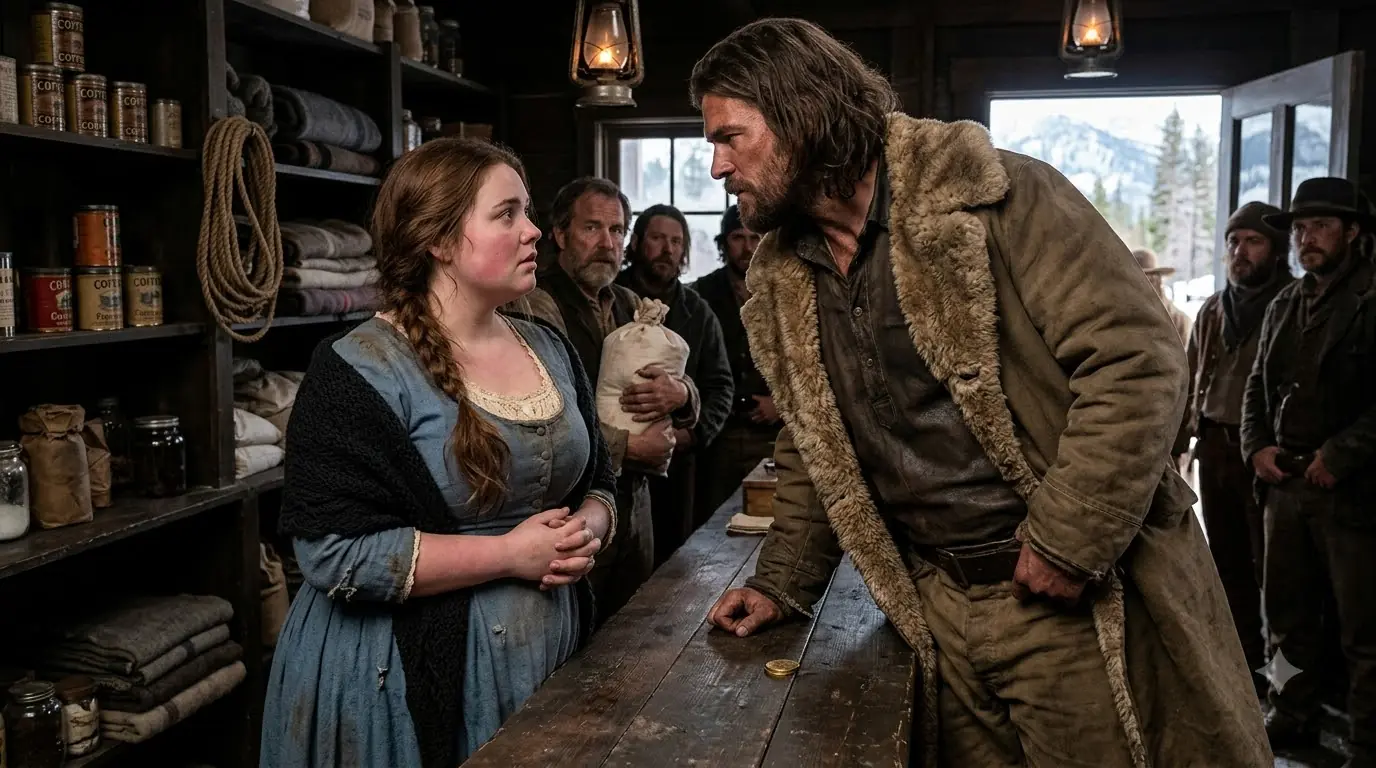
Josie sat on an overturned pickle barrel inside O’Malley’s trading post with both hands folded tightly in her lap.
She kept her eyes on the floorboards.
If she looked at her father, she might cry.
If she looked at O’Malley, she might become angry.
And if she looked at the mountain man standing near the door, she was not sure she would be able to breathe at all.
The trading post smelled of lamp oil, damp wool, leather, coffee, smoke, cured meat, and frightened horses outside.
Winter wind pushed against the windows.
Snow had begun before dawn and had grown heavier every hour.
By nightfall, the road north would probably be closed.
By tomorrow, perhaps the entire valley.
Everyone knew it.
That was why the shelves looked emptier than usual.
Families had spent the previous week buying whatever they could.
Flour.
Salt.
Beans.
Candles.
Coal oil.
Feed.
Blankets.
Medicine.
Anything that might turn six months of mountain winter from a death sentence into an inconvenience.
Josie’s family had bought almost nothing.
There was no money.
There had been no money since summer.
Their potato crop failed first.
Then one of the two milk cows became sick.
Her father sold it.
The second disappeared during a storm.
Amos claimed wolves had taken it.
Josie never believed him.
Her father’s breath smelled of whiskey the next morning.
By November, they were boiling potatoes so thinly that the broth contained more water than food.
Three days earlier, the last potatoes were gone.
That morning Josie drank hot water with salt and told her father she was not hungry.
He knew she was lying.
He did not care enough to challenge it.
Now he stood at O’Malley’s counter with his hat crushed between both hands.
“I’ll pay you spring.”
O’Malley continued writing in his ledger.
“You said that last spring.”
“I had trouble.”
“Everybody had trouble.”
“I’ll trap.”
“You don’t trap.”
“I’ll cut timber.”
“You owe forty dollars already.”
Amos leaned farther over the counter.
“My girl can work.”
O’Malley finally looked up.
“Then send her somewhere that pays wages.”
Josie lowered her eyes.
She had tried.
The hotel laundry rejected her.
The baker needed a girl fast enough to work the ovens.
The dressmaker said there was no room.
One woman had hired Josie for cleaning until her husband began making comments about Josie’s body.
Two days later, Josie was dismissed instead of him being corrected.
The world had taught her a simple lesson.
When something unpleasant happened around a woman like her, the easiest solution was to remove the woman.
Josie had always been large.
Not merely plump.
Not simply broad.
Large enough that strangers noticed before they noticed anything else.
At twenty-two, she stood five feet six inches and carried close to four hundred pounds on a body built with wide hips, thick thighs, heavy arms, a large round stomach, and a full chest.
Her mother had been large too.
That had not stopped her mother from being strong.
Josie remembered watching her lift flour sacks men twice her age complained about.
She remembered her mother laughing loudly.
Eating without apology.
Dancing at harvest gatherings.
Then cholera came.
Her mother died.
Two brothers followed within the week.
After that, Amos changed.
Perhaps grief hollowed him.
Perhaps whiskey finished the work.
Whatever remained treated Josie as one more mouth in a house that no longer had enough food.
He stopped defending her when people laughed.
Eventually he joined them.
“Easy, Josie,” he would say when she reached for bread.
“Winter ain't kind to appetites.”
The first time he said it, she thought he was joking.
The fifth time, she stopped eating around him whenever she could.
Then hunger came anyway.
Real hunger.
Hunger made jokes irrelevant.
For three days Josie had consumed almost nothing.
Her large body did not make starvation gentler.
If anything, people assumed it should.
She had heard someone whisper only yesterday:
“She has enough on her to last.”
As though a body were a pantry.
As though pain respected size.
O’Malley shut the ledger.
“No more credit.”
Amos’s shoulders sagged.
Then the trading post door opened.
Cold air rushed inside.
Every conversation stopped.
The mountain man entered.
Judson Vale had to duck beneath the frame.
Snow covered the shoulders of his huge fur coat.
His beard was dark.
His hair touched the collar of his leather shirt.
He carried a rolled hide over one shoulder and a rifle across his back.
Nobody welcomed him loudly.
Men nodded.
A few moved aside.
O’Malley immediately straightened.
Judson came down from the mountains only several times a year.
No one seemed to know exactly how much land he owned.