The first thing the plus-size woman did after walking six miles through sleet was throw a spoiled ham onto the ranch owner’s desk.
It landed directly across three unpaid invoices and a red foreclosure notice.
Gray liquid soaked through the butcher paper.
The ranch owner stared at it.
Three ranch hands crowded into the office doorway and stared too.
The woman removed a small kitchen knife from her apron, cut through the ham, and opened it cleanly down the middle.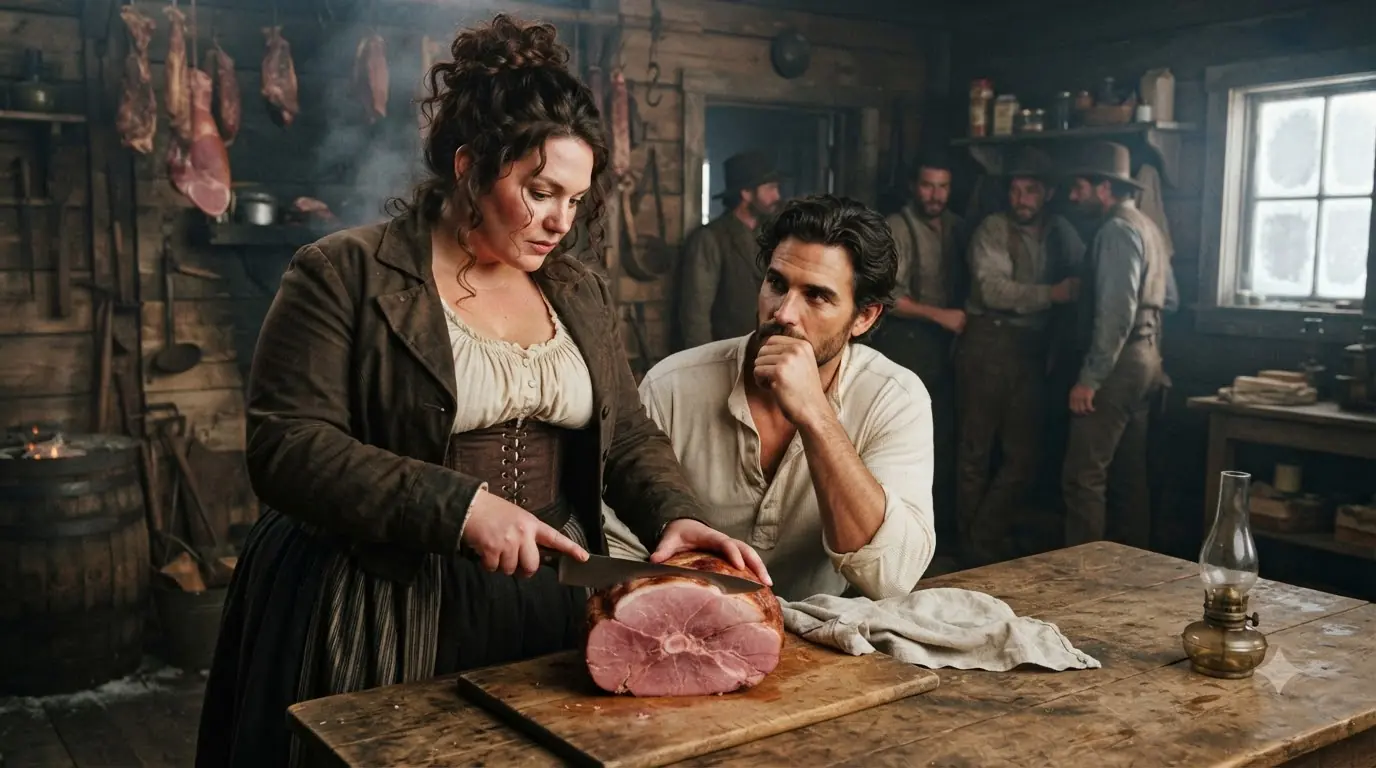
The smell made the youngest ranch hand swear and retreat into the hallway.
The woman looked at him.
“That is what nine men are supposed to eat in February.”
The ranch owner raised his eyes slowly.
He was thirty-nine, tall and broad-shouldered, with dark wavy hair, a trimmed beard, and a face that looked as though sleep had become something he remembered rather than something he experienced.
His cream work shirt was open at the throat.
His sleeves were rolled.
His hands looked capable of repairing a wagon axle but not of explaining how his ranch had reached the point where winter food was decomposing behind the barn.
“Where did you get that?”
“Your smokehouse.”
His expression sharpened.
“You walked onto my land without permission?”
“You advertised in town for somebody who could cure pork.”
“I advertised for a smokehouse hand.”
“That is why I’m standing here.”
The youngest ranch hand laughed.
The woman turned.
He was twenty-four, handsome enough to mistake attention for authority, with an easy grin that seemed to appear whenever somebody else was uncomfortable.
“You?”
“Yes.”
“You carried that thing six miles?”
“Yes.”
“And you expect to run a smokehouse?”
The woman folded the ruined meat back into its paper.
“I expect you to be grateful when there is something edible on your plate in January.”
The older ranch hands tried not to smile.
The young man’s grin weakened.
The ranch owner did not laugh.
That was the first thing she noticed about him.
The second was a framed photograph turned face-down on a shelf behind his desk.
The third was the name printed at the top of the foreclosure notice.
Everyone in that part of Montana knew the creditor.
He owned the general store in town, financed seed, extended winter credit, bought distressed cattle, arranged freight, and somehow always appeared beside failing land before the owner had admitted out loud that failure was possible.
The plus-size woman had known men like him before.
They offered help when there was still something worth collecting later.
The ranch owner stood.
“What happened to the meat?”
“Too much moisture.”
She pointed toward the opened ham.
“Not enough salt early enough, and somebody shut the draft when it should have remained open.”
The youngest ranch hand shifted.
The woman noticed.
“You?”
He frowned.
“What?”
“You were tending the smokehouse?”
“I checked the fire.”
“How often?”
“A few times.”
“There it is.”
The young ranch hand looked toward his boss.
“She doesn’t know what she’s talking about.”
The woman looked around the office.
“Then keep feeding everybody rotten pork.”
Silence.
The ranch owner walked around the desk.
“How much can you save?”
“Of that?”
She pointed toward the ham.
“Nothing.”
His jaw tightened.
She continued.
“I saw seven fresh carcasses hanging in the cold shed.”
“You went through that too?”
“Yes.”
“You make a habit of inspecting property you haven’t been hired to manage?”
“I make a habit of understanding a problem before asking somebody to pay me to solve it.”
One of the older hands coughed into his fist.
The ranch owner looked toward him.
The man immediately became interested in the floorboards.
The plus-size woman continued.
“The fresh meat can be saved.”
“How much?”
“Enough.”
“For nine men?”
“If nobody interferes with me.”
The young ranch hand laughed again.
This time the ranch owner looked at him.
The laughter stopped.
The plus-size woman began counting on her fingers.
“I need coarse curing salt.”
“Dry hardwood.”
“New hooks.”
“Clean cloth.”
“Two full days to scrub the smokehouse before anything fresh goes inside.”
“And?”
“Control.”
The young ranch hand laughed before he could stop himself.
The woman turned her eyes toward him.
“Something funny?”
“You want control of the smokehouse?”
“Yes.”
“You have been here ten minutes.”
“And already found what you missed for three months.”
His face reddened.
The ranch owner looked between them.
The woman faced him.
“If somebody opens that door because he is curious, moves meat because his grandfather did things differently, or throws whatever wood he finds onto the fire, I leave.”
“You won’t owe me anything.”
The ranch owner studied her.
She was thirty-two.
Fair-skinned.
Wind-reddened cheeks.
Thick dark-brown hair pinned badly beneath a damp wool hat.
A patched brown coat hung heavily around a large, full figure that most people noticed before they noticed anything else.
She had spent her entire life watching strangers decide things about her body before she had spoken.
Slow.
Clumsy.