The sound came before Glenn Trivet understood what had happened.
It was a dull, heavy crack, almost like a thick piece of green timber splitting under pressure, followed by a sudden sideways pull that made his John Deere tractor shudder beneath him. Glenn immediately lifted the box blade, eased off the throttle, and looked over his shoulder toward the freshly disturbed gravel. For forty years, he had worked this land in the mountains of western North Carolina, and he knew almost every sound his equipment could make. He knew the sharp metallic ring of a blade striking stone, the scraping resistance of roots buried beneath the soil, and the hollow thud of steel catching an old fence post. But this sound was different, and something about it made him uneasy.
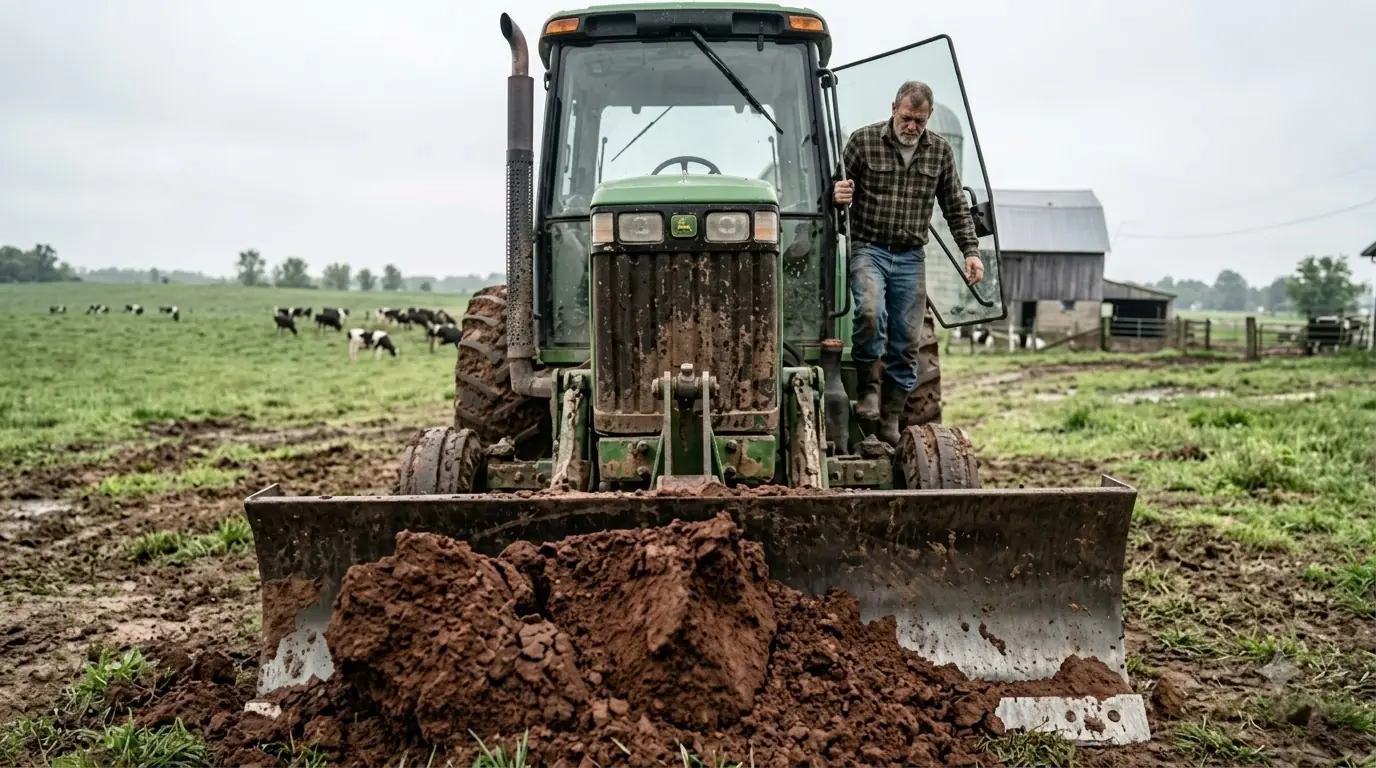
It was a Monday morning in April 2003, and Glenn had expected nothing more complicated than an hour of routine maintenance. The farm lane stretched approximately two hundred feet from the county road to the barn, cutting through pasture ground his grandfather had cleared during the 1940s. Every winter left its mark on that narrow strip of earth. Rainwater collected in shallow depressions, wagon and tractor tires carved ruts into the gravel, and freezing temperatures pushed stones toward the surface. Every spring, Glenn brought out the box blade, dragged it back and forth, and restored the lane to something approaching level ground.
He had already completed three passes without trouble. The gravel was moving smoothly beneath the blade, and the deepest ruts were beginning to disappear. On the fourth pass, halfway between the county road and the barn, the tractor caught on something hidden beneath the surface. Glenn felt the resistance through the seat before he heard the crack. For an instant, he thought he had struck a buried root, but the sound that followed was too deep and too deliberate. He stopped, raised the blade, backed the tractor a few feet, and climbed down to investigate.
Six inches beneath the lane surface, exposed by the blade, lay a section of dark timber split lengthwise along most of its body. The wood was nearly black where the fresh break revealed its grain, yet it appeared surprisingly solid. Glenn crouched beside it and brushed away the loose dirt with his hand. At first, he assumed it was an old fence rail, something left behind when the land was cleared and gradually buried by decades of gravel and mud. Then he noticed the opening.
Running straight through the center of the timber was a perfectly circular hole, approximately two inches across.
And water was coming out of it.
Glenn leaned closer. It was not the muddy seepage he sometimes found beneath the lane after heavy rain. This water was clear, cold, and moving steadily through the center of the wood. It gathered against the broken face, spilled into the loose earth, and disappeared beneath the gravel. He placed one finger inside the opening and felt water pressing against the back of his fingernail.
He remained crouched there, staring at the impossible-looking object.
Whatever this was, it was not a fence post.
A pickup truck slowed on the county road. Behind the wheel was Merl Coffee, a neighboring cattleman who had known Glenn for years. Merl noticed the tractor stopped awkwardly near the lane entrance and saw Glenn crouching beside what appeared to be a broken log. From the road, there was nothing particularly remarkable about the scene. Farmers found buried timber all the time, especially in old lanes that had been repaired and filled repeatedly over the decades.
Merl considered stopping, but he had forty steers to check before noon. He watched Glenn for another moment, then continued down the road. Whatever his neighbor had uncovered would probably still be there later.
Neither man could have known that the dark piece of timber beneath the gravel was part of a forgotten water system constructed more than a century earlier. Nor could Glenn have imagined that the discovery would lead him through old agricultural records, hidden iron fittings, a costly mistake, and a remarkable piece of family history that had been lying beneath his feet for his entire life.
The Trivet farm occupied 180 acres along the lower slope of a ridge in the Cove Creek watershed, roughly three miles west of Boone, the county seat of Watauga County. This was Blue Ridge country, where the land folded into steep coves beneath wooded ridges and natural springs emerged near the upper margins of fields. The creeks ran fast through narrow valleys, and the mornings remained cold through much of the year. Even in summer, water emerging from the deeper hillside rock could feel almost icy against the skin.
The barn stood at an elevation of approximately 3,200 feet. Behind the upper pasture, the hillside climbed another two hundred feet before reaching the ridge. The fields were irregular, shaped more by the mountain than by any farmer's preference. Some sections were gentle enough for equipment, while others rose sharply toward the timberline. It was not easy land, but generations of the Trivet family had learned how to work it.
Glenn's great-great-grandfather, Ezra Trivet, had arrived in the Cove Creek Valley during the 1860s. He cleared approximately sixty acres of bottomland and lower hillside, established a cattle operation, and began building the farm that would remain in his family for generations. Ezra's son added acreage. Glenn's grandfather cleared the upper pasture during the 1940s and oversaw the arrival of electricity in 1951. Glenn's father expanded the lower hay fields, and Glenn himself had taken responsibility for the operation in 1984.
By 2003, he was raising thirty-five beef cattle. His wife, Martha, kept the accounts and helped with the countless daily responsibilities that kept a small farm operating. Their son, Keith, had worked summers and weekends on the property since he was old enough to drive a tractor. The family was accustomed to doing things themselves whenever possible. They repaired fences, maintained equipment, and made careful decisions about every major expense.
For Glenn, the farm was more than land. It was the accumulated work of people whose names appeared in family Bibles, old ledgers, and fading photographs. Every pasture had been cleared by someone. Every fence line represented hours of labor. The barn contained tools that had belonged to men Glenn remembered only through stories. He had spent his entire working life surrounded by evidence of the generations before him, but he rarely had reason to question the purpose of objects that had always been there.
One of those objects hung on the south wall of the barn.
It was a heavy, hand-forged pod auger, an old boring tool with a two-inch iron bit and spiral flutes approximately twenty-four inches long. Its wooden handle had been replaced at some point, but the iron head was clearly much older. The surface had darkened with age, and decades of storage had left it rough and discolored. Glenn had always assumed it was used for fence construction, barn repairs, or some other kind of timber work. He had passed it thousands of times without taking it down.
He had no idea that the tool would eventually provide the final piece of the mystery.
For years, the farm's most persistent problem had been its water supply. Near the upper margin of the pasture stood a stone-and-concrete spring box built into the hillside, where a natural spring had surfaced for as long as anyone could remember. A modern two-inch plastic pipe carried water downhill toward a pressure tank near the barn. Under favorable conditions, the system supplied enough water for the cattle. But it was unreliable, and Glenn had grown increasingly frustrated with it.
Heavy rain often washed sediment into the spring box's inlet screen, reducing the flow for days. During dry periods, the spring's usable output weakened, and pressure at the barn could fall below what the automatic waterers required. The summers of 2001 and 2002 had been particularly difficult. By August, the pressure gauge sometimes dropped below ten pounds per square inch, far short of the approximately fifteen pounds needed to serve the herd reliably.
Glenn had spent those summers thinking about drilling a well.
A contractor in Boone had quoted between eight thousand and twelve thousand dollars, depending on the required depth. It was a substantial investment for a modest cattle operation, and Glenn had hesitated. There were always other expenses waiting: fencing materials, feed, equipment repairs, veterinary bills, and the ordinary costs of keeping a farm running. He wanted a dependable water supply, but he was reluctant to commit thousands of dollars without exhausting every reasonable alternative.
What made the situation especially frustrating was that the spring itself had not disappeared. Cold water continued emerging from the hillside. The problem was getting enough of it to the barn at the pressure the cattle needed.
And now, beneath the lane, Glenn had found another water line.
He carefully pulled the split timber free and set it on the grass beside the road. It was approximately eight feet long, with dense, straight grain unlike the pine and oak he commonly encountered around the property. The wood looked old, but it had not crumbled. Its dark surface seemed almost preserved.
Glenn retrieved a spade and began digging along the original position of the log. He worked cautiously, removing soil from both sides until he reached the end of the buried section. There, protruding from the timber, he found a short iron sleeve about an inch long.
The sleeve connected the first log to another.
Glenn stopped digging and examined the joint.
The second timber was made from the same dark wood. It had the same two-inch bore running through its center, and the iron sleeve fitted neatly between the two sections. He uncovered another two feet, then continued far enough to see that the second log also connected to a third.
The alignment was remarkably straight.
These were not pieces of wood discarded randomly beneath an old road. Someone had prepared them, bored holes through their centers, and connected them end to end using iron fittings. The work had required planning and precision.
Glenn stood and looked uphill.
The line ran toward the upper pasture.
Toward the spring box.
His first thought had been that he had found a buried fence rail. That explanation was now impossible. His second thought was that the logs formed an old drainage channel, perhaps installed to carry overflow away from the springhouse. But the direction of the line did not support that idea.
The spring box stood above the barn.
Water naturally flowed downhill.
If the logs ran from the spring toward the barn, then the system was not simply removing unwanted water from a field.
It was delivering water to the farm.
Glenn looked back at the dark timber and felt a growing sense of disbelief. He had been struggling with water pressure for years, and now he was standing above what appeared to be an abandoned supply line. It was buried beneath ground he had worked for decades, yet he had never heard anyone mention it.
He walked to the barn and called Martha in from the garden.