By the time Walter Granger arrived, they had already used four recovery trucks, a hydraulic crane, two hundred feet of steel cable, and enough horsepower to drag a loaded grain trailer through concrete.
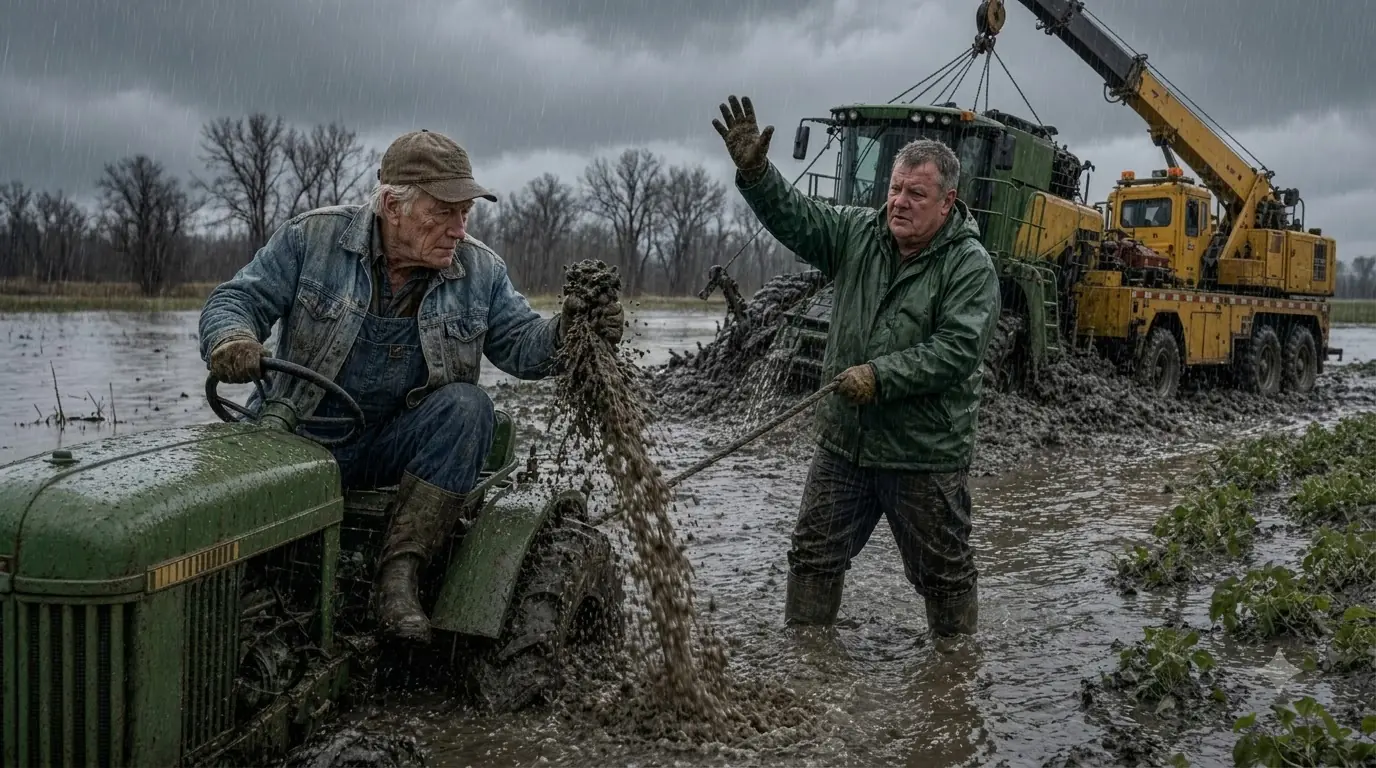
The combine had moved eleven inches.
Down.
Keith Torrence stood in ankle-deep water beside the rear axle of his largest recovery rig and watched another black wave of Iowa mud squeeze around the combine’s front tires.
“Kill it!”
A worker slapped both hands over his head.
“Kill the pull!”
The diesel engines dropped to idle. The steel cable sagged. For several seconds, nobody spoke.
Rain hammered the soybean field so hard that the surrounding farmland seemed to disappear behind a gray curtain. The stuck machine was a nearly new high-capacity combine weighing well over twenty tons before counting the fuel in its tank and the mud now packed beneath it. Its grain tank was empty. Its header had already been removed. None of that mattered. The front tires were buried almost to their hubs. One rear tire had disappeared past the lower rim. Brown water swirled through the ruts. Every time the crews pulled, the combine seemed to settle deeper.
Keith wiped rain from his face.
“Son of a—”
He stopped himself. There were six men within earshot and all six looked as exhausted as he felt.
Keith Torrence was forty-eight years old and had been recovering heavy farm equipment for more than two decades. He had pulled semis from frozen ditches, excavators from riverbanks, loaded grain trucks from washed-out roads, and a bulldozer from a pond once. He understood weight. He understood leverage. He understood anchors, snatch blocks, cable angles, ground pressure, and exactly how quickly a bad recovery could become a deadly one.
But this field had defeated everything he had tried.
The trouble had started that morning. The farmer leasing the ground, Ryan Keller, had been trying to finish soybeans before another week of storms arrived. The forecast had called for light rain after noon. Instead, rain began at ten-thirty. By eleven, the northwest corner of the field was already soft. Ryan had turned the combine toward the field entrance. He made it perhaps eighty yards. Then the left front tire broke through. He tried reversing. Wrong decision. The right tire sank. He stopped immediately and called for help.
A neighboring tractor arrived first. It couldn’t move the combine. Then a larger four-wheel-drive farm tractor came. The tow strap stretched tight. Nothing.
Keith’s company arrived at 12:40. At first he had not been worried.
“Seen worse.”
That was what he’d told Ryan.
Three hours later, nobody was saying that anymore.
Keith had positioned one recovery truck on the county road. Another sat near the field entrance. A third was chained to the second as an anchor. Steel cable ran across the flooded ground to the combine. When that failed, Keith changed angles. When that failed, they brought in ground mats. The mats disappeared beneath the recovery truck’s tires. Then came the hydraulic crane from another job site fourteen miles away. Its operator took one look at the soil and refused to bring it closer. So they used the crane only to unload timbers and additional equipment. Then the rain intensified. The combine sank another three inches.
At 3:17 p.m., Ryan looked at Keith and asked the question neither man wanted to discuss.
“How long before we can’t get it out at all?”
Keith stared at the machine.
“We’ll get it.”
Ryan said nothing. Keith heard the doubt anyway.
Then one of his workers, Cody, looked toward the county road.
“What the hell is that?”
Keith turned.
Something green was coming through the rain. Slowly. Very slowly. A faded two-cylinder tractor rattled along the shoulder pulling a small wagon.
Cody squinted.
“You’ve gotta be kidding me.”
The tractor turned onto the field approach. Its narrow front tires cut through the shallow water. Its green paint had faded almost to gray in places. The yellow wheels were scratched and rusted around the edges. The exhaust stack puffed rhythmically beneath the rain.
Pop. Pop. Pop. Pop.
Cody started laughing.
“Keith.”
Keith didn’t answer.
“Keith, I think reinforcements are here.”
Two other men turned. One whistled.
“Is that a Model 50?”
The old tractor stopped before the worst of the mud. The man operating it shut down the engine. Silence replaced the slow two-cylinder beat.
Then Walter Granger climbed down.
He was seventy-four. Lean. White-haired. Weathered enough that the lines around his eyes looked carved there. He wore denim overalls beneath a soaked brown canvas coat and a faded seed-corn cap. Mud already covered his boots before he even reached them.
Cody looked at the antique tractor. Then at the buried combine. He couldn’t resist.
“Four recovery rigs failed.”
Walter continued walking.
Cody pointed behind him.
“That antique won’t last five minutes out here.”
Walter did not even look at him. He stopped twenty feet from the combine. Not in front of it. Not beside the cable. He looked at the ground.
Keith noticed that. Everybody who had arrived that afternoon looked at the combine first. Walter didn’t. He looked at the water. Then the ruts. Then the field. He walked ten yards east. Pressed his boot into the soil. Moved another six feet. Did it again. Then crouched.
Keith frowned.
Walter pushed three fingers into the mud. Lifted a handful. Squeezed it. Dark water ran between his fingers. He dropped it. Walked south. Repeated the process.
Cody whispered to another worker.
“Maybe he’s looking for worms.”
The other man laughed.
Walter heard them. Still no reaction.
Then the combine made a sound. Not mechanical. A deep wet sucking noise came from beneath the front axle. Everyone looked. The machine settled another inch.
Ryan swore. Keith raised his hand toward the recovery crew.
“Nobody touches that winch.”
Walter turned.
“Good.”
Keith stared at him.
Walter walked toward the combine.
“Keep it that way.”
Keith was already frustrated.
“And you are?”
“Walter Granger.”
Ryan looked up.
“Granger?”
Walter nodded.
“You knew my dad?”
“Harold Keller?”
“Yeah.”
“Bought seed from him for twenty-two years.”
Ryan blinked. Then recognized him.
“You used to farm the west section.”
“Thirty-seven years.”
Keith stepped between them.
“That’s nice, gentlemen, but unless Mr. Granger brought a bigger wrecker—”
Walter walked past him. Keith’s jaw tightened.
Walter reached one of the cable attachment points. He studied the direction of the pull. Then looked at the tracks left by the combine. He followed them backward. Thirty feet. Forty.
The rainwater wasn’t sitting evenly. A thin current moved through the field. Almost invisible. Walter stopped. He watched bits of soybean leaves floating past his boot. They drifted southeast. Then curved. Toward a shallow depression in the field. A drainage swale.
Walter’s eyes narrowed. He walked toward it. Keith followed now—not because he trusted Walter, but because Walter appeared to be looking for something specific.
Walter stepped into the swale. Water reached halfway up his boots. He turned toward the combine. Then toward an old fence line beyond the field. His expression changed.
“Stop pulling that machine.”
Keith laughed once.
“We already stopped.”
“No.” Walter pointed at the recovery rigs. “I mean stop trying to pull it the way you’ve been pulling it.”
Keith crossed his arms.
“You got a better idea?”
Walter walked back toward the combine.
“Yes.”
Cody snorted. Walter stopped beside him.
“Every time you pull it forward, it sinks.”
Cody shrugged.
“No kidding.”
“Every time you pull it backward?”
Keith answered.
“Same.”
Walter nodded.
“And you’re wondering why.”
Keith’s patience finally broke.
“We have eighty thousand dollars’ worth of recovery equipment sitting here. We’ve changed pull angles six times. We unloaded the header. We cribbed the front once until the cribbing disappeared. So if you’ve got something useful, say it.”
Walter looked directly at him.
“Then stop pulling before you bury it for good.”
Keith stepped closer.
“You think you know something we don’t?”
Walter pointed at the combine.
“You understand the machine.”
Then he pointed down.
“You never checked what’s holding it.”
Keith stared at him.
“What’s holding it?”
Walter looked beneath the combine. Then toward the drainage swale.
“The field.”
Nobody laughed.
Walter walked to the left front tire. He knelt despite the water. Then drove a steel probe from his wagon into the mud. Two feet. Three. The rod suddenly dropped. Walter stopped. He pulled it out. Moved six feet sideways. Drove it down again. This time it stopped much sooner. He tried a third place. Then another.
Keith watched.
“What are you finding?”
Walter ignored him.