At 2:07 in the morning, three police officers kicked down my front door and entered my house with guns raised.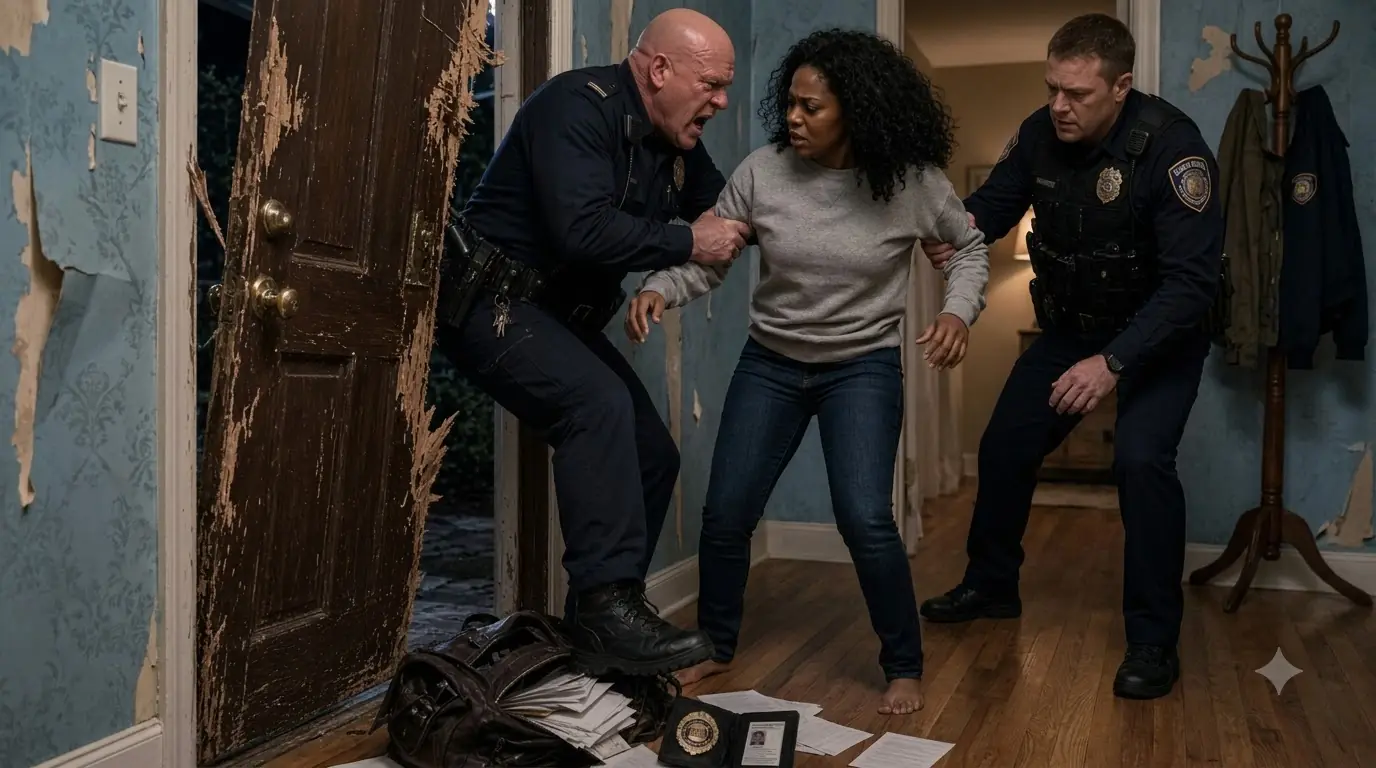
They never knocked.
They never announced a warrant.
They never asked who lived there.
The first thing I heard was wood exploding.
The second was a man shouting:
“Police! Don’t move!”
I woke with my hand already reaching toward the locked drawer beside my bed.
Years of training.
Years of knowing exactly how quickly confusion could become a funeral.
Then I heard another voice downstairs.
“Find the drive.”
My hand stopped.
Not:
Clear the house.
Not:
Where is the suspect?
Not:
Check for weapons.
Find the drive.
That told me more than they understood.
I slid out of bed barefoot.
My name is Special Agent Maya Bennett.
Thirty-eight years old.
Black.
Fifteen years with the FBI.
At the time, I was assigned to the Philadelphia Field Office and serving as case agent on a public-corruption investigation involving stolen narcotics, protection payments, and several officers from the East Briar Police Department.
The men downstairs did not know that.
At least, not yet.
To them, I was simply the woman who had been seen that afternoon speaking to one of their former evidence clerks in a grocery-store parking lot.
A woman they believed had something they desperately wanted back.
A blue encrypted flash drive.
And they were willing to break into my home at two in the morning to find it.
Footsteps hit the stairs.
Heavy.
Fast.
I stepped away from the drawer.
If I opened it now, the agents investigating my death would eventually prove I had every legal right to reach for my service weapon.
That would not bring me back.
So I left it closed.
I raised both hands.
The bedroom door slammed inward.
Officer Kyle Benton entered first.
Young.
Maybe twenty-eight.
Gun raised.
Behind him came Officer Travis Cole, heavier, older, breathing hard.
Then Sergeant Dean Wade.
I knew all three names.
That was the part they never considered.
Their faces had been on my case board for seven weeks.
Wade looked at me.
For half a second, surprise crossed his face.
Then authority returned.
“On your knees.”
I stayed still.
“Do you have a warrant?”
Cole moved toward me.
“On the floor!”
“For what?”
Wade’s eyes moved around the room.
Not checking corners.
Searching furniture.
“Hands where I can see them.”
“They are.”
Benton’s gun remained fixed on my chest.
His eyes kept jumping between me and Wade.
He looked nervous.
Good.
Nervous officers sometimes still understood consequences.
Wade pointed toward the floor.
“Last warning.”
I lowered myself slowly.
Cole came behind me.
Plastic restraints tightened around my wrists.
Not handcuffs.
Zip ties.
That was interesting too.
I looked up at Wade.
“What are you looking for?”
His eyes narrowed.
“You know.”
“No.”
“The drive.”
There it was again.
Benton looked toward Wade.
“Sergeant—”
“Search.”
Cole opened my closet.
Wade started on the dresser.
Drawer after drawer.
Underwear.
Documents.
Jewelry box.
He moved quickly.
Too quickly for a legal search.
This was not evidence collection.
It was retrieval.
I stayed on my knees.
Calm.
Listening.
Memorizing.
Then Wade opened the top drawer of my nightstand.
He moved aside a paperback.
A charger.
A small black leather credential wallet.
He picked it up.
His hand stopped.
For the first time that night, Sergeant Dean Wade looked afraid.
He opened it.
The gold badge reflected the bedside lamp.
Then his eyes dropped to the identification card.
FEDERAL BUREAU OF INVESTIGATION
SPECIAL AGENT MAYA BENNETT
His mouth opened slightly.
Benton saw his face.
“What?”
Wade did not answer.
Cole turned from the closet.
“What is it?”
Wade held up the credential wallet.
Nobody moved.
Benton lowered his gun first.
“Jesus Christ.”
Cole stared at me.
Then at Wade.
“No.”
Wade whispered:
“Shut up.”
I looked directly at him.
“No, Sergeant.”
He slowly turned toward me.
I held his stare.
“Don't tell him to shut up.”
The room had gone completely still.
I looked toward Benton’s chest.
No red recording light.
Then Cole’s.
Nothing.
Then Wade’s.
Also off.
I smiled once.
Not because anything was funny.
“Now turn your body cameras back on.”
Nobody moved.
That was the moment all three understood the night had changed.
Twelve hours earlier, none of them knew my name.
At least that was what we believed.
The investigation into East Briar had started with something small.
A missing bag of fentanyl from a property room.
The official paperwork said the drugs had been transferred for destruction.
The destruction facility had no record of receiving them.
Internal Affairs called it clerical error.
Then another package disappeared.
Then cash.
Then a handgun.
A deputy district attorney noticed three unrelated cases had evidence-control irregularities involving the same group of officers.
Sergeant Dean Wade appeared in all three chains.
Not always directly.
Sometimes as supervisor.
Sometimes as evidence witness.
Sometimes approving paperwork.
At first, that meant nothing.
Then a patrol officer named Anthony Pierce was arrested by state police carrying narcotics that matched packaging from one of the supposedly destroyed seizures.
Pierce asked for a lawyer.
Then asked whether federal protection was possible.
That was when the FBI entered.
According to Pierce, Wade had been running a side operation for years.
Seized drugs disappeared.
Cash disappeared.
Weapons disappeared.
Some of it was sold through intermediaries.
Some was used to pressure informants.
Some was planted.
And whenever another officer asked too many questions, Wade reminded them how easy it was to ruin someone with evidence nobody would question.
Pierce was frightened.
Not of prison.
Of his own department.
He gave us names.
Cole.
Two detectives.
A narcotics lieutenant.
And eventually Benton.
But Benton was different.
Pierce said the younger officer had been used mostly as a driver and lookout.
“He sees things,” Pierce told me.
“Does he participate?”
“Sometimes.”
“Does he know?”
Pierce looked away.
“He knows enough.”
That mattered.
Knowing enough is where many corruption cases live.
Not in dramatic conspiracies.
In people seeing something wrong and deciding silence is safer.
The blue flash drive came from Elaine Porter.
Fifty-four.
Former civilian evidence clerk for East Briar Police.
She had worked there sixteen years.
Then quit without explanation.
We discovered her name through an old access log.
Packages that later disappeared often passed through her workstation.
At first, I suspected her.
Then she called our tip line.
Not from home.
From a pay-as-you-go phone purchased two counties away.
She refused to meet at the field office.
She refused to speak near her house.
She chose a grocery-store parking lot outside the city.
I went alone visually.
Not actually alone.
Surveillance teams covered the area.
Elaine entered my SUV carrying a reusable shopping bag.