“Get out of the car, now!”
Adrian Ross had barely hung up the gas nozzle when the spotlight hit him. Two officers. A rest stop off I-16. Middle of nowhere, Georgia.
“The hell? I’m pumping gas, man.”
“Did I stutter? Out! Hands where I can see them!”
“You got no right to—”
“Pike, pull this animal out before I do it myself.”
Pike ripped the door open. Wells grabbed Adrian by the collar and slammed him face-first onto the asphalt, cuffs biting into his wrists.
“You think you can talk back to me, boy? Your kind don’t get to have an attitude.”
No charges, no warrant, no reason. Just two badges and a Black man who didn’t belong.
But what happened the next morning, Wells would give anything to take that night back. Because the next morning, both officers realized their careers were already over.
The highway stretched long and empty through southern Georgia—the kind of road where the trees pressed in close and the only light came from your own headlights bouncing off the asphalt. Adrian Ross had been driving for six hours. His fingers tapped a slow rhythm on the steering wheel, keeping time with the low hum of the engine. The sedan ate up miles of nothing: pine forests, the occasional dead armadillo, and exit signs for towns he’d never heard of.
Tomorrow morning, he would sit behind a bench for the first time as a federal judge. Not a mock trial, not a moot court exercise—the real thing. His name on the brass plate.
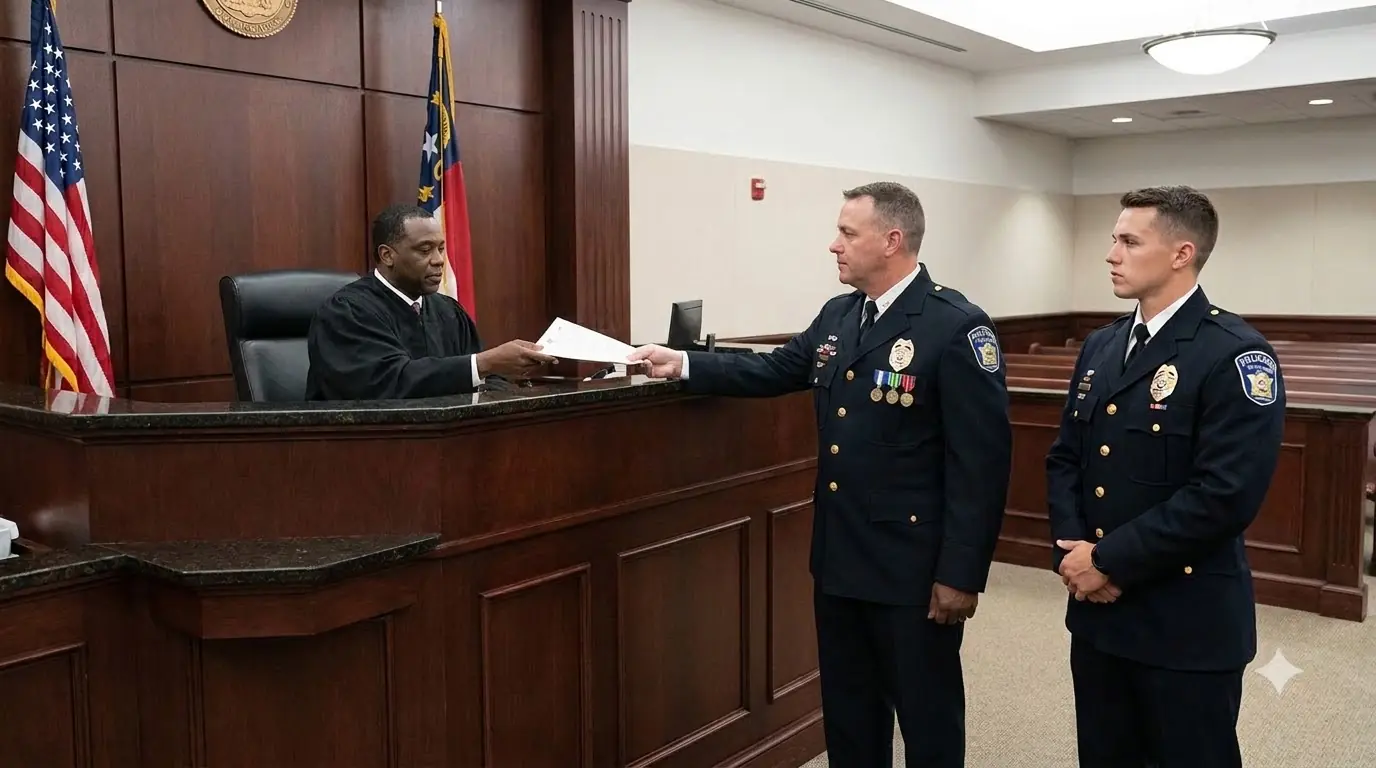
He’d spent twenty-two years building toward that chair: four years at Howard, three at Yale Law, fifteen years grinding through cases as a civil rights attorney—the kind of work that paid in purpose, not money. 700-page briefs, depositions in windowless rooms, clients who cried on the phone at midnight because they didn’t think anyone would believe them. And now this: a lifetime appointment.
A robe in the garment bag on the backseat, still wrapped in dry-cleaning plastic.
The gas gauge dipped below a quarter tank. Next town was forty miles out, but there was a rest stop in three. Adrian flicked on the blinker, even though there wasn’t another car in sight. Old habit. His mother had drilled it into him: Always signal. Always use your manners. Always give them one less reason.
The rest stop appeared like a dim island in the dark: a Quickmart with half its sign burned out, two gas pumps from the previous decade, and a parking lot cracked down the middle where weeds pushed through. A single overhead light buzzed and flickered, casting everything in a sickly yellow wash.
Adrian pulled up to the pump, killed the engine, stepped out, and stretched—arms above his head, spine popping after hours in the seat. The air hit him thick and warm, heavy with pine sap and old gasoline. Crickets screamed from the treeline. Somewhere behind the building, a bullfrog called out and got no answer.
He swiped his card, started the pump, and walked toward the Quickmart for coffee.
The patrol car was parked in the far corner of the lot, tucked behind a dumpster where the light didn’t reach. Adrian noticed it the way you notice a wasp on the windowsill: not alarmed, just aware. Every Black man in America develops that radar by the time he’s twelve. It’s not fear, exactly; it’s geometry. Calculating angles, distances, sightlines—knowing where you are in relation to the uniform without ever looking directly at it.
He pushed through the door. The clerk, a teenager with acne and headphones around his neck, barely glanced up. Adrian poured a large black coffee, grabbed a pack of peanuts, and set them on the counter.
“$3.78.”
He paid in cash, left the change, and walked back out into the warm dark. The gas pump clicked off. He replaced the nozzle, screwed on the cap, and reached for his car door.
Inside the patrol car, two figures sat watching. The cabin light was off, but the glow of a laptop screen lit their faces from below. Sergeant Grady Wells, sixteen years on the force, built like a fire hydrant, the kind of man who spoke in commands even ordering breakfast; and Officer Danny Pike, twenty-four, fresh from the academy, still young enough to think every shift might be the one that made his career.
Wells watched the sedan, watched the man in slacks and a pressed shirt buying coffee at 11:30 at night in the middle of nowhere. He picked up the radio.
The spotlight hit Adrian before he heard the engine. One second he was standing at the pump reaching for the gas cap; the next, a wall of white light pinned him against the sedan like a moth on a board. He raised one hand to shield his eyes.
The cruiser doors opened in unison.
“Step away from the vehicle!”
Sergeant Grady Wells came first. Sixteen years in the department had given him a walk—slow, wide, deliberate, the walk of a man who had never once been told no in uniform. His hand rested on his holster, not gripping, just resting—the way a man rests his hand on a fence he owns.
Officer Danny Pike came from the passenger side: twenty-four years old, six months out of the academy, eager in a way that made his movements sharp and twitchy. He circled wide, flanking the sedan from the rear.
“License and registration.”
Adrian reached into his back pocket, slowly. Every Black man learns the choreography before he learns to drive: hands visible, movements announced, no sudden turns. “Here.”
Wells took the license, held it up to the spotlight, squinted, looked at Adrian, and looked back at the card. “Adrian Ross. That’s your real name?”
“It’s on the license.”
“I didn’t ask what’s on the license. I asked if it’s your real name.” Wells tucked the card into his shirt pocket like it belonged to him now. “Where you coming from?”
“Atlanta.”
“Where you headed?”
“Dalton.”
“Dalton.” Wells repeated the word like it tasted wrong. “What business you got in Dalton?”
“Work.”
“What kind of work?”
“Legal work.”
Wells glanced at Pike. Pike smirked—the kind of smirk that said, “Sure, buddy. Legal work at midnight driving through Telfair County.”
Wells leaned against the sedan—Adrian’s sedan. Put his full weight on it like he was leaning on his own truck at a barbecue. “You know what that sounds like to me?”