Blood had dried across the woman’s knuckles before she noticed it.
She noticed the nail first.
It had bent halfway into the beam.
She pulled it free with the claw of her hammer, dropped it into a small tin beside her knee, and selected another.
The cut could wait.
Nails could not.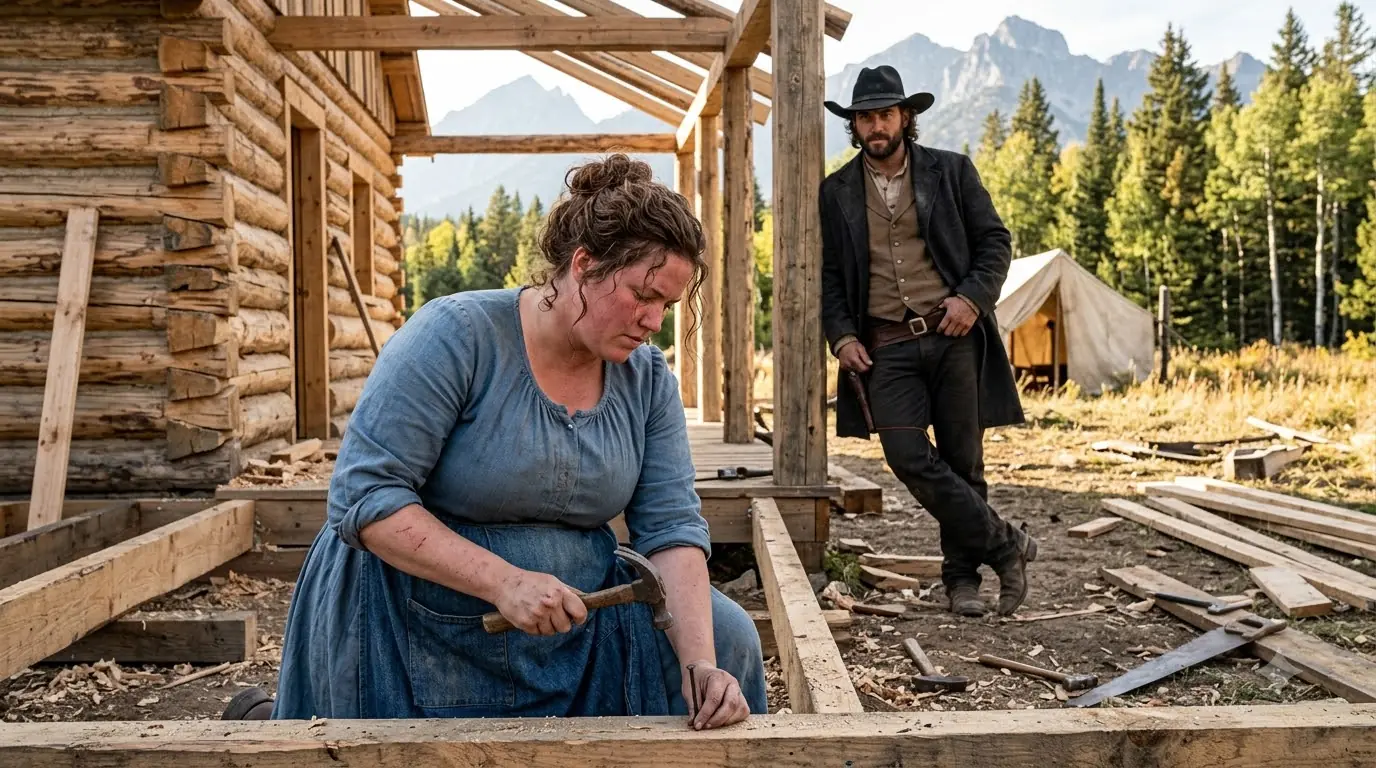
September sunlight poured over the unfinished cabin, turning fresh pine shavings gold against the earth.
The woman knelt beside the floor framing with one knee pressed into sawdust and the other angled awkwardly beneath the weight of her seven-month pregnancy.
Every movement required negotiation now.
Standing.
Kneeling.
Reaching.
Even breathing after carrying boards uphill from the timber pile.
The baby inside her seemed to object to nearly all of it.
A small heel pushed beneath her ribs.
The woman paused.
“Not now.”
Another kick answered.
She placed one dusty palm against the curve of her stomach.
“You’ve had opinions all morning.”
The baby moved again.
The woman smiled despite herself.
Then she picked up the hammer.
The people of Harland Creek would have enjoyed seeing her struggle.
Not all of them.
That would be unfair.
The widow who operated the dry-goods counter had quietly sold her canvas at cost.
The blacksmith had straightened a bent drawknife without charging her.
An elderly farmer once left a sack of potatoes beside her fence and refused to admit it had been him.
There was kindness in town.
But kindness was quieter than judgment.
Judgment gathered around stove counters and store porches.
A pregnant woman alone on forty rough acres made excellent conversation.
Especially when the woman had arrived without a husband.
Some said she had been abandoned.
Others said she had run away.
A few whispered that she had probably done something to deserve either.
The facts interested them less than the ending.
Everyone seemed certain about that.
She would fail.
Maybe before first snow.
Certainly before January.
The roof would collapse.
The creek would freeze.
The firewood would run out.
The baby would come early.
The woman would finally admit what sensible people had known from the beginning.
A woman in her condition needed protection.
The woman responded by buying more nails.
Her homestead sat six miles beyond town where the valley narrowed between timbered slopes.
Nobody else had wanted the parcel.
Forty acres sounded respectable until someone actually saw it.
Half the land climbed.
The lower ground was rocky.
The creek ran strong in spring and thin by August.
Dense lodgepole pine covered the northern side.
The road became mud after rain.
The nearest established ranch lay miles away.
But the claim had one quality the woman valued more than rich soil.
It was hers.
No husband could order her out.
No landlord could increase the rent.
No relative could decide she had overstayed.
Nobody could tell her where the baby would sleep.
The first time she stood on the property with the deed papers in her hand, she had cried.
Not because the land was beautiful.
Though it was.
She cried because ownership felt like silence.
There was nobody else’s voice inside it.
That had become rare in her life.
Before the homestead, there had been a proper house.
White curtains.
A polished dining table.
China cups.
A husband who never struck her.
That was what people would have said in his defense.
He never struck her.
As though cruelty only counted when it left bruises.
His method was smaller.
More patient.
He corrected.
Everything.
The way she kept accounts.
The volume of her laugh.
The placement of dishes.
The amount of sugar in tea.
The dress she selected for church.
The friends she trusted.
When she proposed taking bookkeeping work for local merchants, he smiled.
“You don’t understand business.”
She had kept his household books for four years.
When she suggested opening a separate bank account, he smiled again.
“Why would my wife need separate money?”
When she asked why he disappeared for days without explanation, the smile became colder.
“You’re becoming emotional.”
Eventually, she stopped asking.
Not because he convinced her.
Because the cost of every question became exhaustion.
Then pregnancy changed the calculation.
When she told him, she expected surprise.
Perhaps joy.
At minimum, concern.
He placed his fork beside his plate and said:
“The timing is inconvenient.”
She remembered those words more clearly than anything else from the marriage.
Not anger.
Not accusation.
Inconvenient.
As though the child inside her were a late shipment.
He explained that she would stay with his sister while he traveled to Denver.
After the baby arrived, they would discuss what happened next.
“With the child?”
she asked.
“With you.”
That night, she finally understood the marriage.
She was not his partner.