The first thing the federal agent noticed was that the local patrol car had stopped in exactly the wrong place.
Not illegally.
Not dramatically.
Just wrong enough to matter.
Its front bumper projected several feet into the intersection, and its flashing red and blue lights reflected against the side of the dark unmarked SUV parked near the curb.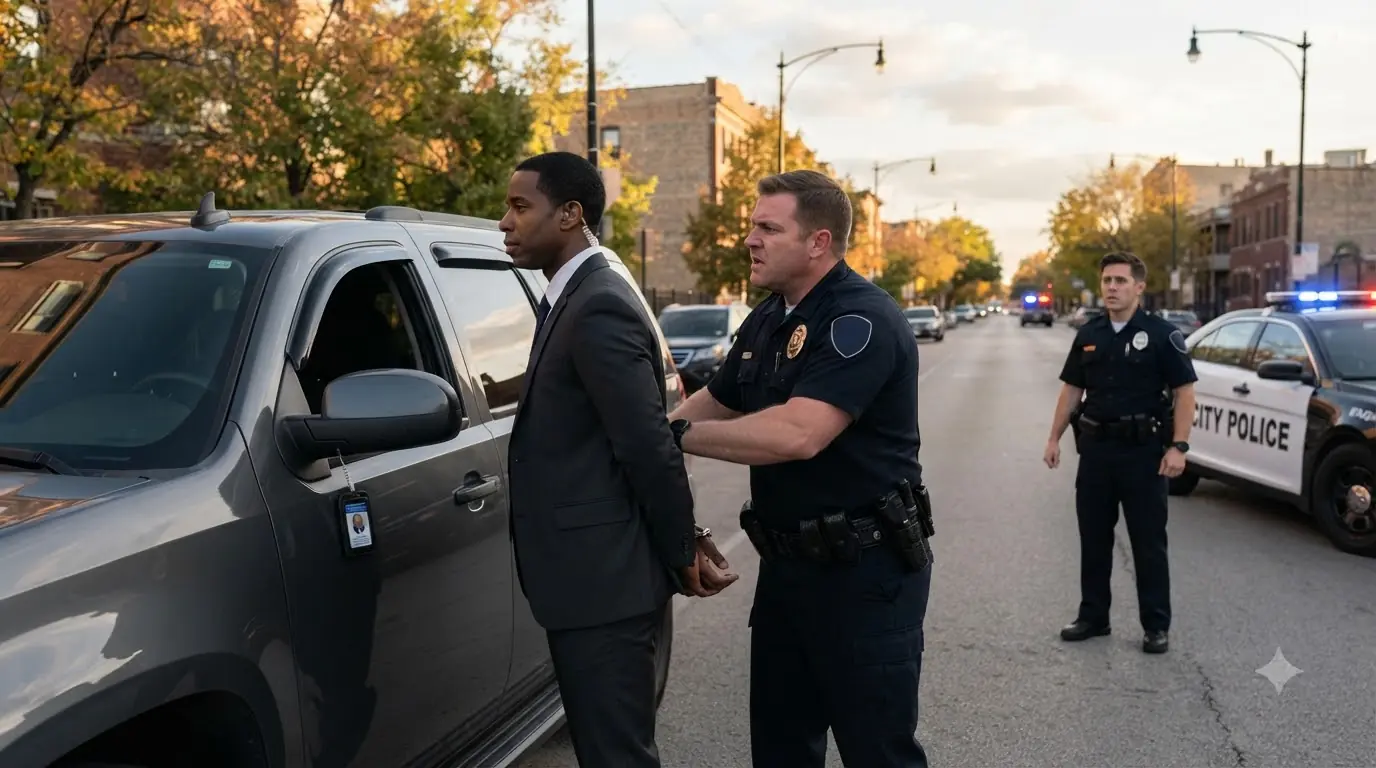
The federal agent glanced at his watch.
Then toward the distant avenue.
Then back at the officer walking toward him.
He felt the pressure immediately.
Not fear.
Timing.
Everything that afternoon had been built around timing.
Road closures.
Communications checks.
Position changes.
Traffic control.
Transportation coordination.
Nothing about the system depended on one person being heroic.
It depended on hundreds of people doing ordinary things correctly at exactly the right time.
The federal agent was one of those people.
He sat behind the wheel of the unmarked SUV wearing a dark charcoal suit, white shirt, dark tie, and a discreet clear communications earpiece routed beneath his collar.
A professional credential rested where it could be seen without him reaching for it.
He had been told to remain at the intersection, observe, communicate, and keep unnecessary vehicles from lingering nearby.
Simple.
Then the patrol car arrived.
The local officer stepped from it quickly.
White American.
Early forties.
Broad shoulders.
Short brown hair.
Dark navy uniform.
Body camera centered on his chest.
His posture announced irritation before he said a word.
The federal agent lowered the window halfway.
The officer stopped beside the door.
“What are you doing here?”
The federal agent looked at him calmly.
“Working.”
The officer’s eyes narrowed.
“This street is restricted.”
“I’m aware.”
“Then why are you parked here?”
The federal agent glanced toward the visible credential.
“I’m assigned here.”
The officer followed his eyes but did not actually read what he was looking at.
“Assigned by who?”
The federal agent gave his agency and title.
The local officer stared at him.
Then laughed once.
Not loudly.
Not kindly.
The federal agent had heard that laugh before.
It was the sound people made when they had already reached a conclusion and were waiting for reality to cooperate.
A second local officer remained beside the patrol car.
Younger.
Late twenties or early thirties.
He looked from the unmarked SUV to his partner.
Then toward the unusually empty street.
The federal agent noticed him noticing.
That mattered.
“Officer,” the agent said, keeping both hands visible on the steering wheel, “my credentials are in plain view. You can verify them through your dispatcher.”
The older officer leaned closer.
“Turn the vehicle off.”
The agent did not move.
“Before I do anything else, I need you to contact dispatch and verify my identity.”
The officer’s expression hardened.
“I gave you an instruction.”
“And I’m explaining why you need to verify before you interfere with this position.”
The younger officer finally stepped closer.
“Maybe we should run him.”
The older officer did not look back.
“I know how to handle a traffic stop.”
The federal agent answered immediately.
“This isn’t a traffic stop.”
That sentence landed badly.
The older officer straightened.
“What did you say?”
The federal agent kept his voice level.
“I said this isn’t a traffic stop.”
“You approached a parked federal vehicle inside an active restricted area.”
“You can confirm that in less than a minute.”
The local officer stared through the window.
His eyes moved across the dashboard.
The federal agent could almost see the conflict happening behind them.
The equipment did not look ordinary.
Neither did the agent.
Neither did the location.
But pride had begun competing with curiosity.
Pride was winning.
The officer pointed toward the ignition.
“Turn it off.”
The federal agent inhaled slowly.
“Officer, listen carefully.”
He spoke more quietly now.
That made the younger officer pay closer attention.
“This roadway is being held clear for an official movement.”
“I am positioned here because I was assigned here.”
“If you have any doubt, verify me.”