She has not touched a serious instrument in eight months.
Richard expects a childish tune.
Emma announces Chopin’s Étude Op. 25 No. 11, “Winter Wind.”
The laughter stops.
As Emma begins playing, the restaurant slowly realizes that the young woman Richard selected for ridicule is not merely competent. She is extraordinary. Waiters stop serving. Diners put down their forks. A respected music scholar named Dr. James Hartford recognizes the distinctive technique of Emma’s former conservatory training and realizes exactly what everyone is witnessing.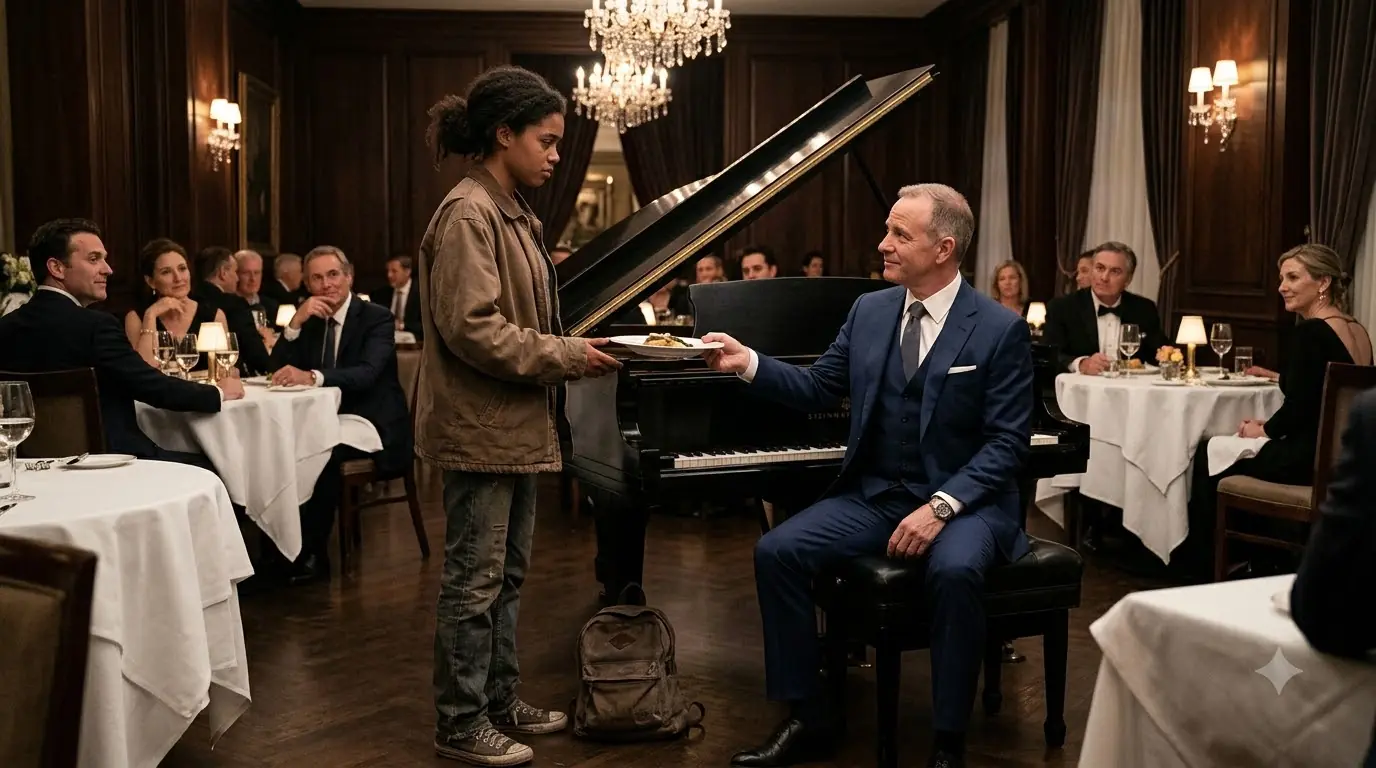
When Richard attempts to stop the performance after understanding that his spectacle has turned against him, Hartford rises and orders him to remain silent.
Emma finishes to absolute stillness.
Then the entire room rises.
The performance brings opportunities Emma believed had disappeared forever, but her transformation is not instantaneous. She must confront grief, shame, fear of returning to music, and the painful question of whether people now care about her talent while still overlooking thousands of others without something spectacular to reveal.
Richard faces consequences of his own, but Emma refuses to make revenge the center of her future.
Months later, she returns to a concert stage.
This time she is not playing because a wealthy man has demanded that she prove she deserves food.
She is playing because music was hers long before anyone decided whether she deserved to be heard.
And the piano that was meant to demonstrate her supposed worthlessness becomes the instrument that returns her name, her future, and her voice.
Emma Rivers had seventeen dollars and forty-two cents left in the world.
She knew because she had counted it twice that morning.
Fourteen dollars in crumpled bills rested inside the inner pocket of her backpack.
Three dollars and forty-two cents in coins sat inside an old prescription bottle because loose change made too much noise when she walked.
Seventeen dollars and forty-two cents.
Enough for several cheap meals if she was careful.
Not enough for a room.
Not enough to recover the phone service disconnected the previous week.
Not enough to buy the winter coat she would need soon.
Certainly not enough to repair a life.
Emma sat on the edge of a narrow shelter bed and pulled on the same faded jeans she had worn for four days.
The left knee had been repaired with dark thread.
The jacket hanging from the bedpost was two sizes too large because it had come from a church donation bin.
Her sneakers had once been white.
Now they were gray.
She looked at herself in the small mirror mounted above the sink.
Nineteen years old.
She looked older.
Not mature.
Tired.
There was a difference.
Her dark hair had been pulled into a loose twist, though strands had escaped around her face.
Her cheekbones had become more pronounced during the last year.
The dark circles beneath her eyes made it appear as if someone had lightly bruised the skin.
Emma reached into her backpack.
At the bottom rested a photograph.
She almost never removed it anymore.
That morning she did.
Three people stood beside a piano.
Emma at sixteen.
Her mother, Elena Rivers, on one side.
Her father, Daniel Rivers, on the other.
Her mother had one hand resting proudly on Emma’s shoulder.
Her father looked directly at the camera wearing the ridiculous grin he always wore after one of her performances.
Behind them sat the old Steinway from their apartment.
The instrument had occupied more space than their dining table.
Her mother used to joke that the piano had better furniture than the family.
Emma touched the edge of the photograph.
“Morning.”
She did not know whom she was greeting.
Her parents.
The girl she used to be.
Maybe both.
She returned the photograph to the backpack.
Then she stood.
Work.
That was the goal.
Not music.
Not memories.
Work.
For eight months, survival had trained her to make goals small enough to reach.
Find breakfast.
Find work.
Find somewhere warm.
Make it through the day.
Grand dreams were expensive.
Emma had learned to live cheaply.
Outside, Manhattan was bright and cold.
Autumn had arrived with enough wind to warn everyone what winter intended to become.
Emma walked south.
She checked restaurant windows for hiring notices.
A coffee shop manager told her they needed experience.
She had experience.
He asked for references.
Her last restaurant had closed.
He said he would call.
Emma knew what that meant.
A small grocery store said applications were online.
Emma explained she did not currently have reliable internet access.
The clerk gave her the address of a library.
She thanked him.
At another restaurant, the host looked at her jacket before she finished asking.
“No.”
Emma continued walking.
By eleven-thirty, hunger had become a steady ache beneath her ribs.
She stopped outside the Meridian Grand.
The hotel occupied nearly half a block.
Stone entrance.
Brass doors.
Valets in long coats.
A revolving glass door reflected taxis, pedestrians, and Emma herself.
She almost kept walking.
Then she saw the sign.
STAFF ENTRANCE — DELIVERIES AND EMPLOYMENT INQUIRIES AROUND SIDE
Emma walked around the building.
The service entrance was busy.
A delivery truck blocked part of the alley.
Two employees carried produce inside.
Emma approached a man with a clipboard.
“Excuse me.”
He turned.
“Yes?”
“Are you hiring?”
He looked at her.
“Department?”
“Anything.”
He frowned.