Late September, 1991. Rural Missouri. The soybean fields have gone the color of dry biscuits, and every farmer in the county is watching the sky and the calendar at the same time.
At Bell’s Farm Equipment Repair, a farmer named Harold Voss backs an old Ford tractor off a trailer and cuts the engine. Twenty years old, maybe more. Faded blue. A dent in the hood from a gate post, and a seat patched with duct tape. And it still runs. That is what makes it so hard. “It doesn’t quit,” Harold says. “It just gets weak. And it stinks.”
Mr. Bell wipes his hands on a rag. “Tell me when.” “When I pull the drill. Wheat drill, full of seed, uphill. The engine’s turning fast, but the tractor’s barely moving. Then after an hour or so, I smell something hot.” He rubs the back of his neck. “And it’s worse when it’s warm. First thing in the morning, it’s almost fine.”
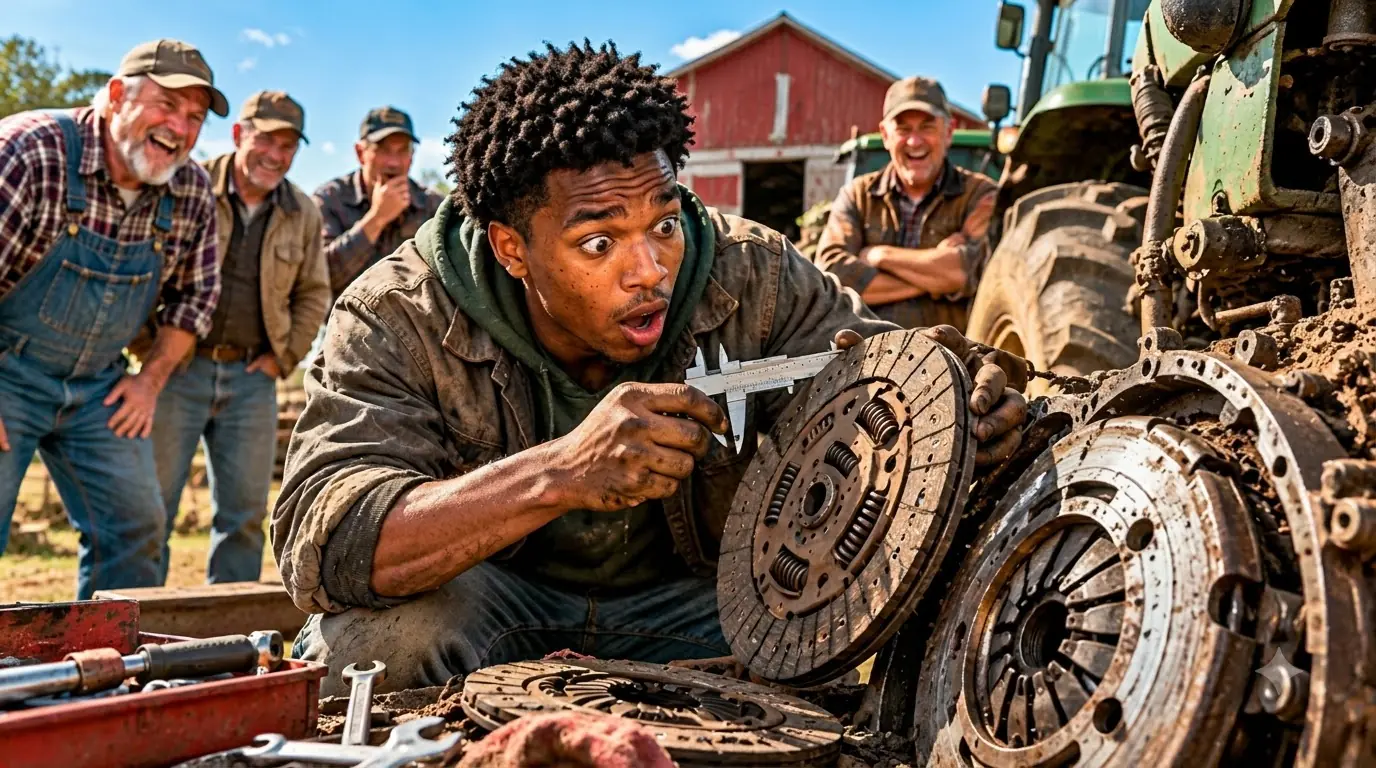
Malik Carter, sixteen years old, is standing by the parts counter with a clipboard, pretending to count filters. He is listening to every word. “My neighbor Gene says it’s the clutch,” Harold says. “And I called the dealer in town. They said, if it’s the clutch, figure on a week and a bill I don’t want to say out loud. Wheat has to be in the ground by the middle of October. I’ve got a hundred and twenty acres to drill. I can’t be sitting on my hands for a week.”
Ray, one of the mechanics, wanders over from the next bay. “Sounds like a slipping clutch to me,” he says. “Engine speeds up, ground speed doesn’t. Worse when it’s hot. Burning smell. That’s the textbook.” And here is the thing. He is right. That is the textbook. Nobody in that shop is being lazy. Nobody is being foolish. Those symptoms really do point at a worn clutch, and a clutch job is no small thing. New disc. New pressure plate. Release bearing. Probably a pilot bearing, since you are in there anyway. And on a tractor like this, the machine has to be split in two, right at the bell housing. Front half rolled away from the back half. Heavy iron. Careful work.