The first thing the Black teen noticed was that the police officer never looked at the registration for more than two seconds.
That bothered her more than the accusation itself.
He had asked for proof.
She had given him proof.
Then he acted as though the proof had somehow made her more suspicious.
She stood beside the rear quarter panel of the matte-gray Lamborghini at pump seven, one hand resting against the roof and the other holding a neat stack of documents.
Her outfit had been carefully chosen that morning.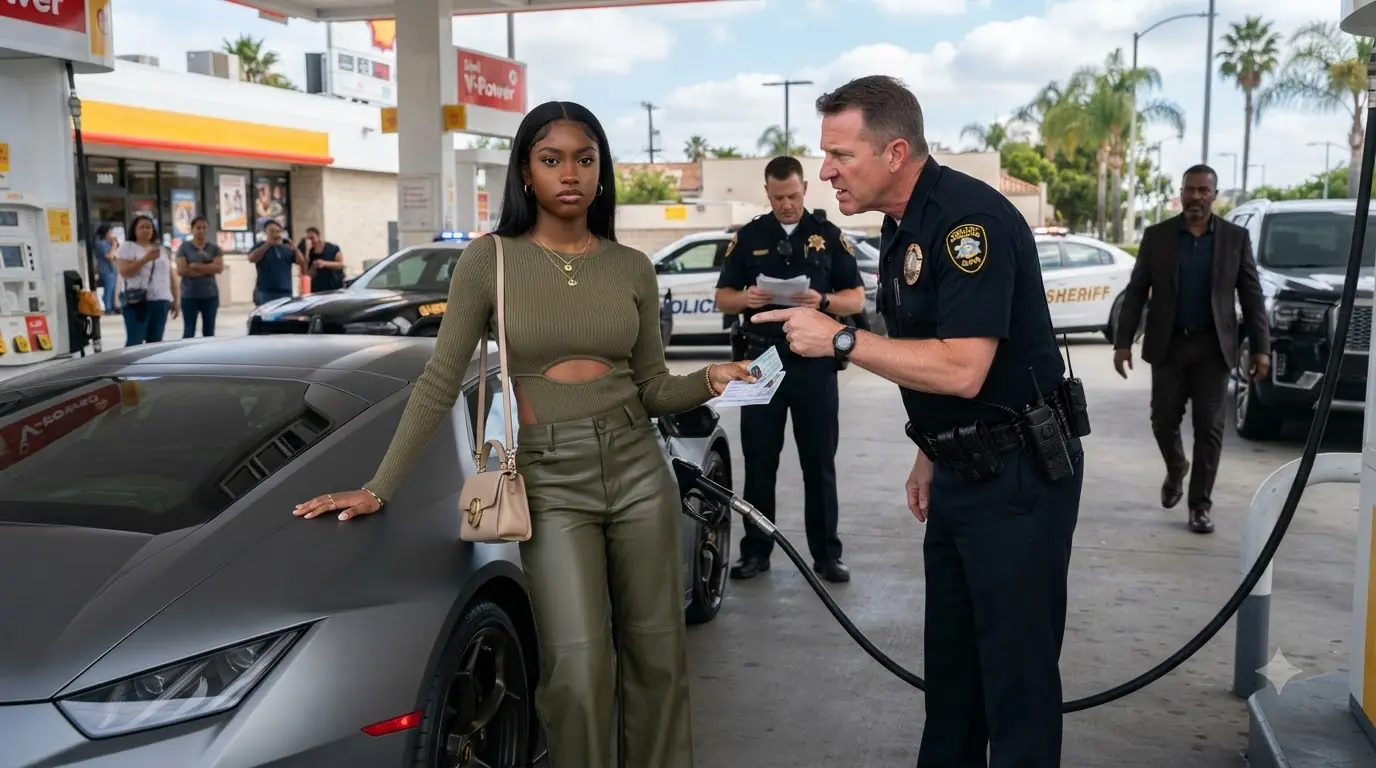
An olive-green ribbed long-sleeve top.
High-waisted olive leather trousers.
Low-profile designer sneakers.
A small beige handbag.
Nothing about the clothes had been selected for a confrontation with police.
She had been planning lunch with a friend.
Then a campus orientation meeting.
Then dinner with her father.
Ordinary things.
Now one officer stood close enough that she could smell coffee on his breath.
A second officer stood near the front of the car, looking down at the registration.
Three police cruisers were parked behind the gas station.
Customers had begun watching.
The first officer pointed toward the Lamborghini.
“You expect me to believe this is yours?”
The teen stared at him.
“I expect you to read the paperwork.”
His jaw tightened.
“You have an attitude.”
Her fingers tightened around the documents.
“No.”
“I’m getting tired of being accused of stealing my own car.”
The officer looked toward his body camera.
Then back at her.
“Your own car.”
“Yes.”
“How old are you?”
“Eighteen.”
He laughed once.
Not loudly.
Worse.
Dismissively.
The teen felt heat rise behind her face.
She had spent enough of her life around adults who disguised disbelief as humor.
Teachers asking whether her father had “really” bought the house.
Salespeople asking whether her mother wanted to approve purchases.
A restaurant host once asking whether she was “waiting for the actual reservation party” even though the reservation carried her family name.
None of those moments had involved a badge.
That changed the weight of everything.
The officer lifted her driver’s license.
“You got this six months ago?”
“Yes.”
“And now you’re driving a Lamborghini.”
“Yes.”
“You understand why that looks strange?”
The Black teen looked at him.
“No.”
He frowned.
“No?”
“I understand why it surprises you.”
“That is not the same thing.”
The second officer looked up from the papers.
“Registration is current.”
The first officer barely turned.
“That doesn’t tell us who was driving it before today.”
The second officer glanced toward the computer mounted inside the cruiser.
“VIN matches.”
The first officer’s expression hardened slightly.
“Run it again.”
The Black teen stared.
“You already ran it?”
Neither answered her.
She looked toward the body camera.
“Did dispatch say the car was stolen?”
The first officer stepped closer.
“You don’t question the investigation.”
“I’m asking whether anyone reported this car stolen.”
He pointed toward her.
“Stop.”
She stopped speaking.
Immediately.
Not because she agreed.
Because something inside her understood that from this moment forward every movement mattered.
Her father had taught her that.
Not because he expected trouble.
Because he hated ambiguity.
“Documents first.”
He said it about business.
Cars.
Contracts.
Travel.
Insurance.
“If something goes wrong, facts should already exist before people start arguing.”
She had rolled her eyes when she was younger.
Now she was standing beside a six-figure car while an officer treated valid registration like an obstacle.
Suddenly her father’s obsession with paperwork felt less annoying.
The second officer walked toward them.
“VIN comes back clean.”
The first officer looked at him.
“No theft entry?”
“No.”
“Recent report?”
“Nothing.”
The teen heard every word.
The first officer turned toward her.
“Who bought the car?”
“My father.”
“For you?”
“Yes.”
“Why?”