“Get that rust bucket out of here, old man.”
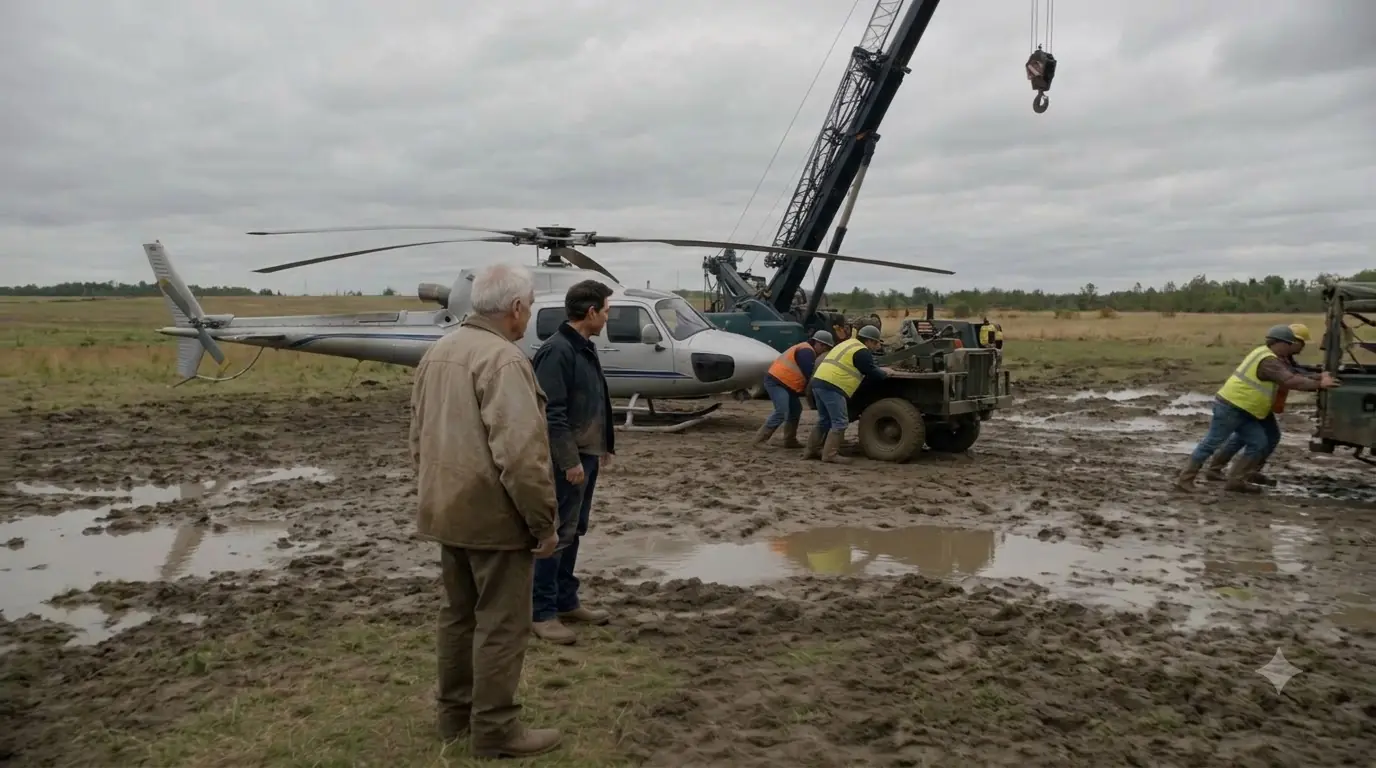
Merrick Sable’s voice carried across the pasture sharply enough that two men beside the disabled crane stopped talking. He stood twenty yards from a silver corporate helicopter worth more than every house in Kestrel Valley combined, his expensive flight jacket streaked with gray mud and his polished boots already ruined. The aircraft sat crooked in the middle of Orson Kettner’s lower field, both skids buried deep enough that only their upper tubes remained clearly visible. One side had settled farther than the other, giving the fuselage a slight but unmistakable lean. A rescue crane had tried to reach it that morning and now sat useless near the edge of the field, its left outrigger sunk into saturated ground despite two layers of timber cribbing beneath it.
Orson Kettner ignored Merrick.
He shut off the engine of the machine Merrick had just insulted.
It was a 1945 Diamond T 969A military wrecker, an olive-drab six-wheel truck built during the final years of the Second World War. Most of its original paint had disappeared beneath seventy-nine years of sun, grease, welding scars, and carefully brushed-on patches of primer. The hood carried three dents. One fender had been repaired with steel Orson cut from an old grain bin in 1987. Its heavy recovery boom had not lifted military trucks in decades, but the winch still worked, the transfer case still shifted, and the engine still settled into the same slow mechanical rhythm Orson had heard since his father bought the machine at a government surplus sale.
To Merrick Sable, it looked like scrap.
To Orson, it was simply a tool.
He climbed down from the cab.
At seventy-two, Orson moved more slowly than the men from the professional recovery company, but nothing in his movements suggested uncertainty. He wore a canvas chore coat, mud-darkened work pants, and boots whose soles had been replaced twice. His hair had gone white around the ears, and his face carried the permanent lines of someone who had spent most of his life outdoors looking into weather.
Merrick stepped toward him.
“Did you hear me?”
“Yes.”
“Then why are you still here?”
Orson looked past him.
At the helicopter.
At the crane.
At the depressions left by the crane’s support mats.
At the water shining along the edges of those depressions.
Then he looked toward the low ridge on the western side of the pasture.
“Because you’re working from the wrong ground.”
Merrick stared.
Behind him, Vance Harlan, supervisor of the aircraft recovery contractor, turned his head.
Vance had spent twenty-eight years moving wrecked machinery from places machinery had no business being. Aircraft, buses, loaded trucks, construction cranes. He was fifty-five, heavyset, careful, and increasingly unhappy about the pasture beneath his boots.
“What ground?” he asked.
Orson pointed toward the ridge.
“There.”
Vance looked.
All he saw was wet grass and a line of old cottonwoods.
“We probed that side yesterday.”
“Where?”
Vance indicated a point near the lowest cottonwood.
Orson shook his head.
“Too far south.”
Merrick folded his arms.
“You’ve got a fifteen-million-dollar aircraft sitting in mud, professional recovery equipment already here, and now we’re discussing which patch of cow pasture looks better to a man driving something from 1945.”
Orson looked at him for the first time.
“You want the helicopter out?”
“Obviously.”
“Or do you want it airworthy afterward?”
Merrick’s mouth tightened.
“Both.”
Orson nodded toward Vance.
“Then let him do his job.”
He began walking toward the western ridge.
For several seconds, nobody followed.
Then Vance did.
The night before, none of them had expected to meet Orson Kettner.
Merrick Sable’s helicopter had been traveling northeast toward Bozeman when the weather deteriorated faster than forecast. He was forty-eight years old, founder and executive chairman of Halcourt Ventures, a technology and infrastructure investment firm whose name appeared on office towers, logistics companies, renewable-energy projects, and financial-news broadcasts. He was not a fool. He had built a real company from a modest start and had spent twenty-five years becoming extremely good at decisions measured in millions of dollars.
That had also given him a dangerous habit.
When a problem appeared, Merrick expected scale to solve it.
More engineers.
More equipment.
More money.
More pressure.
Most of his world rewarded that instinct.
Weather did not.
The pilot, Captain Daniel Reeves, had nearly twenty years of rotorcraft experience. When a mountain storm pushed visibility below his personal minimum and severe wind forced him away from the intended route, Daniel did exactly what a good pilot was supposed to do.
He abandoned the schedule.
He searched for somewhere safe to land.
The Kettner pasture looked suitable from the air.
Long.
Open.
No power lines.
No livestock near the center.
No visible standing water.
Daniel performed a cautious precautionary landing rather than gambling the aircraft against worsening visibility.
The helicopter touched down normally.
For approximately ten seconds, nothing happened.
Then the left skid began settling.
Daniel felt the tilt immediately.
He reduced power smoothly.
The right side sank next.
By the time the rotor stopped, both skids were embedded in soil that had looked firm from fifty feet above.
Kestrel Valley had received more than two inches of rain over the previous thirty-six hours. The surface layer had remained deceptively intact, protected by dense pasture grass. Beneath it lay saturated clay over a less permeable subsoil.
Locals called it gumbo.
Not because it possessed mystical suction capable of overpowering helicopters.
Because once disturbed while saturated, it became heavy, slick, adhesive, and nearly useless for carrying concentrated loads.
A cow could cross it.
A pickup might cross carefully.
A multi-ton aircraft resting on narrow skid tubes concentrated its weight very differently.
Orson had been feeding cattle on the upper ground when the helicopter landed.
He drove down in his pickup after the rotor stopped.
Daniel met him halfway.
“Your property?”
“Yes.”
“I’m sorry. We had weather.”
Orson looked at the aircraft.
“Everybody all right?”
“Yes.”
“Then you made a good landing.”
Daniel visibly relaxed.
Emergency services had already been informed. Nobody was injured. There was no fuel leak. No fire. No immediate danger.
Merrick emerged next.
“What’s the nearest paved road?”
“Four miles.”
“Nearest airport?”
“Twenty-seven by road. Less by air.”
Merrick looked toward the helicopter.
“We’ll be back in the air before then.”
Daniel did not answer.
That was the first disagreement.
The second came when Merrick wanted the engines restarted the moment the rain weakened.
Daniel refused.
“The left skid settled deeper.”
“So use power and lift vertically.”
“No.”
“Why?”
“Because I don’t know whether both skids will release together.”
Merrick looked toward Orson as though expecting rural geography to support him.
Orson said:
“Pilot’s smarter than you about helicopters.”
Daniel almost smiled.
Merrick did not.
The risk was not that mud somehow exceeded the engine’s horsepower.
The aircraft might have had enough lift to break free.
The danger was uneven release.
One skid might remain partially trapped while the other rose, creating a rapid roll tendency close to the ground. Mud and debris could also be thrown into areas where nobody wanted them once rotor wash increased. Daniel had no intention of improvising with an aircraft whose manufacturer provided specific recovery and inspection guidance.
So they waited.
Merrick spent the night in a guest room at the Kettner farmhouse because the county motel was full with a high-school wrestling tournament.
That fact alone seemed to offend him.
Orson gave him clean towels.
Said breakfast was at six.
Then went to bed.
By dawn, Merrick had made eight calls.
A professional recovery crew was already moving toward the valley.
They arrived shortly after eight with a heavy wrecker, support vehicles, composite access mats, rigging, pumps, and a mobile crane subcontracted from a regional company.
They also brought Vance Harlan and an FAA-certified aircraft mechanic named Rachel Kim.
Rachel inspected the helicopter before anyone touched it.
No visible structural failure.
No leaking fuel.
No obvious skid-tube deformation.
But nobody could properly inspect buried surfaces until the aircraft was removed.
The recovery plan began conservatively.
Reduce unnecessary weight.
Remove baggage.
Pump down fuel only as required and safely possible.
Build access.
Stabilize the aircraft.
Use approved lifting and attachment points.
Raise it just enough to get suitable support beneath the skids.
Then move it to prepared ground for inspection.
The plan was good.
The pasture was not.
The first set of mats supported the lighter service trucks.
The crane was different.
As the boom extended, outrigger loads concentrated through pads and matting. The saturated subgrade compressed unevenly beneath them. One mat shifted. Another settled.
Vance stopped the operation before the crane became unstable.
That was not failure.
That was competence.
But Merrick did not experience it that way.
He experienced only delay.
At ten fifteen he asked whether they needed a larger crane.
Vance said:
“No.”
“At ten thirty he asked if a tracked machine would work.”
“Maybe for access. Not automatically for the lift.”
“At eleven he suggested helicopters had been recovered from jungles and mountains and therefore there had to be a way to lift one from a pasture.”
Vance answered:
“There is. We’re trying to avoid turning one stuck aircraft into two damaged machines.”
By noon, Merrick’s assistant Clara had rescheduled three meetings.
The meeting Merrick cared about most was the following morning in New York, where Halcourt’s board expected to review final terms of an acquisition that had consumed eight months.
He could fly commercially.
He could charter another aircraft.
He could drive.
None of those facts improved his mood because the helicopter itself had become a symbol of the problem.
It was expensive.
Powerful.
Sophisticated.
And helpless in mud.
Then one of Orson’s neighbors mentioned the old Diamond T.
Vance asked about it.
Orson said it ran.
“Winch?”
“Runs.”
“Boom?”
“Runs.”
“Anchor capacity?”
“Depends where you put the truck.”
That answer interested Vance.