The first time Earl Bennett came to my house, there was snow on his shoulders.
Not much.
Just a thin dusting across the leather vest, gray hair, and enormous beard of a man who looked as though winter should have been afraid of him instead of the other way around.
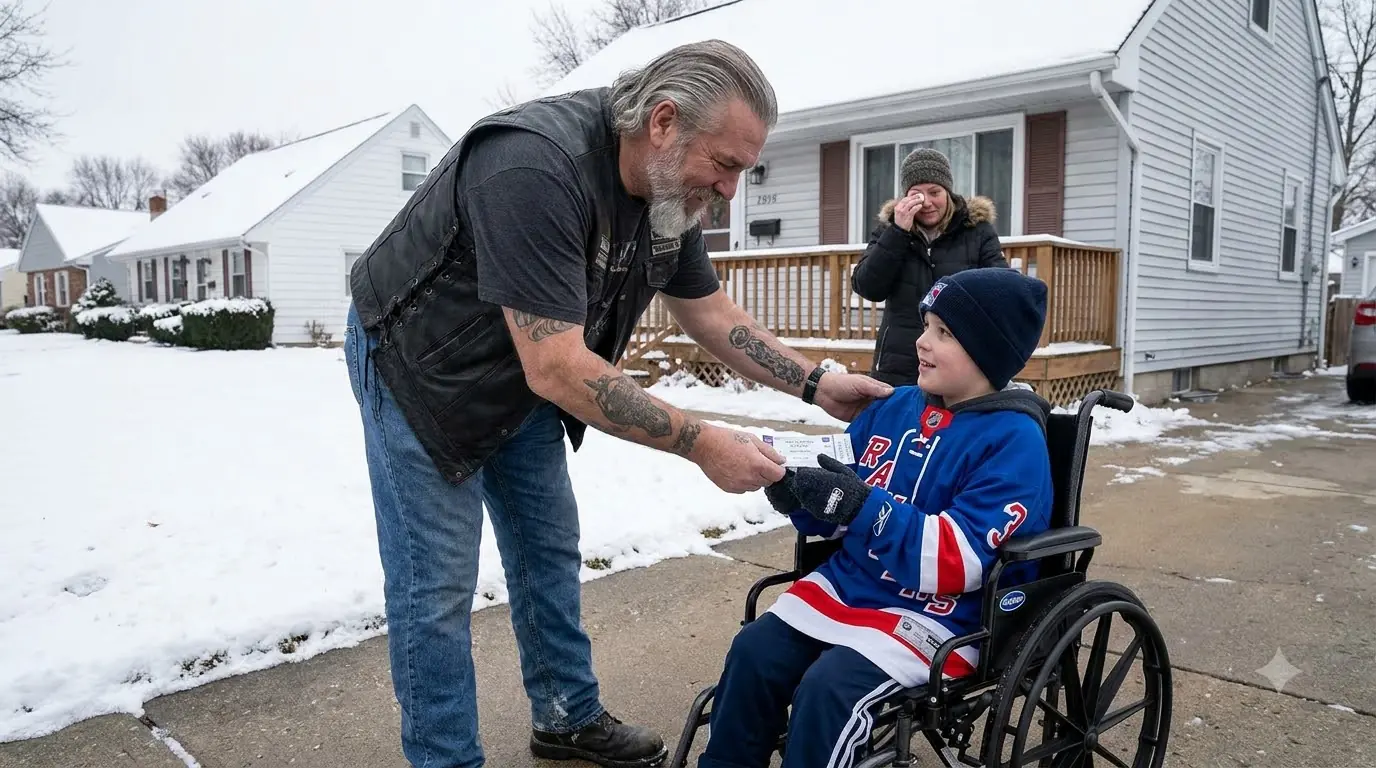 He stood beneath my porch light holding two hockey tickets.
Behind him, parked at the curb, was a black touring motorcycle surrounded by dirty snowbanks.
I opened the door only halfway.
"Can I help you?"
His eyes moved past me toward the hallway.
"Caleb home?"
Every instinct I had as a mother tightened.
My son was eight years old.
This stranger looked at least sixty.
He had tattooed forearms, heavy boots, faded jeans, and more patches sewn onto his vest than I could count.
I kept one hand on the door.
"Who are you?"
"Earl."
That was apparently the entire introduction.
I waited.
He cleared his throat.
"Earl Bennett."
"How do you know my son?"
"Train station."
That did not improve things.
I stared at him.
Earl noticed.
His rough face softened slightly.
"Your boy and his therapist came off the afternoon train Tuesday."
I remembered.
Caleb had physical therapy in Manhattan twice a month.
Normally I drove him, but snow had made traffic terrible, so his therapist, Megan, had suggested using the commuter line home.
Earl continued.
"He had that Rangers hat on."
My eyes dropped to the tickets.
"What happened at the station?"
"Nothing bad."
He glanced over my shoulder again.
"We talked hockey."
That sentence surprised me enough that I opened the door another inch.
Caleb had not talked hockey with me in almost two years.
Before the accident, hockey had been one of the only things he wanted to talk about.
The Rangers.
Players.
Scores.
Goalies.
Equipment.
He had been six years old when he began begging me to let him join a youth league.
His father and I had finally agreed.
Then everything changed.
A drunk driver crossed the center line one rainy November evening.
Our SUV spun into a guardrail.
I broke my wrist.
Caleb's father escaped with bruises.
Caleb suffered damage to his spinal cord.
The doctors eventually explained it as clearly as they could.
He had movement and strength above the injury.
Below it, his body would not work the way it had before.
He would use a wheelchair.
Maybe medicine would change someday.
Maybe technology would change.
But we needed to build his life around what was real now.
Caleb was six.
How do you explain forever to a six-year-old?
We told him he was alive.
We told him he was strong.
We told him he was still Caleb.
All true.
None of it answered the question he asked after the doctor left.
"So I can't play hockey?"
His father turned away.
I sat beside him.
"We're going to figure out what you can do."
Caleb looked at his legs beneath the hospital blanket.
"That's not what I asked."
He was six years old.
And somehow he understood immediately that adults sometimes answered the question they wished a child had asked instead of the one that hurt too much to answer.
"No," I whispered.
"Not the same way."
He nodded once.
Then turned toward the window.
For months afterward, he refused to watch hockey.
We took the Rangers posters down because he asked us to.
His little stick went into the garage.
His skates stayed inside a cardboard box.
The blue jersey he had once worn nearly every day disappeared into the back of his closet.
Caleb learned wheelchair skills.
He learned transfers.
He learned how to move around school.
He learned which ramps were too steep.
Which doors were too heavy.
Which classmates helped naturally and which ones helped in a way that made him feel like a baby.
He learned everything adults praised him for learning.
But something in him became quieter.
At first I assumed it was part of healing.
Then a year passed.
Caleb smiled less.
He stopped asking friends to come over.
Birthday parties became something he tried to avoid.
If another child complained about running laps at school, Caleb's face would change.
If a hockey commercial appeared on television, he changed the channel.
His therapist said grief could look different in children.
Sometimes angry.