By the time the sun came up on the morning Elias Marsh lost his water, the cattle had already stopped walking toward the trough.
Animals learn disappointment faster than people.
The twenty-three head standing along the fence did not bellow or pace.
They simply waited.
Heads low.
Flies moving around their eyes.
Their bodies angled toward the pipe that had fed the pasture for longer than Elias had been alive.
Nothing came.
Elias stood at the head gate with both hands resting on the top rail.
Across from him, a county water employee looped a chain around the valve assembly and snapped a new padlock shut.
The man did not look proud of it.
He did not look ashamed either.
He checked a clipboard.
“Temporary conservation reallocation.”
Elias stared at the lock.
“Temporary.”
“Yes, sir.”
“How temporary?”
The employee shifted.
“Depends on conditions.”
“What conditions?”
“Basin levels.”
“That ditch has run onto this farm since my grandfather was here.”
“I understand.”
“No, you don’t.”
The man finally looked at him.
Elias immediately regretted the sharpness.
The employee had not written the policy.
He had only been sent to close the gate.
“Sorry.”
The man nodded.
“County office can explain the appeal process.”
He climbed into a white truck that still carried a dealership sticker in the rear window.
Elias watched him drive away.
Two hundred yards uphill, an old stone springhouse sat collapsed beneath weeds and blackberry vines.
Nobody had used it in decades.
His grandfather had insisted they leave it alone.
Elias had never asked enough questions about why.
He was thinking about the cattle now.
Not ruins.
Not history.
Water.
Forty acres.
Twenty-three cattle.
A vegetable patch his wife maintained behind the house.
Two fields of alfalfa that had already begun curling at the edges.
Numbers.
Everything had become numbers.
How many gallons.
How many days.
How much diesel.
How many cattle could be sold without damaging the herd permanently.
How late could the mortgage payment become before the bank called?
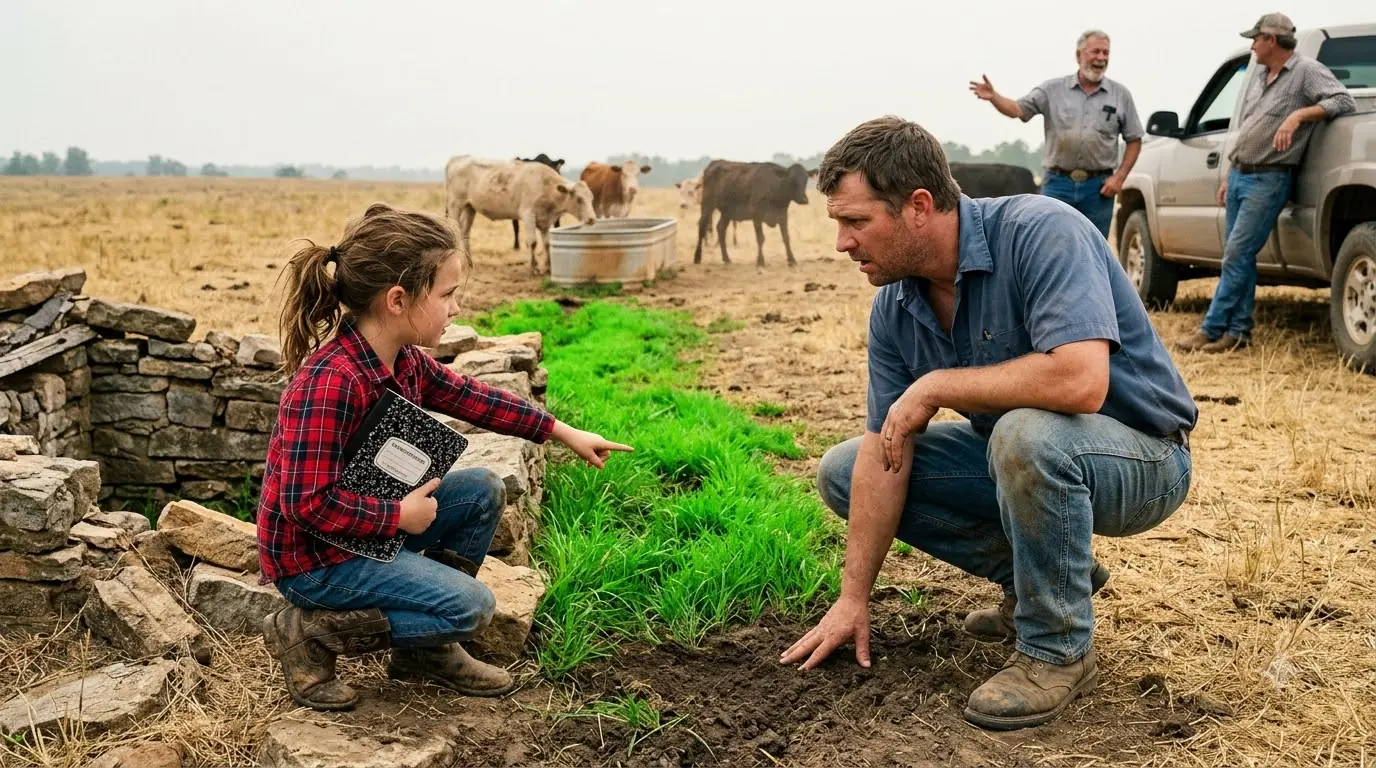
Behind the springhouse, his eight-year-old daughter Ren crouched in weeds with a composition notebook balanced on one knee.
Elias did not notice her.
She noticed almost everything.
The strip of grass near the old stones was still green.
Not healthy summer green.
Nothing looked healthy after six weeks without meaningful rain.
But compared with the straw-colored pasture surrounding it, the difference was obvious.
Ren pressed one finger against the page and wrote:
Grass by old stones still green.
Then underneath:
Cows keep looking there.
She closed the notebook.
Elias called from the fence.
“Ren!”
She stood.
“Coming!”
She ran downhill.
The notebook bounced against her side.
Elias looked toward the cattle.
“Stay out of the lower field today.”
“Why?”
“No water.”
“There’s water.”
He looked at her.
“Not enough.”
“No.”
She pointed toward the ruined springhouse.
“There.”
Elias sighed.
“That’s old mud.”
“It isn’t mud.”
“Ren.”
“The ground’s green.”
“Grass does that sometimes.”
She frowned.
“Not when everything else is dead.”
Elias looked at the strip.
He saw it.
Of course he saw it.
But adults are good at seeing things without having enough energy left to make them important.
“Come on.”
He started toward the house.
“Your mom needs help.”
Ren followed.
Then looked back.
The cattle remained near the same corner of fence.
By evening, Garrett Voss arrived.
He did not drive to the house.
Garrett rarely did anything that suggested intimacy if a property line would serve the purpose better.
His black pickup stopped beside the fence.
Engine running.
Window down.
Elias walked over.
Garrett was fifty-two, broad, clean-shaven, wearing a pale work shirt with sleeves rolled exactly twice.
His family owned nearly seven hundred acres around the basin.