The first man laughed when he saw the jars.
Not a polite laugh.
Not the kind people used when they wanted to soften disagreement.
He leaned both forearms against the old wooden fence, pointed toward the row of glass jars glowing red beneath the late-afternoon sun, and laughed loudly enough that the other two farmers beside him joined in before they even knew what he found funny.
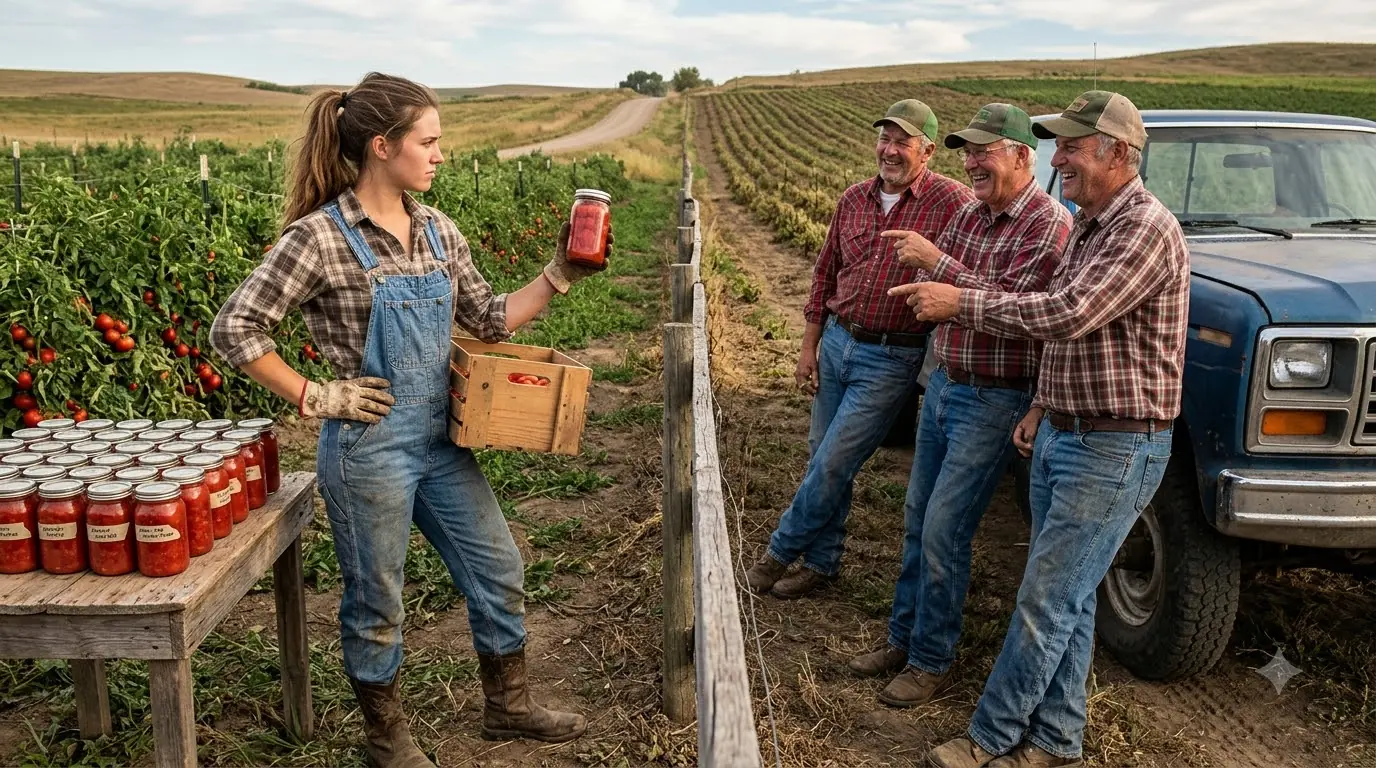
The Farm Woman kept walking.
A wooden tomato crate rested against one hip.
Her blue denim overalls were streaked with dry mud from the knees down, the sleeves of her brown-and-cream plaid shirt had been rolled to her elbows, and loose strands of dark brown hair had escaped from the ponytail at the back of her head.
She was tired.
Too tired to give three grown men the reaction they clearly wanted.
The first farmer called across the fence.
“Look at all that.”
The Farm Woman continued toward the packing table.
The second farmer pointed toward the jars.
“You spent half a year growing tomatoes from mystery seeds just so you could put them in glass?”
The third man laughed.
“You know stores sell those, right?”
The Farm Woman placed the wooden crate on the table.
The tomatoes inside were dense, deep red, heavy for their size.
Thirty-one sealed jars stood behind them.
Not every tomato had been canned.
Those were only the surplus.
The fresh harvest had already fed the household, filled produce boxes, and supplied two small market deliveries.
The men did not know that.
They were not interested in asking.
The first farmer slapped the fence.
“You could’ve bought nursery starts in April and saved yourself four months of babysitting seedlings.”
The Farm Woman picked up another crate.
She did not turn around.
The second farmer raised his voice.
“You hear us?”
“Yes.”
That stopped them for half a second.
The oldest grinned.
“And?”
The Farm Woman finally turned.
Her expression was flat.
Calm.
No smile.
No embarrassment.
No anger visible enough to reward them.
Behind her, crooked tomato rows stretched toward the old barn.
The rows looked wrong to anyone accustomed to commercial symmetry.
Some plants stood farther apart.
Others shifted slightly left or right instead of forming one perfectly clean line.
The spacing widened where prevailing summer winds crossed the property.
Near the barn, where airflow changed, the pattern tightened.
To people who did not know why, it looked careless.
That had been the joke since spring.
The oldest farmer pointed again.
“Still planting crooked.”
The Farm Woman removed one glove with her teeth.
“Still watching.”
The two other men laughed.
The oldest farmer narrowed his eyes.
“Those rows look like somebody planted them after three beers.”
The Farm Woman picked up one jar.
Sunlight passed through it, illuminating thick red tomato pieces in their own juice.
She walked toward the fence.
The farmers stopped laughing only when she placed the jar on the top rail between them.
“Then explain something.”
The oldest farmer looked at the jar.
“What?”
The Farm Woman pointed past them.
Not at her own field.
At theirs.
Their tomato acreage stretched across the road.
The rows were perfectly straight.
Uniform spacing.
Nursery-bought plants.
Identical varieties.
The kind of crop that photographed beautifully from the road.
Until someone looked closer.
Dark lesions marked leaves near the bottom of dozens of plants.
Yellowing moved upward along stems.
Some rows had already lost almost half their lower foliage.
At the far end, several plants stood nearly bare.
The oldest farmer’s smile faded.
The Farm Woman said:
“Your rows are straight.”
Nobody answered.
She continued.
“Your starts were bigger.”
No response.
“You planted earlier.”
The second farmer shifted his weight.
“You sprayed twice.”
The first farmer’s jaw tightened.
The Farm Woman tapped the lid of the jar with one finger.
“And I’m still filling these.”
The oldest farmer looked toward her field.
Then back to his.
“You got lucky.”
The Farm Woman nodded once.
“Maybe.”