“Put the paddle down, sweetheart,” Randall Pritchard said into the microphone, and his voice rolled through the old livestock barn from two speakers bolted high above the rafters. A few farmers laughed, not cruelly at first, but with the easy amusement adults sometimes used when a child wandered into a conversation they assumed was too complicated for her. Eleven-year-old May Cutler sat in the third row with her faded bidder paddle still raised, brown hair tied behind her neck with a red shoelace because she had lost her ribbon before breakfast. Her boots did not reach the concrete floor, but the small green cash box resting in her lap was heavy enough to remind her why she had come.
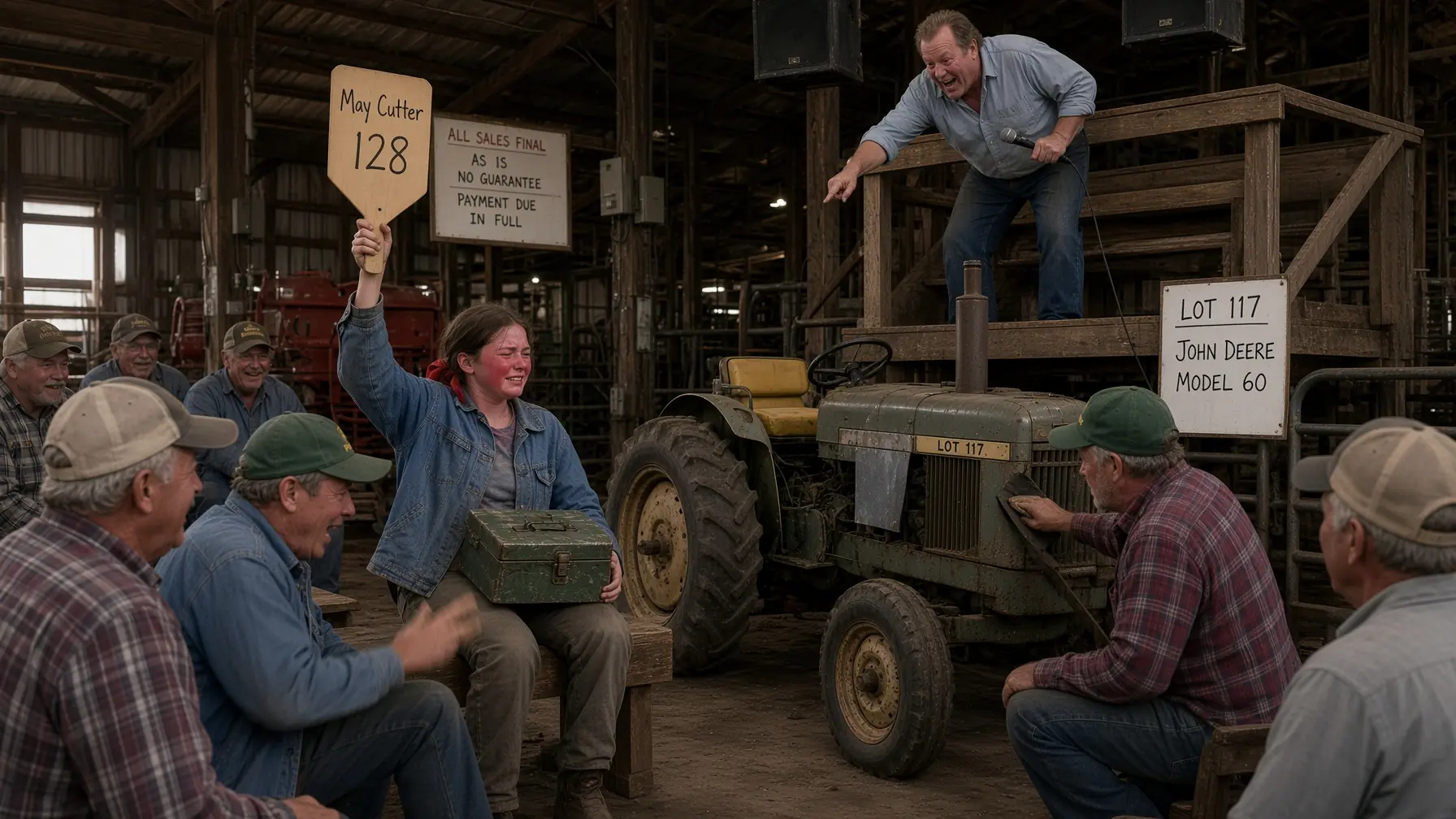
Inside that box was almost every dollar May had managed to save during the previous three years. There was county-fair prize money, birthday cash from relatives, twenty-dollar bills earned mucking stalls, five-dollar bills from washing eggs at Mrs. Talley’s farm, and coins she had rolled herself at the kitchen table until her fingers smelled like metal. The total was $2,843, a number May knew without looking because she had counted it so many times that the digits felt almost like part of her name. Her mother had made her promise that whatever happened at the auction, she would not spend every dollar simply to prove she was right.
At the far end of the barn stood the reason she was having difficulty keeping that promise. Lot 117 was a battered John Deere tractor whose green paint had faded into the dull color of an old army blanket, with rust spreading across both rear fenders and yellow foam pushing through a split seat. One front tire sagged nearly flat, the exhaust stack leaned slightly toward the hood, and a rectangular piece of newer sheet metal had been crudely fastened over part of the left side panel. The auction catalog described it with almost insulting simplicity: JOHN DEERE MODEL 60, NON-RUNNING, PARTS OR RESTORATION, YEAR UNKNOWN, SOLD AS-IS.
Most of the men in the barn had already inspected it and moved on. The engine was seized, the carburetor was missing, one rear wheel wore the wrong rim, several gauges were broken, and grease had hardened around the engine block until parts of the frame looked almost black. According to the estate records, the tractor had spent seventeen years inside a collapsing equipment shed belonging to the late Everett Pike, a farmer who accumulated machinery faster than he repaired it. Nobody expected Lot 117 to become the most interesting thing sold that day, and certainly nobody expected an eleven-year-old girl to be the person who made it interesting.
Randall lowered his microphone and looked directly at May. “Maybe you’re holding your daddy’s number,” he said, and the laughter returned when May shook her head and answered, “No, sir.” He asked whether she was bidding for a grandfather, uncle, or neighbor, but every question received the same calm answer until Randall finally asked, “Then whose bidder number is that?” May held the paddle a little higher and said, “Mine.”
Across the aisle, Harvey Sloan leaned back in his chair and studied her. Harvey owned six hundred acres outside Briar Glen, had been farming longer than May’s father had been alive, and possessed the thick hands and permanent squint of someone who had spent most of his adult life repairing things outdoors. “What are you planning to do with that thing, little lady?” he asked, expecting a cute answer. May looked at the tractor instead of Harvey and said, “Buy it.”
The room erupted harder this time. Someone behind May whispered that the kid probably wanted a lawn ornament, while another man suggested she could plant flowers in the engine compartment if the block was too far gone to rebuild. May’s cheeks burned, but she had expected the laughter and decided before arriving that it would not change what she knew. She had come for one tractor, and if she left without it, three months of reading, crawling through grease, and secretly comparing old photographs would have been for nothing.
The bidding had opened at five hundred dollars because Everett Pike’s estate simply wanted the machine removed. Two parts dealers pushed it to eight hundred, then dropped out when one of them decided the rear housing was too questionable to justify hauling it forty miles. Randall called nine hundred and looked for another hand. May raised her paddle.
Randall stopped. “One thousand dollars?” he asked, as though May might have misunderstood the amount, and May answered, “Yes, sir.” He stared toward the registration table, where a clerk checked the paperwork and gave him a small shrug because May had registered properly with her mother’s written authorization and the bidder number was valid. Randall lifted the microphone again and announced, “One thousand dollars from our youngest bidder today, and does anybody want to save this child from a very expensive mistake?”
Harvey Sloan raised two fingers. “Eleven hundred,” Randall called, and the barn relaxed because an adult had finally restored order. May answered twelve hundred before Harvey finished lowering his hand. Harvey looked across the aisle, and for the first time he stopped smiling.
He bid thirteen. May said fourteen. Harvey bid fifteen, May answered sixteen, and the easy laughter in the barn began thinning into murmurs because children might impulsively bid once, but May was moving with the certainty of someone who had decided exactly how far she intended to go. Randall asked her again whether she understood the tractor did not run, and May replied, “I understand.”
Harvey leaned toward his older brother, Dennis, who had inspected the tractor that morning. “Block?” Harvey whispered, and Dennis answered that the engine was seized hard enough that they had not been able to rotate it. Harvey asked about the hydraulics, rear end, and transmission, but every answer ranged from questionable to bad. “Then why is the kid bidding?” Harvey asked, and Dennis shrugged.
Seventeen hundred came from Harvey. May answered eighteen. Harvey increased by fifty dollars rather than a full hundred, testing her, and May immediately moved to nineteen hundred.
Two men stood from the back row and walked toward Lot 117. May saw them go and felt the first real wave of fear that morning, not because she believed they wanted the tractor for themselves, but because attention was the one thing she had hoped to avoid. She had spent the previous afternoon beneath that machine after most buyers had left the preview yard, using a rag, flashlight, notebook, and everything her father had taught her about old equipment. If one experienced collector began looking in the right place, the room might stop laughing very quickly.
Harvey raised to two thousand dollars. May’s fingers tightened around the wooden paddle. Her mother’s limit had been twenty-four hundred, though May had never explained exactly how she arrived at that number or why spending any amount on Lot 117 seemed reasonable in the first place. “Twenty-one hundred,” she said.
Randall finally stepped away from the microphone. “May, I need you to understand something,” he said, using the patient tone adults often chose when they believed patience could disguise condescension. “This machine may need more money in repairs than it will ever be worth, and when that hammer falls, there are no refunds because you changed your mind.” May looked at him and said, “I know.”
“Then why do you want it?” Randall asked. Every face nearby seemed to turn toward her, and May felt the small spiral notebook inside her denim jacket pressing against her ribs. Her mother had given her one instruction about that question. “Don’t tell anybody what you think until the tractor belongs to you,” Rachel Cutler had said, because information at an auction had a way of becoming everybody’s information the moment it became valuable. May swallowed and answered only, “Because I want it.”
The laughter came back, but Harvey did not join it. He stood and walked toward the tractor while Randall sighed about inspection time already being over. Harvey did not open anything or remove parts, merely crouched beside the frame and wiped at an exposed patch with his thumb. May stood without realizing she had done it.
Harvey moved to the other side. Wrong place, May thought, trying not to watch too obviously. Then he stepped around the rear wheel, crouched again, and pulled a rag from his pocket.
May’s stomach tightened. Harvey wiped grease from one metal plate, leaned closer, and stared at something for several seconds. When he returned to his seat, his expression had changed, though not enough for May to know exactly what he had seen.
“Twenty-two,” Harvey said. May answered twenty-three.
The room went quiet again. Harvey studied her face, then looked back toward the tractor, and May wondered whether he knew enough to push harder or merely suspected enough to become dangerous. After several seconds he smiled faintly and lowered his hand. “I’m done.”
Randall raised the microphone. “Twenty-three hundred going once.” May exhaled for the first time in what felt like an hour.
“Twenty-four hundred,” a voice called from the rear. May turned and saw Leonard Price standing beside the aisle.
Leonard owned a used-equipment dealership two counties east and had spent the morning buying tractors that actually ran, which made his sudden interest much worse than Harvey’s. He had ignored Lot 117 during preview, but dealers were skilled at recognizing when somebody else had discovered value they had missed. Leonard did not need to know what May knew; he only needed to believe her certainty had a reason.
Twenty-four hundred was May’s limit. Rachel had made her repeat it three times before leaving home, then looked her directly in the eyes and said, “Do not spend every dollar you have because you’re afraid somebody will think you were wrong.” May had promised. She looked at Leonard, then at Lot 117, then down at the green cash box in her lap.
Tucked beneath the bills was an old photograph. It showed May at six years old sitting on the rear tire of a different tractor while her father, Daniel Cutler, leaned beside her with grease covering both hands and a grin stretching across his face. Daniel had died eighteen months earlier after an illness that moved so quickly the family still sometimes spoke about him in the present tense by accident. May touched one corner of the photograph with her thumb.