A few weeks in, a farmer named Curtis Hale came by expecting to buy weights. He had heard about Grady’s tractor and assumed his own sluggish planter pass meant the same fix. Malik ran the same test. The slip numbers came back close to what the guidance called normal for that tractor and implement. The tires, on the other hand, were underinflated for the load they were carrying.
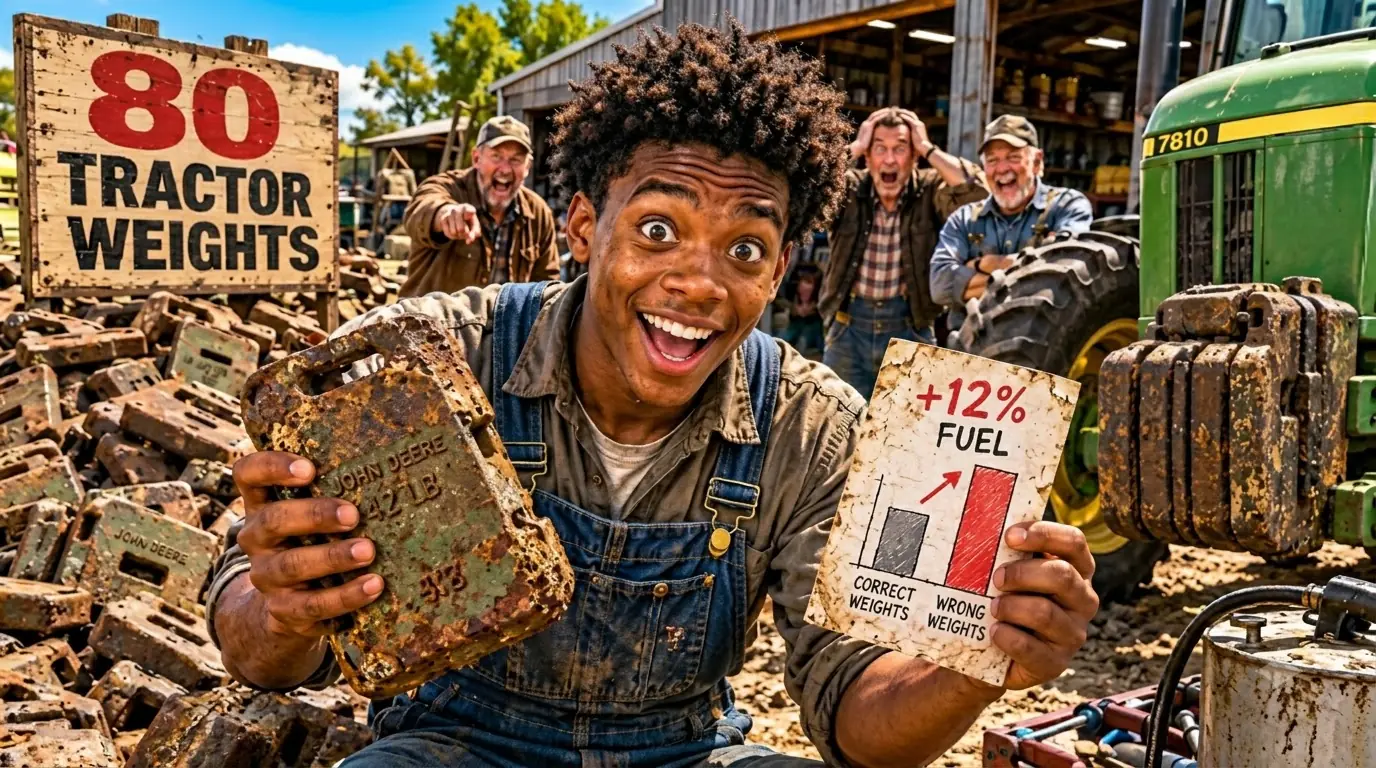
“You don’t need any of my weights,” Malik told him. “Your ballast is already in range. Your tires are running low for what they’re carrying. Fix the pressure and see how it pulls.” Curtis looked skeptical, since he had driven out expecting to buy iron, but he adjusted the tire pressure to the chart’s recommendation. The next pass showed a clear improvement. “If the measurement says you don’t need another pound,” Malik told him, “I’m not selling you another pound.”
Not every one of the eighty weights found a home. A handful were sized for models nobody around there ran anymore, and those eventually went to the scrapyard, same as Roy had figured from the start. Over the following seasons, a fair share of the rest found their way onto tractors where the measurements actually called for them. The remainder sat as inventory, useful only when a farmer’s numbers pointed that direction.
A few weeks after Curtis’s visit, an older farmer named Wendell Price pulled in towing a brand-new field cultivator, bigger than anything he had run before. Wendell had been one of the ones who laughed months earlier at a sixteen-year-old hauling three tons of scrap iron behind Otis Bell’s shop. He climbed down and looked at Malik. “Got myself a new implement,” he said. “How much weight you think this tractor of mine needs to handle it right?”
Malik wiped his hands on a rag, the way he had watched Otis do a hundred times, and thought about it before he answered. “I don’t know yet,” he said. “Let’s measure what it’s doing.”
Because that was the real lesson sitting behind Otis Bell’s shop the whole time, buried in a pile of iron nobody wanted. A weight fitting a tractor never told you whether that tractor needed it. Only measuring what the tractor was actually doing under load could tell you that. Malik had not made any tractor stronger, and he had not found some way to squeeze extra horsepower out of an old diesel engine. He had learned how to find out when a tractor was wasting part of the power it already had, spinning its wheels against dirt instead of putting that power to work, and how to leave the tractor alone when it was not.