Emily Carter first noticed something was wrong because the soybeans refused to die.
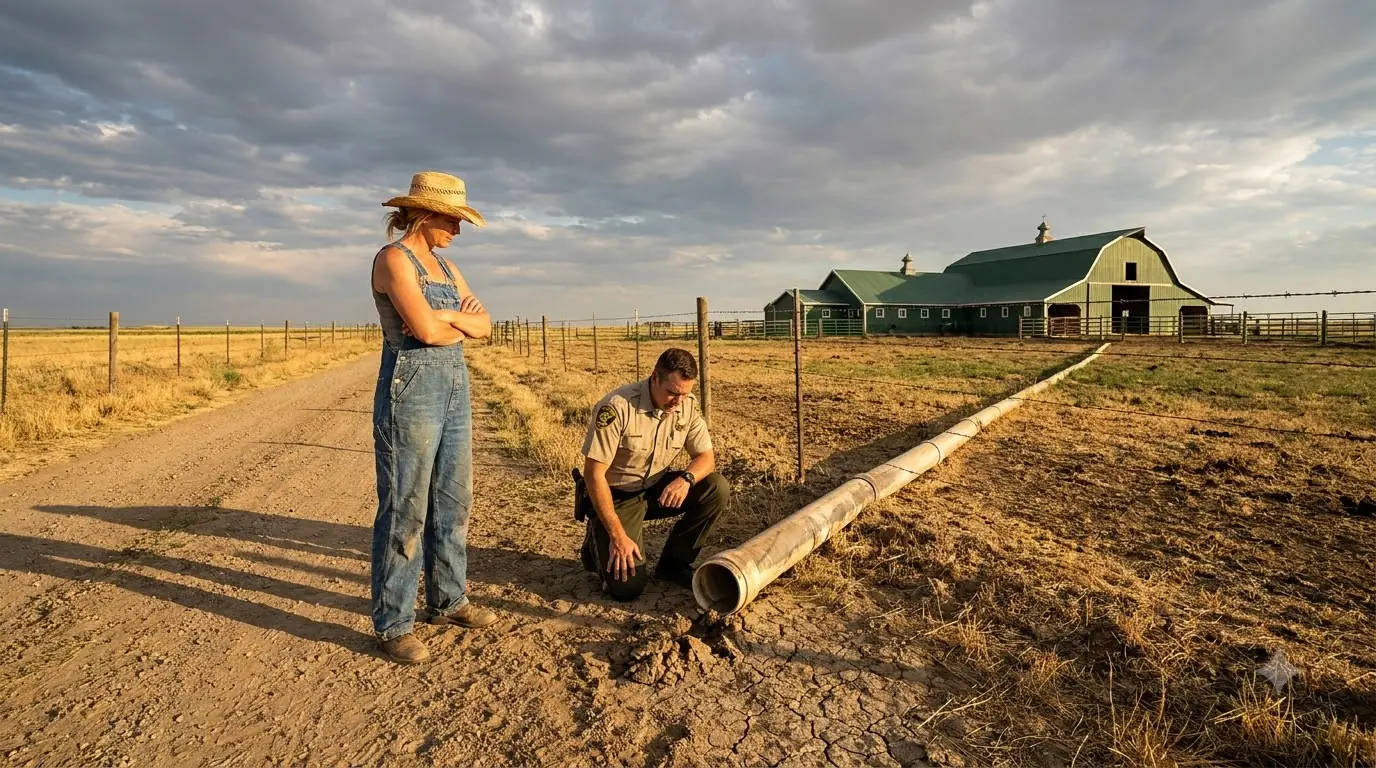
By the middle of July, almost every field along Dry Creek Road had begun losing color.
Leaves curled inward by noon.
The soil cracked beneath boots.
Dust rolled behind pickup trucks in pale brown clouds that hung over the road long after engines disappeared.
Farmers stopped talking about rain because talking did not make clouds appear.
They talked instead about wells.
Pumps.
Allocation schedules.
County reservoirs.
Pressure.
And money.
Especially money.
Emily heard those conversations every morning at Miller’s Feed and Supply, where the coffee tasted burned and the men standing beside the counter considered weather forecasting an acceptable substitute for religion.
“Another ten days like this and soybeans are finished.”
“Corn’s already finished.”
“My north field got half the pressure it should’ve had last night.”
“County says the lines are normal.”
“County says a lot.”
Emily usually listened without joining.
At twenty-three, she had learned that being the youngest farmer in the room was already enough reason for people to watch her.
Being a woman added another reason.
Being the daughter of Thomas Carter added several more.
Her father had farmed the same two hundred and forty acres outside Salina for thirty-four years.
Then one morning in early spring, he suffered a stroke beside a grain bin.
He survived.
But the right side of his body never fully recovered.
Doctors told him he might walk independently again with enough therapy.
Nobody promised he would ever climb into a tractor.
That meant Emily became responsible for the farm almost overnight.
She had worked beside him since childhood.
She could rebuild a worn planter bearing.
Calibrate a sprayer.
Set irrigation timers.
Read moisture sensors.
Recognize soybean aphids before populations became obvious.
But working beside a farmer and becoming the farmer were not the same thing.
Everyone seemed eager to remind her.
Harold Mercer did it most often.
He farmed nearly nine hundred acres two miles west.
Sixty-seven years old.
Gray stubble.
Permanent tan line beneath a battered cap.
Heavy hands shaped by decades of steering wheels, wrenches, fence wire, and bad decisions he preferred calling experience.
Harold was what people politely called respected.
He had served on the county agricultural board.
His father had helped dig portions of the original irrigation network.
His name appeared on plaques at the fairgrounds.
When the county needed a farmer for a television interview about drought, Harold Mercer usually appeared.
He also believed Emily should have leased the Carter land to someone “with enough years behind him.”
He had offered.
Three weeks after her father’s stroke.
“Just temporary,” Harold told her.
They stood beside the machine shed.
“I’d run the ground this season. Give you a fair percentage.”
Emily looked at him.
“What percentage?”
“Depends on harvest.”
“What happens when Dad recovers?”
Harold rubbed his jaw.
“We talk.”
“So you want control.”
“I want to keep you from losing what your father built.”
Emily smiled.
“I’ll risk it.”
His face tightened.
“You think farming is proving something?”
“No.”
“Then stop acting like it.”
She walked away.
Harold never forgave being refused.
At first, the season almost proved him right.
Rain disappeared.
Temperatures climbed.
County irrigation restrictions began in June.
Every registered farm received scheduled pumping windows based on acreage, crop type, historical allocation, and reservoir volume.
Emily followed them obsessively.
She had to.
One violation could mean penalties or reduced allocation.
She programmed timers.
Checked meters.
Recorded pressure readings.
Photographed gauges.
Her father had always kept notebooks.
Emily created spreadsheets.
Thomas hated spreadsheets.
“Paper never needed a battery,” he muttered from his recliner one afternoon.
Emily smiled.
“Paper also doesn’t calculate flow variance.”
“Flow variance didn’t need calculating when I was running it.”
“You’re welcome to come outside.”
Thomas glared.
Emily kissed his forehead.
“Thought so.”
By late June, something strange appeared.
The west soybean field looked weak.
Expected.
The south field looked worse.
Also expected.
But two long strips running through the central field remained unusually green.
Not perfect.
But healthy.
Dark leaves.
Good canopy.
Pods developing evenly.
Emily thought at first the soil held moisture better there.
Her father disagreed.
“That section is sandier.”
“Exactly.”
“So it should be worse.”
Emily looked at the map.
He was right.
The green rows followed an old buried irrigation line installed before she was born.
The line connected to a county lateral shared with several farms farther west.
Emily checked the valve.
Normal.
Meter.
Normal.
Pressure.
That was where things became interesting.
Her scheduled inlet pressure was consistently higher than predicted for short intervals.
Not dramatically.
Enough.
Pressure rose at odd hours when Emily was not actively irrigating.
Then fell.
She checked for faulty gauges.
Replaced one.
No change.
She called the county water office.
A technician came out.
“Could be line surge.”
“For three weeks?”
He shrugged.
“Old system.”
“Can you log upstream pressure?”
“Already do.”
“Can I see it?”
He looked uncomfortable.
“Need a request.”
“I’ll submit one.”
“You worried somebody’s feeding your line?”
Emily looked toward the green rows.
“I don’t know what I’m worried about yet.”
The technician laughed.
“That’s usually when people become interesting.”
His name was Kevin Shaw.
He was forty-two and had worked county water systems since Emily was ten.
Two days later he emailed her pressure logs.
Emily printed them.
Then sat at the kitchen table until midnight.
Her father’s farmhouse still looked the way it had when her mother was alive.
Oak cabinets.
Yellowing photographs.
A clock that ran three minutes fast because Thomas insisted fixing it would make everyone late.
Emily spread maps across the table.
County lateral.
Farm meters.
Pressure stations.
Reservoir feed.
She drew times beside pressure drops.
One pattern appeared.
Pressure along the shared lateral fell sharply between 1:30 and 4:00 a.m. on nights when Harold Mercer’s scheduled allocation had already ended.
Not every night.
Most.
Then pressure briefly rose along Emily’s old central line after the drop.
That made no sense.
Unless water was being redirected through an unauthorized connection and creating back-pressure.
Emily called Kevin the next morning.
“Hypothetically.”
He laughed.
“Dangerous opening.”
“If someone tapped a county lateral downstream of my meter—”
“Illegal.”
“I said hypothetically.”
“Still illegal.”
“Could it create pressure changes upstream?”
“Depends on valves.”
“Could a partially closed bypass cause surge when shut down?”
“Yes.”
“Enough to affect nearby lines?”
“Possibly.”
“Can unauthorized pipe run beneath private land without appearing on county maps?”
“Pipe can run anywhere if someone buried it.”
Emily looked toward the west.
Harold’s property sat directly beyond the shared lateral.
“Kevin.”
“No.”
“I haven’t asked.”
“Whatever you’re about to ask sounds like something my boss wants paperwork for.”
She smiled.
“Probably.”
Emily did not accuse Harold.
Not yet.
She investigated her own ground first.
For three mornings she walked the irrigation path.
She wore faded gray work shirts, charcoal bib overalls, boots, and an old tan cowboy hat that had belonged to her mother.
The hat made Harold laugh whenever he saw her.
“Playing rancher now?”
Emily ignored him.
On the fourth morning, she found a depression near the western property fence.
Fresh soil.
Not very fresh.
Maybe months old.
Grass had been reseeded.
The depression followed a straight line.
Emily crouched.
Her dog, Scout, sniffed beside her.
“Find treasure?”
Scout sneezed.
Emily scraped loose dirt.
Nothing.
She walked farther.
The depression continued toward Harold’s property.
At the fence line, it disappeared beneath a patch of taller grass.
Emily photographed everything.
Then she called Kevin.
He arrived in a county truck near sunset.
“You didn’t tell my supervisor?”
“I told him you reported possible unmarked infrastructure.”
“Good.”
“That means he’ll blame me if we’re digging up somebody’s innocent pasture.”
“Better you than me.”
Kevin laughed.
They used a utility locator.
Signal.
Weak.
Then stronger.
There was pipe underground.
Not shown on county maps.
Kevin stared at the screen.
“That ain’t supposed to be there.”
Emily’s stomach tightened.
“Where does it go?”
“Need tracing.”
They marked the route with orange flags.
The line ran east to west.
From near the county lateral.
Under Emily’s fence.
Then beneath Harold Mercer’s south field.
Kevin called his supervisor.
The supervisor called the county engineer.
Nobody dug that evening.
They needed authority.
Emily went home.
Her father listened while she explained.
Thomas’s face darkened.
“Mercer.”
“Maybe.”
“It’s Mercer.”