The water hit the first tray before the teenage girl understood that the HOA president actually intended to pour it.
One moment, thirty-two chocolate brownies sat beneath clear plastic wrap on a folding table beside the driveway.
The next, a thick stream of water crashed across them.
The plastic shifted.
Water rushed underneath.
Dark chocolate turned glossy, then soft.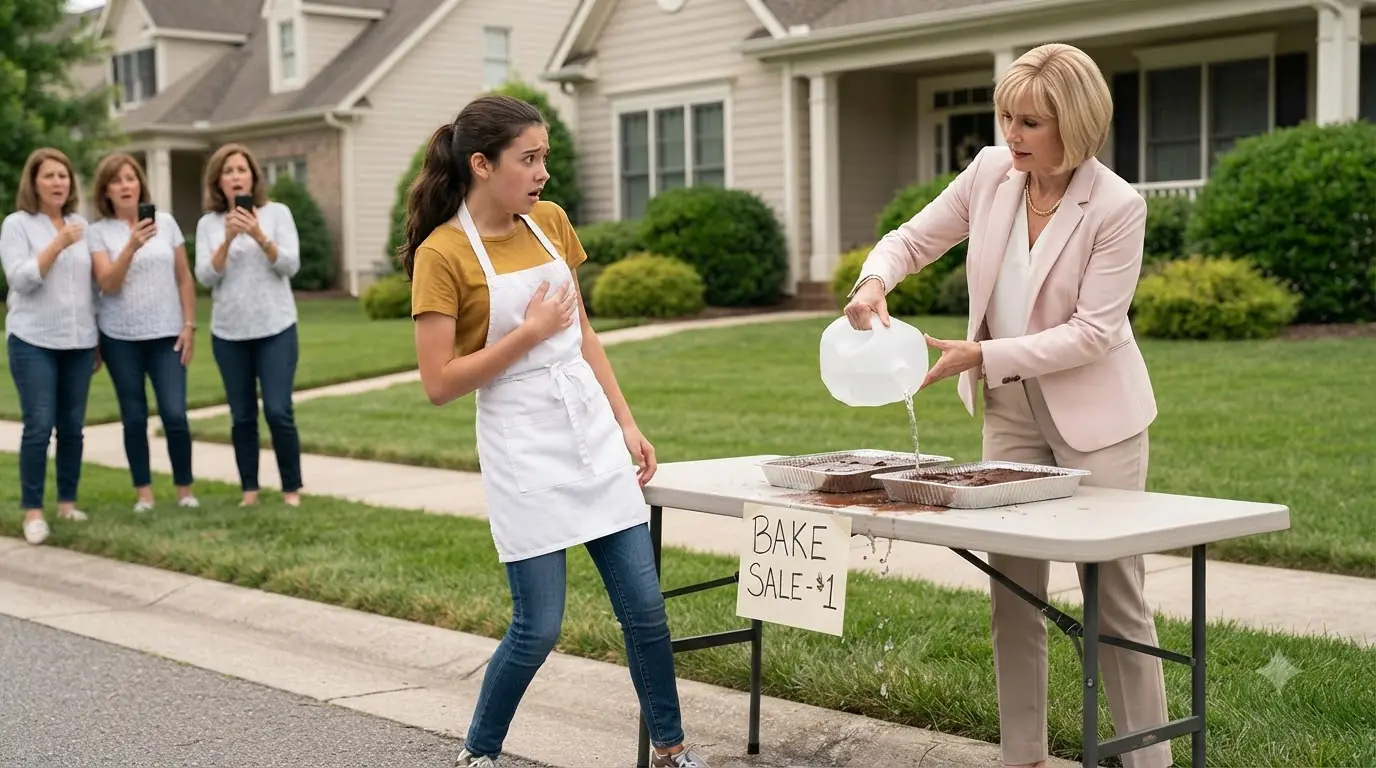
The paper labels curled immediately.
The girl gasped.
“Stop!”
The HOA president did not.
She raised the gallon jug higher.
Water poured across the second aluminum tray.
The teenager lunged forward, then stopped herself because the older woman’s body was between her and the table.
Several neighbors were already watching.
One had a phone raised.
Another stood frozen beside a mailbox.
The teenager’s face crumpled.
“Those were for the school fundraiser!”
The HOA president lowered the empty jug.
She was a polished white woman in her late fifties with a neat blonde bob, a pale pink blazer, white blouse, beige trousers, gold necklace, and the rigid expression of someone who believed public certainty could substitute for being correct.
She placed the jug on the table beside the ruined brownies.
“Then learn the rules before selling anything in my neighborhood.”
The girl stared at her.
“My mom said I could.”
“Your mother does not run this association.”
“This is our yard.”
The HOA president gave a cold little laugh.
“Not that part of it.”
The teenager looked down.
Her bake-sale table stood perhaps eight feet from the sidewalk, close to the hydrangea bed that bordered the family’s lawn.
The HOA president pointed toward the grass beneath it.
“That strip is maintained under HOA landscaping authority.”
“So?”
“So you cannot conduct an unauthorized commercial activity there.”
The girl’s hands trembled.
“I’m not running a business.”
“You are exchanging food for money.”
“It’s donations.”
“You’re still taking money.”
“It’s for school.”
“That doesn’t change the covenant.”
The teenager looked toward the neighbors.
Nobody spoke.
That hurt more than she expected.
Three people had bought brownies that morning.
Two had wished her luck.
One had given her twenty dollars and refused change because his grandson attended the same high school.
Now those same adults looked uncomfortable.
Interested.
Embarrassed.
But silent.
The HOA president picked up one of the soaked paper signs.
The ink had started bleeding.
SCHOOL ENGINEERING CLUB FUNDRAISER
She held it between two fingers.
“This should never have been placed here.”
The girl’s eyes filled completely.
“You could’ve just told me.”
“I did.”
“No.”
The teenager’s voice sharpened through tears.
“You walked up and started yelling.”
The HOA president’s expression hardened.
“Watch your tone.”
“You destroyed them.”
“They were being sold in violation of community rules.”
“They cost me seventy dollars to make.”
“That is not my responsibility.”
“You could have asked me to move the table.”
“I am not required to negotiate every time a resident decides the rules are optional.”
The girl wiped her cheek angrily.
“I live here too.”
“You are a minor.”
The teenager stared.
“What does that have to do with anything?”
The HOA president leaned forward.
“It means you should stop arguing with adults who understand the property better than you do.”
Then came the boots.
Heavy.
Measured.
Crunching across the edge of the gravel driveway.
The first neighbor noticed.
Then another.
The HOA president turned.
A tall man in his late forties was walking toward them from the sidewalk.
He wore dusty work boots, faded khaki work pants, a dark utility shirt, and a reflective county vest partly unzipped over his chest.
A weathered leather notebook rested in one hand.
A rolled survey map was tucked beneath his opposite arm.
Orange marking flags protruded from one pocket.
The teenage girl recognized him vaguely.
He had been walking through the neighborhood since early morning, checking metal pins near curbs and measuring distances with another county worker.
The HOA president looked irritated.
“This is association business.”
The county surveyor stopped near the ruined table.
His eyes moved from the soaked brownies to the empty jug.
Then to the crying teenager.
Then to the HOA president.
“I heard enough of it.”
The HOA president straightened.
“Then you heard that she was selling food on HOA-maintained common ground.”
The surveyor opened his notebook.
He did not answer immediately.
That silence unsettled her.
“What?”
He turned several pages.
“Ma’am, you might want to stop calling this HOA property.”
The HOA president’s face changed.
Only slightly.
The teenager saw it.
“So did three neighbors.
The surveyor looked toward a small orange flag near the hydrangeas.
Then toward another marker beside the sidewalk.
“This table is approximately nine feet inside the homeowner’s deeded parcel.”
The HOA president blinked.
“No.”
The surveyor looked back down.
“Twelve feet three inches from the monument line to your decorative fence.”
“That fence marks the common-area boundary.”
“No.”
“Yes.”
“No, ma’am.”
His voice remained calm.
“It marks where somebody installed a fence.”
The HOA president stared.
“That is the association boundary.”
The surveyor turned the notebook toward her.