By the spring of 1891, nearly everyone in the little Montana farming town of Willow Bend knew two things about Clara Whitmore.
The first was that she was twenty-seven years old and had somehow managed to keep her family’s failing farm alive for three years after her father died.
The second was that sooner or later, according to nearly every man who liked offering opinions from the comfort of the general store, she was going to lose it.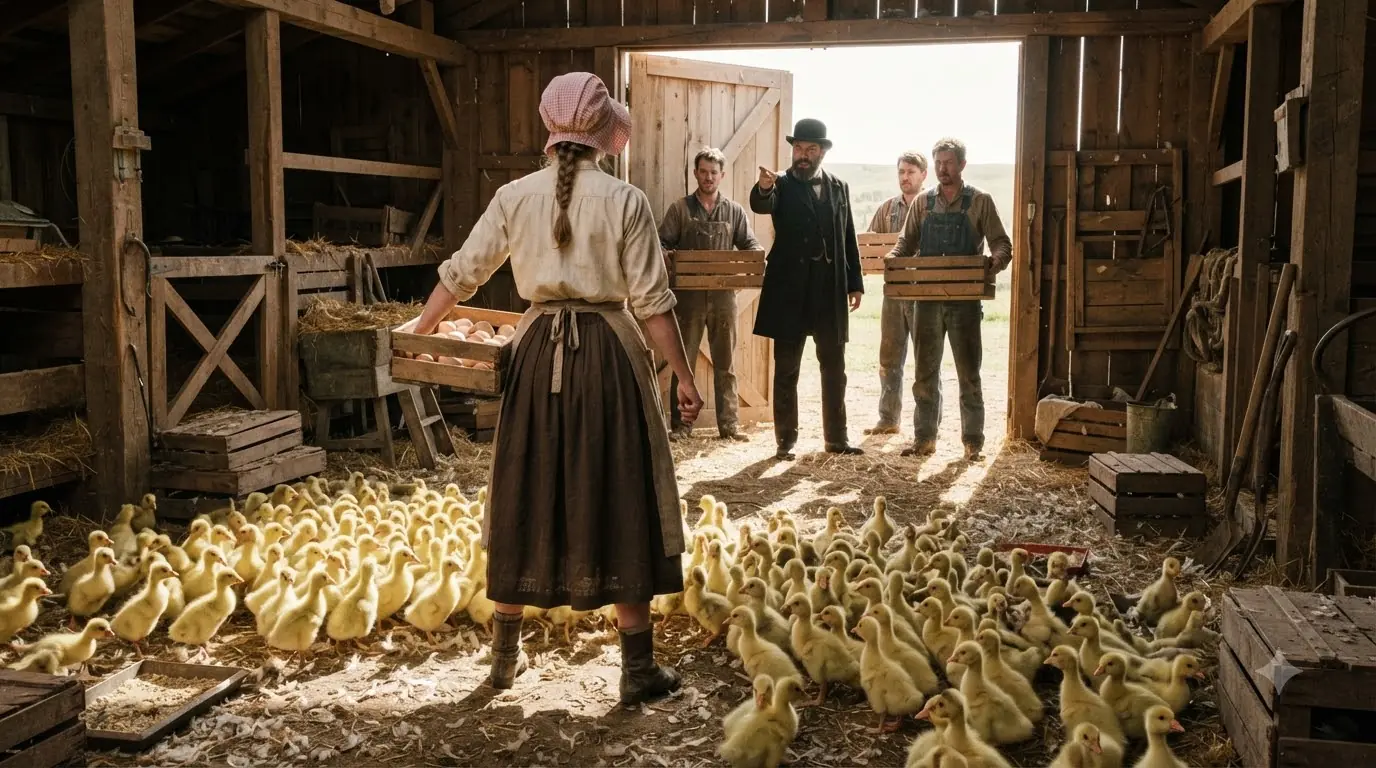
Clara heard those predictions often enough that they eventually became background noise.
She heard them while buying flour.
She heard them while repairing fence posts.
She heard them when merchants quietly asked whether she was certain she could pay her account at the end of the month.
She even heard them whispered at church, where sympathy sometimes carried the same sting as ridicule.
Whitmore Farm sat four miles beyond Willow Bend, pressed between a slow creek and a broad stretch of rough pasture that climbed toward the distant mountains.
It had once supported cattle, chickens, two workhorses, pigs, and enough wheat to keep Clara’s parents comfortable.
By 1891, the cattle were gone.
One workhorse remained.
The pig pen stood empty.
Half the chicken house had collapsed beneath winter snow.
Clara owned fourteen hens, one stubborn milk cow, and a wagon whose left rear wheel groaned every time it turned.
But she also owned the land.
No banker had taken it yet.
That distinction mattered deeply to her.
Every sunrise that found Clara still standing on Whitmore soil felt like a small victory.
She dressed for work before dawn each morning in clothes that cared nothing for fashion.
A plaid work shirt.
A worn canvas farming jacket when the morning was cold.
Heavy trousers or a practical work skirt depending on the task.
Mud-stained boots.
Her brown hair tied low behind her head so it would not fall into her face while she worked.
Clara’s hands were not delicate.
They were scarred from wire, roughened by cold, and strong enough to lift feed sacks men twice her weight sometimes struggled to carry without complaining.
Yet strength alone did not pay taxes.
That spring, Clara needed money badly.
Her wheat seed had cost more than expected.
A late freeze had damaged part of the vegetable garden.
The roof on the north side of the barn leaked.
Worst of all, the county tax notice sat folded beneath a tin cup in her kitchen.
Thirty-seven dollars and sixty cents.
Due before autumn.
Thirty-seven dollars did not sound like much to men who owned mills or mines.
To Clara, it might as well have been three hundred.
She had spent most of March thinking about livestock.
Not cattle.
Cattle required too much land and feed.
Not pigs.
Pig prices had been weak.
She kept returning instead to geese.
There was growing demand for feathers.
Restaurants in Helena paid well for good birds.
Families bought geese for holiday meals.
A breeding flock could multiply quickly if managed carefully.
The problem was simple.
Clara had no breeding flock.
Good goose eggs were expensive.
Goslings were worse.
Every hatchery in the region knew spring demand was strong, and none had any reason to offer charity to a woman whose farm was already considered a financial corpse.
The largest hatchery within twenty miles belonged to Harold Briggs.
Briggs Hatchery was not beautiful, but it was profitable.
Three long wooden buildings stood beside the main road, surrounded by sheds, wagons, fenced yards, and rows of nesting birds.
Harold Briggs liked people to know that he owned more breeding geese than anyone between Willow Bend and Helena.
He also liked people to know that he had money.
He wore better boots than most farmers.
His wagons were freshly painted.
His brass watch chain was always visible.
And when he laughed at someone, he did so loudly enough for witnesses.
Clara avoided him whenever possible.
Then, on a wet April morning, she saw the wagon accident.
She had gone into town for nails and lamp oil and was heading home when she passed Briggs Hatchery.
A freight wagon stood crooked beside one of the loading sheds.
One wheel had slipped into a rut.
Several wooden egg crates had fallen hard against the sideboards.
Workers were carrying damaged crates behind the main building.
Clara slowed her wagon.
One crate had split open.
Inside, dozens of pale goose eggs lay against straw.
Many had hairline cracks.