Some gestures become important only after they have been repeated long enough for nobody to remember when they stopped being ordinary.
For Thomas Calloway, it was Tuesday.
Tuesday meant cattle in the western pasture.
Tuesday meant checking the irrigation ditch along the southern edge of the property.
And for three years, Tuesday meant Margaret Hale crossing the field between their ranches carrying something warm beneath a cloth.
Bread.
Stew.
Biscuits.
Preserves.
Once, an entire roast that Thomas suspected she had cooked mostly because she was irritated by how thin he had become.
And in September of 1883, it meant apple pie.
Thomas was sitting on his porch when he saw her coming.
He had been pretending not to wait.
That was an important distinction in his mind.
A man did not wait for a neighbor simply because she often arrived on the same day at nearly the same hour.
He happened to drink coffee on the porch most Tuesday mornings.
He happened to face south.
He happened to notice the blue of her dress moving through the field before she reached the fence.
Coincidence could be remarkably reliable when a man worked hard enough not to examine it.
Margaret pushed through the gate and walked toward the house.
Colorado sunlight caught in her auburn-brown hair.
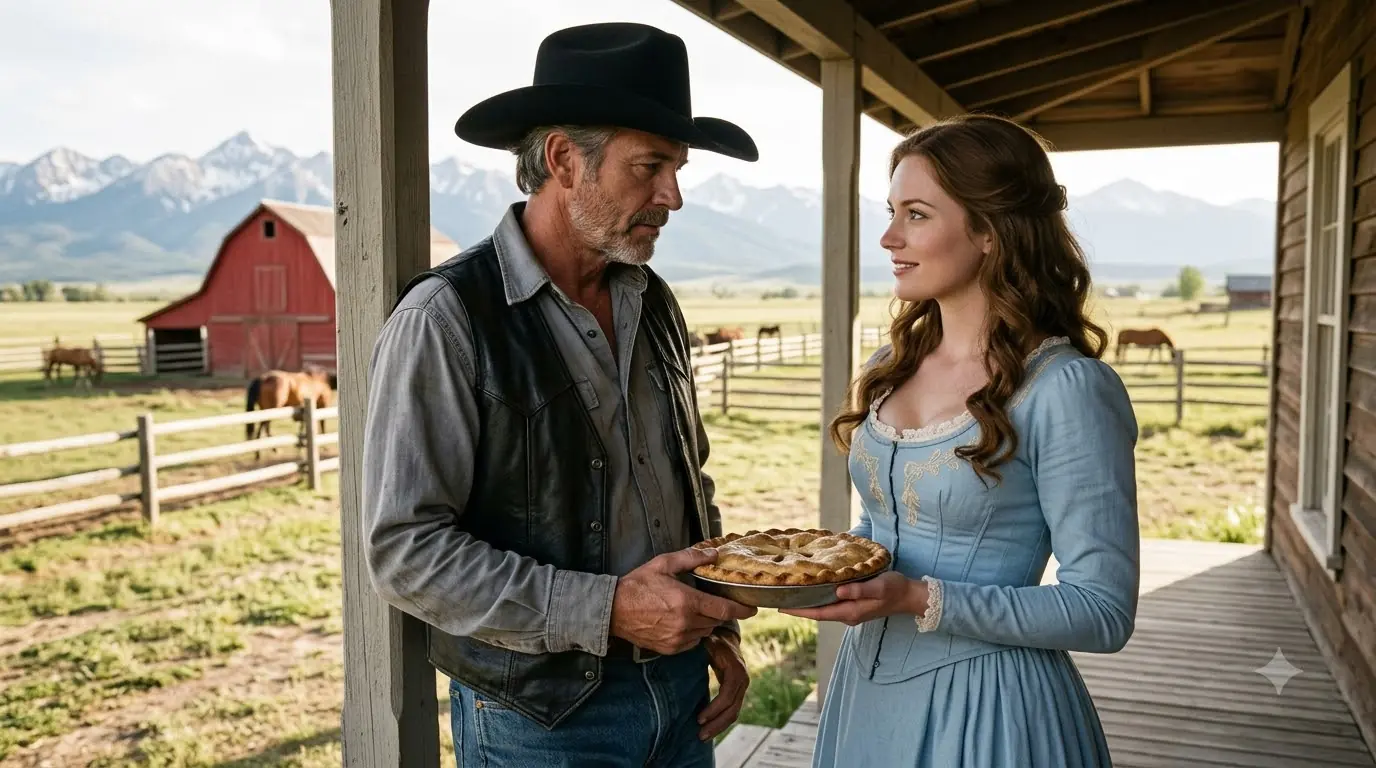
The September wind moved the full skirt of her powder-blue dress around her boots, and Thomas found himself noticing that the neckline was lower than the dresses she usually wore while working.
Not improper.
Nothing Margaret did looked careless.
But softer.
More feminine.
The cream lace rested against her skin, and the fitted waist made Thomas remember, inconveniently, that she was not simply the capable neighboring rancher he had trained himself to think of her as.
She was twenty-five.
Beautiful.
Warm.
And carrying a pie toward a fifty-five-year-old man who had spent three years pretending her visits meant exactly what she said they meant.
“Morning,” Margaret called.
Thomas stood.
“Morning.”
She climbed the porch steps and held out the pie.
“September apples.”
Thomas looked at it.
The lattice crust had been arranged carefully enough that he immediately knew she had spent more time on it than she would admit.
“The good tree?”
“The south tree.”
Thomas nodded gravely.
“Then this is serious.”
Margaret smiled.
“That tree produces eight worthwhile apples every year, Thomas. You should understand what an investment this represents.”
He reached for the pie.
Their fingers touched beneath the warm tin.
Neither released immediately.
Thomas looked at her hand.
Then at Margaret.
She was already watching him.
There was something in her expression he had noticed before and always categorized under affection between neighbors.
Today, perhaps because the dress was different.
Perhaps because the morning was too clear.
Perhaps because loneliness had finally grown tired of being polite.
He saw something else.
He smiled.
Not the restrained half-smile he gave people in town.
The real one.
Margaret’s eyes changed immediately.
Thomas should have stopped there.
He should have taken the pie.
Thanked her.
Asked about cattle.
Discussed rainfall.
Instead, he heard himself say:
“If only I were ten years younger.”
Margaret blinked.
Thomas immediately regretted it.
The sentence had come out lightly, but they both knew what lived underneath it.
He tried to rescue himself.
“I mean, a woman who brings pie like this could make a younger man foolish.”
Margaret continued looking at him.
Thomas became aware that he was still holding the pie with her.
Finally she said:
“Ten years wouldn’t be enough.”
Thomas frowned.
“What?”
Margaret released the tin.
Then, instead of stepping away, she moved closer.
Only half a step.
Enough.
Her hand rose to his shirt collar.
Thomas stopped breathing normally.
She straightened a fold in the gray fabric.
Slowly.
“You keep blaming years for things I never complained about.”
Thomas stared down at her.
Her fingers remained against his chest.
The pie suddenly felt dangerously heavy in his other hand.
“Margaret.”