The first thing the Black CEO noticed was not the hand against his chest.
It was how quickly everyone else looked away.
The polished marble lobby of the Manhattan headquarters had been busy thirty seconds earlier.
Employees crossed toward the elevators carrying coffee.
Assistants checked messages while walking.
Two consultants stood beside reception discussing a presentation.
A delivery worker rolled several boxes toward the service corridor.
Then the Office Manager planted one palm firmly against the Black CEO’s chest.
And suddenly everyone became interested in something else.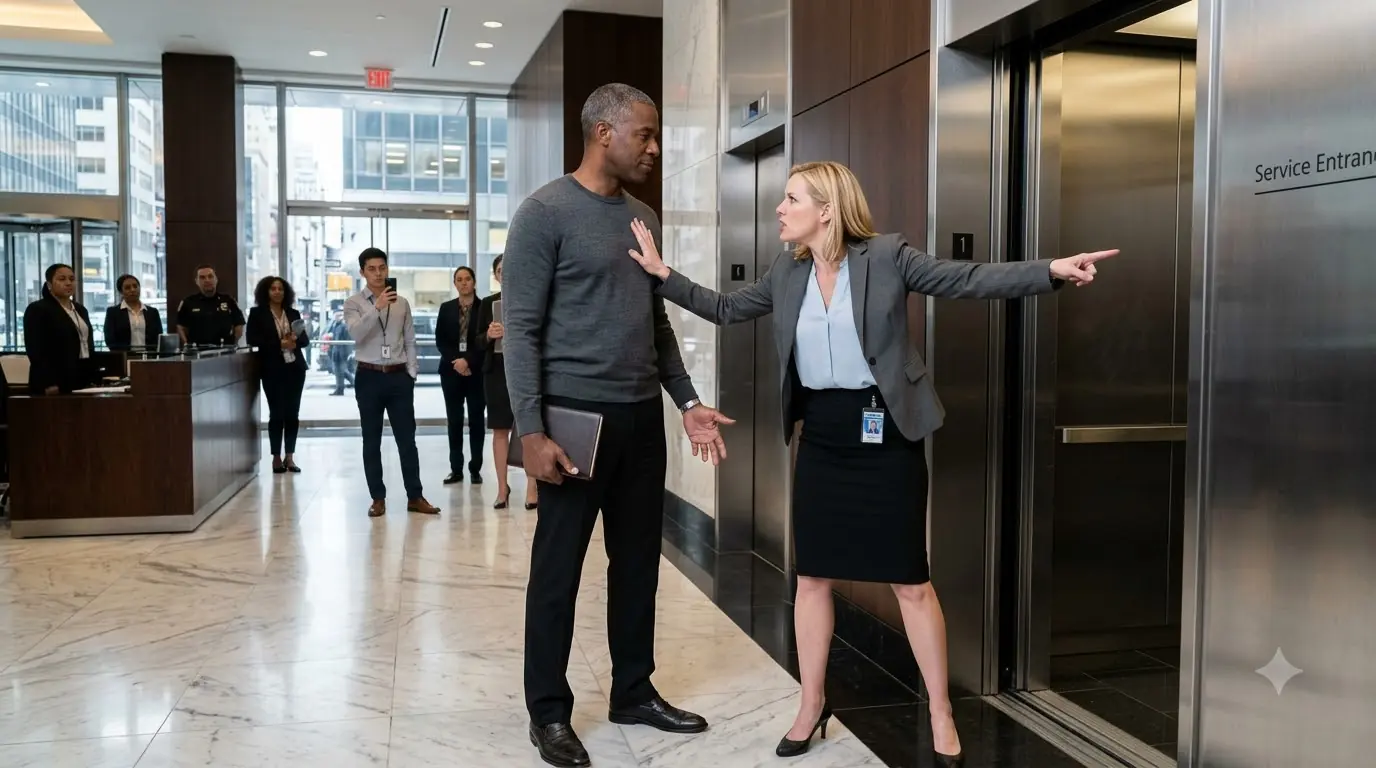
Phones.
Shoes.
Elevator numbers.
Coffee cups.
Anything except the confrontation happening six feet away.
The Black CEO raised both hands.
Not dramatically.
Slowly.
Open palms.
Visible.
The movement was instinctive.
He wanted every camera in the lobby to show the same thing.
He had not touched her.
He had not stepped toward her.
He had not threatened her.
The Office Manager leaned closer.
“Back away from the elevator.”
Her voice carried across the lobby.
The Black CEO looked at her hand.
Then at her face.
“Take your hand off me.”
The Office Manager removed it.
Not apologetically.
As though physical contact had been a minor administrative tool she no longer needed.
Then she pointed toward the side corridor.
“Contractors use the service entrance.”
“I’m not a contractor.”
She looked at his clothes again.
Black crew-neck sweater.
Black tailored trousers.
Dark shoes.
No tie.
No visible badge.
No entourage.
No laptop case except the slim leather notebook tucked beneath one arm.
The Office Manager gave a small laugh.
“Of course.”
The Black CEO did not respond.
He had spent thirty-one years learning that arrogance often became most revealing when it believed silence meant weakness.
The company around them occupied forty-three floors of one of Midtown Manhattan’s most recognizable corporate towers.
Glass.
Stone.
Steel.
Nearly nine thousand employees moved through the building during an ordinary week.
Global finance teams.
Technology.
Logistics.
Pharmaceutical investments.
Infrastructure.
Insurance.
Consumer businesses.
The parent corporation owned pieces of industries most ordinary people never thought about.
The Black CEO had founded the company in a rented office above a printing business when he was twenty-seven.
Four employees.
Two folding tables.
One secondhand fax machine.
A refrigerator that stopped working whenever the air conditioner ran.
The corporation was now valued in the hundreds of billions.
His photograph hung in the boardroom.
His signature appeared in annual reports.
His name appeared on the original incorporation documents locked in the corporate archive.
But no photograph appeared in the lobby.
That had been intentional.
He hated buildings that treated founders like dead presidents.
The company belonged to the people working inside it now, not to the mythology of one man.
At least that was what he had always believed.
Lately, he had begun wondering what kind of company those people had actually built when he was not watching.
Three months earlier, an email reached his private office.
Not the public CEO mailbox.
His private one.
Only thirty-seven people inside the corporation knew it existed.
The message was short.
Sir, I don’t know whether anyone will show you this, but people are being treated differently depending on who managers think they are.
No name.
Attached were five screenshots.
A contract engineer being told to use a freight elevator because he “did not present as executive staff.”
A woman with a temporary badge being questioned for eleven minutes while white consultants with identical temporary badges walked past.
A facilities employee being told not to enter the executive cafeteria although his work order required him to inspect the refrigeration system.
Then another message arrived.
Different employee.
Different department.
Same building.
The executive lobby has become a place where people learn very quickly whether they look important enough.
The Black CEO asked internal compliance for records.