Elias Turner knew something was wrong the moment he saw white fabric above the ridge.
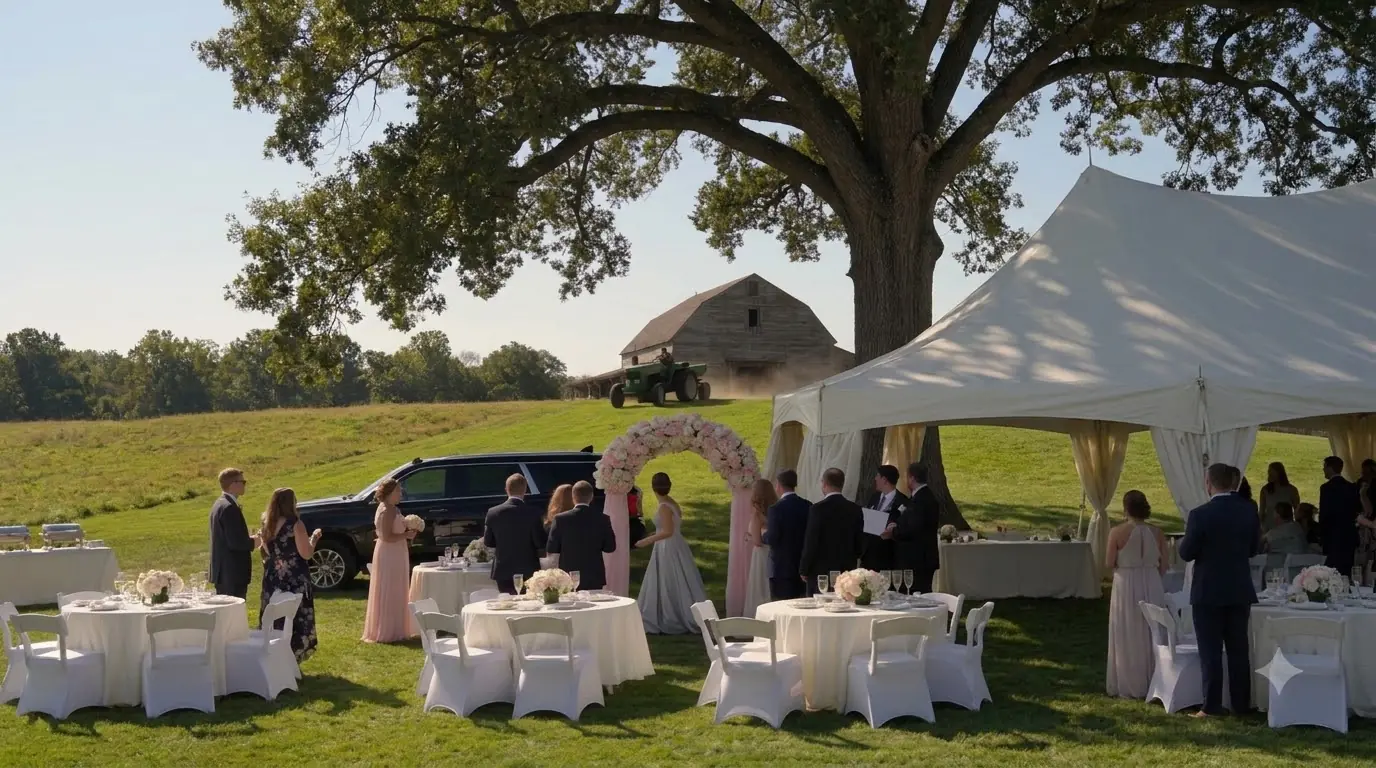
At first, he thought sunlight was catching the roof of a delivery truck.
Then he came around the curve in his gravel driveway and stopped so hard that the old pickup rocked beneath him.
A white wedding tent stood beneath his oak tree.
Not beside the property.
Not near the subdivision.
On his land.
Elias stared through the windshield.
Rows of white chairs covered the grass.
A floral arch wrapped in pink roses stood beneath the branches of the enormous oak his grandfather had protected for decades.
Men in matching shirts were assembling a portable dance floor.
A catering van sat beside his hayfield.
And right in the middle of it all, waving a clipboard like she owned sixty acres of Idaho soil, stood Brenda Wallace.
President of the Whispering Pines Homeowners Association.
Elias shut off the truck.
He did not yell.
Did not slam the door.
Did not call anyone.
Not yet.
He simply climbed out and walked uphill.
The workers noticed him first.
One stopped carrying chairs.
Another lowered a box of table linens.
Brenda finally turned around.
For half a second, surprise flashed across her face.
Then the familiar smile returned.
Thin.
Polished.
Condescending.
“Oh, good,” she said. “You’re here.”
Elias kept walking.
Brenda pointed past him toward his pickup.
“You’ll need to move that.”
Elias stopped.
“What?”
“The truck.”
She frowned as if he were being deliberately difficult.
“It ruins the photographs from this angle.”
Elias looked over his shoulder at the faded blue pickup parked on his own gravel lane.
Then he looked at the tent.
The chairs.
The flowers.
The dance floor.
Finally, he looked at Brenda.
“What is this?”
She laughed lightly.
“A wedding.”
“I can see that.”
“My niece is getting married tomorrow.”
Elias waited.
Brenda gestured toward the valley.
“The sunset from this ridge is gorgeous. She saw it from the walking trail last spring and fell in love with it.”
Elias stared at her.
“So you put a wedding venue on my property.”
Brenda rolled her eyes.
“You own sixty acres.”
“That wasn't my question.”
“We’re using one small section for one afternoon.”
“Without asking me.”
“You weren't doing anything with it.”
Elias slowly looked toward the giant oak.
His grandfather had planted fence around that ridge long before Whispering Pines existed.
Elias had learned to drive a tractor there.
His father’s ashes had been scattered beneath that tree.
His mother still came every October to sit under it with coffee.
Empty ground did not mean unused ground.
Brenda stepped closer.
“You need to stop treating every little thing like an attack.”
Elias looked at her.
“You have one hour.”
Her smile vanished.
“Excuse me?”
“One hour to remove everything.”
Brenda gave a short laugh.
“You’re serious.”
“Very.”
“You can’t make us move this setup.”
“It’s on my property.”
“It’s basically unused pasture.”
“My property.”
“Do you understand how much this tent cost?”
Elias nodded toward the subdivision.
“Then you should’ve put it on land you were allowed to use.”
Brenda’s face tightened.
She lifted her clipboard.
“We have access rights.”
“No, you don’t.”
“There’s a scenic-easement clause.”
“There is no scenic easement across this ridge.”
“I checked.”
“With who?”
“The association.”
Elias almost smiled.
“The association that doesn’t own my farm?”
Brenda’s eyes hardened.
“You know, this is why everyone over there complains about you.”
Elias looked toward the rows of identical roofs beyond his fence.
“I don't live over there.”
“You affect our neighborhood.”
“So does the weather.”
“Your equipment is ugly.”
“My tractor works.”
“Your grass gets too tall.”
“It’s hay.”
“You spread fertilizer.”
“It’s a farm.”
Brenda looked disgusted.
“Exactly.”
That one word explained almost everything.
Whispering Pines had been built beside farmland because people wanted valley views.
But they did not want tractors.
They wanted sunsets without dust.
Fields without fertilizer.
Country living without country work.
And Brenda Wallace had spent nearly two years behaving as though Elias’s family farm were an undeveloped extension of her subdivision.
It had started with letters.
Complaints about the tractor.
Complaints about tall grass.
Complaints about farm equipment visible from back patios.
Once she even mailed him a notice ordering him to repaint his barn in an “approved neutral tone.”
Elias burned that one in his wood stove.
He had ignored her because arguing with Brenda felt like wrestling smoke.
Now she had built a wedding on his hill.
Elias looked at his watch.
“Fifty-nine minutes.”
Brenda’s mouth opened.
He turned and walked away.
The sheriff’s deputies arrived forty-seven minutes later.
Elias had called from the barn.
Brenda had called too.
That became obvious when Deputy Frank Willis stepped out of his cruiser looking like a man who already regretted coming.
Elias knew Frank.
Not well.
Small county.
Everybody knew everybody a little.
A younger deputy followed him uphill.
Brenda was waiting beside the floral arch.
This time she had papers.
Lots of papers.
“Deputy,” she said sweetly, “thank God.”
Frank glanced at Elias.
“Afternoon.”
“Frank.”
Brenda immediately stepped between them.
“This man has threatened to destroy a private event.”
Elias frowned.
“I told them to leave my property.”
Brenda shoved the papers toward Frank.
“We have lawful access under the subdivision’s scenic-use provisions.”
Frank took the documents.
Read one page.
Then another.
His face became less confident with each sheet.
“What exactly is this?”
“Original development agreement.”
Elias shook his head.
“HOA bylaws.”
Brenda snapped:
“You're not an attorney.”
“Neither are you.”
Frank raised one hand.
“Everybody stop.”
He looked toward the huge tent.
“How long has this been here?”
“Since this morning,” Elias said.
Brenda interrupted.
“Setup began legally this morning.”
Elias stared at her.
Frank sighed.
“Do you have your deed?”
“At the house.”
“Survey?”
“County records.”
Brenda smiled immediately.
“The clerk’s office closes at four.”
Elias looked at his watch.
4:23.
There it was.
Frank saw it too.
Brenda had not chosen Friday afternoon by accident.
He rubbed his forehead.
“Here’s my problem.”
Elias already knew what was coming.
Frank continued.
“I can’t adjudicate a property-line or easement dispute standing in a field.”
“There’s no dispute.”
“Brenda says there is.”
“She invented one.”
“Maybe.”
Frank looked apologetic.
“But if I order contractors to remove ten thousand dollars of equipment and it turns out she has some recorded access right I didn’t know about, that becomes a county problem.”
Brenda crossed her arms.
Triumph was already spreading across her face.
Elias asked:
“So what are you telling me?”
Frank hesitated.
“You may need to handle this through civil court Monday.”
“The wedding is tomorrow.”
“I know.”
“You’re telling me they can stay on my land until then.”
“I’m telling you I cannot resolve the title issue tonight.”
Elias stared at him.
Frank added:
“And don’t damage the rented equipment.”
Brenda’s smile widened.
“If you cut the tent, move the chairs, damage the dance floor—”
“I understand.”
“Elias.”
“I said I understand.”
Frank studied him.
Something in Elias’s calmness bothered him.
“Don't do anything stupid.”
Elias looked toward the wedding tent.
Then the grass around it.
“I’m not touching their property.”
Frank seemed relieved.
Brenda did not understand the wording.
Not yet.
Elias walked back to the barn.
He sat on an overturned feed bucket for a few minutes, listening to the distant sound of workers finishing the setup.
The barn smelled like old timber, diesel, dry hay, and grease.