A cold wind pushed through Willow Creek just as Emma Carter stepped down from the stagecoach.
The driver avoided her eyes.
The townspeople did not.
Every face along the muddy street seemed to know something she did not.
Emma kept one gloved hand around the handle of her small brown suitcase and searched the boardwalk.
Walter Briggs had described himself carefully in his letters.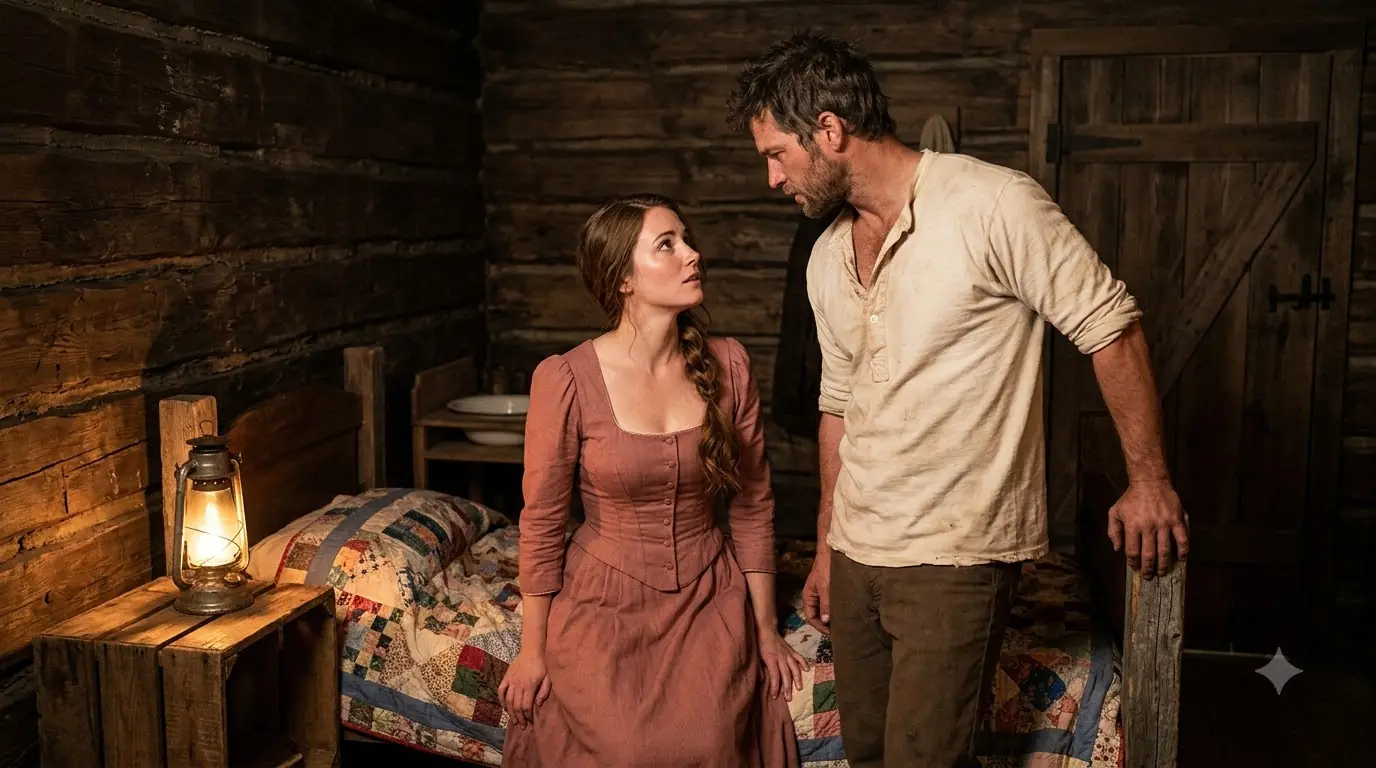
Medium height.
Brown hair.
Gray hat.
Dark wool coat.
Thirty-four years old.
He wrote that he would be waiting beside the hotel when the stage arrived.
Emma found him easily.
He was standing outside the saloon.
He was not walking toward her.
For one hopeful second, she thought perhaps he had not recognized her.
Then their eyes met.
Walter’s face changed.
Not delight.
Not nervousness.
Disappointment.
Emma felt the first cold drop of rain land against her cheek.
She stepped toward him anyway.
“Mr. Briggs?”
Walter removed his hat.
“Miss Carter?”
“Yes.”
The answer should have begun something.
Instead, it seemed to end it.
Walter looked her up and down.
Emma immediately understood what he was seeing.
She was tall.
Nearly six feet.
She had never hidden that.
Her shoulders were strong from years of lifting feed sacks, splitting wood, repairing fences, and working horses beside her father.
Her hands were not soft.
Her body had the shape of a woman who had worked for everything she owned.
Walter had praised those things in letters.
Standing before her now, he seemed to regret every word.
“You didn't tell me you were this tall.”
Emma stared.
“I did.”
Walter shifted.
“You said five feet eleven.”
“That is nearly six feet.”
A laugh came from somewhere near the saloon.
Walter’s ears reddened.
“You look… stronger than I imagined.”
Emma tightened her grip on the suitcase.
“I wrote that too.”
Another man chuckled.
Emma did not look toward him.
She kept her eyes on Walter.
Six months of correspondence stood between them.
Six months of letters written after her parents died and the Missouri farm passed to a cousin who had little use for an unmarried woman sharing his household.
Walter had written about Montana skies.
His small ranch.
Lonely winters.
His wish for children.
He said he wanted a wife who was practical.
Not delicate.
A woman who understood work.
Emma had told him everything.
Twenty-eight years old.
No living parents.
Good with horses.
Capable with tools.
Could drive a wagon.
Could cook well enough not to poison him.
Could mend.
Could read accounts.
Could shoot if she had to.
Walter responded that she sounded perfect.
Now he stared as though somebody had sent him the wrong woman.
“I expected a wife,” he said.
Emma heard the laughter before she understood the cruelty.
Her face remained still.
“And what exactly do you think I am?”
Walter rubbed the back of his neck.
“A woman should look…”
He stopped.
Emma waited.
Walter made the mistake of continuing.
“You look more like someone hired to build a barn.”
Laughter rolled down the boardwalk.
Not everyone laughed.
That almost made it worse.
Some people simply watched.
A few women looked uncomfortable.
One older man lowered his eyes.
Emma felt heat rise into her face.
She refused to lower her head.
“I crossed half this country because I believed your words.”
Walter looked toward the watching town.
His pride had trapped him now.
Instead of apologizing, he hardened.
“I made a mistake.”
Emma’s stomach dropped.
Walter stepped closer.