The diamond necklace had required eighty-three years to return to New York.
That was the first thing the Black woman remembered as she stood in front of the glass case.
Not the price.
Not the insurance value.
Not the whispered estimates moving through the ballroom.
The years.
Eighty-three.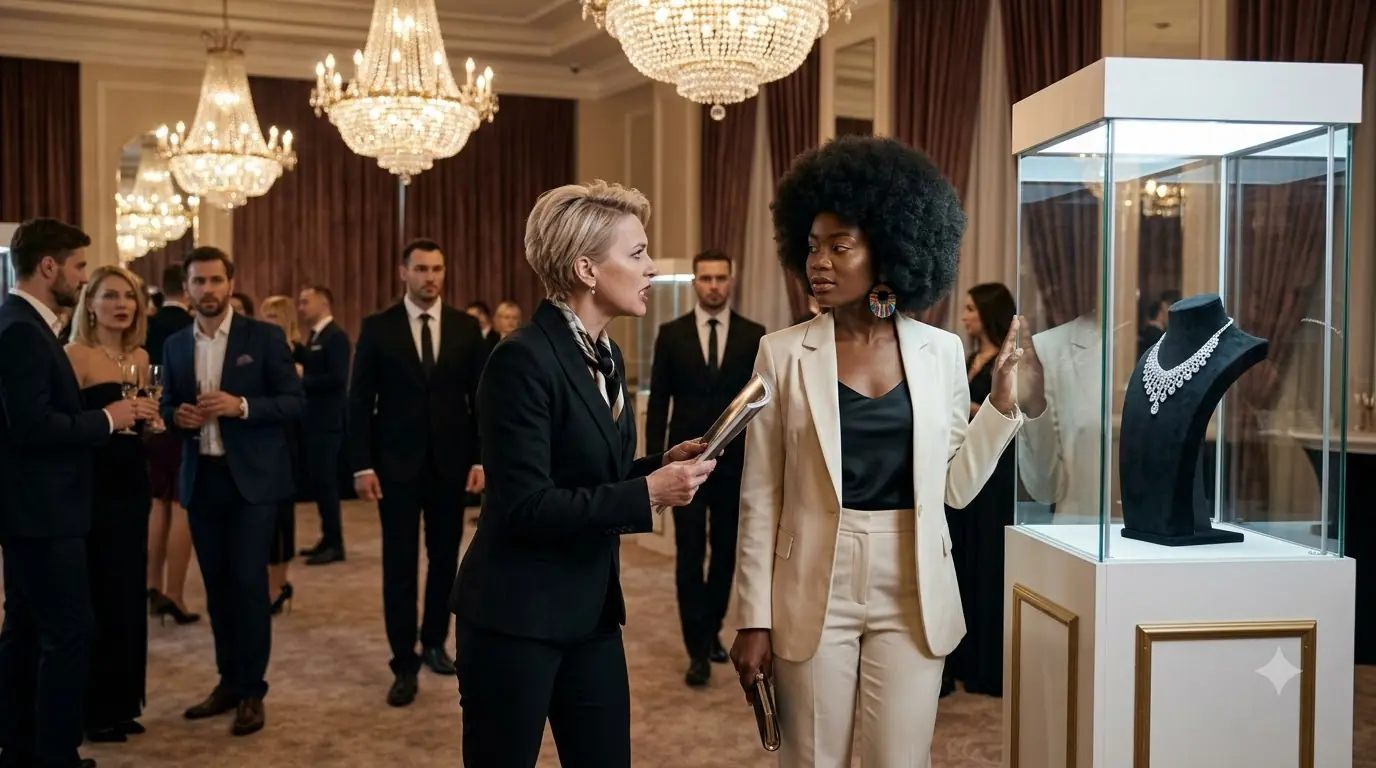
The necklace had been commissioned in Paris in 1943 for a European shipping heiress whose family later sold portions of their collection after the war.
For decades, the necklace moved privately.
Geneva.
Monaco.
London.
A private vault in Toronto.
Then Singapore.
Then back to Switzerland.
It had not appeared publicly at auction since 1967.
Now it rested beneath warm museum lighting inside a climate-controlled glass display in the grand ballroom of one of Manhattan’s most expensive hotels.
One hundred and forty-six diamonds.
Twenty-seven pear-shaped stones.
A central flawless diamond weighing more than thirty carats.
Handmade platinum.
No visible yellowing.
No modern reconstruction.
The insurance value exceeded twelve million dollars.
The expected sale price could go higher.
That depended on the room.
And tonight, the room had money.
Real money.
Not the loud kind.
The quieter kind.
Family offices.
Private collectors.
Luxury investors.
Old Manhattan families.
Technology founders.
International buyers.
A retired professional athlete who owned one of the most important private watch collections in the United States.
A woman whose grandfather had built railroads.
Another whose software company had been acquired before she turned thirty.
Private bankers circulated with champagne.
Jewelers spoke in low voices.
Security officers stood near the walls in dark suits.
A string quartet played beneath a crystal chandelier large enough to illuminate a theater.
The Black woman standing beside the necklace attracted attention too.
But not because anyone knew who she was.
At least, that was what she hoped.
She was in her early thirties, tall and striking, with deep dark-brown skin and a large, beautifully shaped natural afro framing her face.
Her makeup was refined but luminous.
Gold shimmer over her eyelids.
Glossed lips.
Warm highlights across her cheekbones.
Long handmade earrings striped in orange, blue, green, gold, white, and black moved gently whenever she turned her head.
Her cream pantsuit had been tailored perfectly.
The black satin top beneath it was elegant without looking ceremonial.
No diamonds.
No recognizable luxury-logo belt.
No security detail.
No assistant.
No visible guest escort.
Her only accessory suggesting unusual access was a thin matte-black card inside the inner pocket of her blazer.
Nobody could see it.
That was deliberate.
The woman rested the tips of her fingers against the outside of the glass display.
Not enough pressure to leave a noticeable mark.
Just a touch.
She stared at the necklace.
For almost thirty seconds, she forgot the reason she had come.
The stone at the center caught the chandelier and threw cold light against the white velvet form.
Beautiful.
Impractical.
Historically complicated.
Financially absurd.
Emotionally irresistible.
Jewelry at that level rarely existed simply because somebody wanted decoration.
Objects like this accumulated stories.
Marriages.
Deaths.
Inheritance disputes.
Bankruptcies.
Wars.
Family secrets.
Pride.
Regret.
That was what had drawn her into the business as a teenager.
Not diamonds themselves.
Stories compressed into objects.
Her grandmother had understood that.
When the Black woman was twelve, her grandmother had given her a small gold brooch shaped like a bird.
Worth perhaps two hundred dollars.
Maybe less.
The grandmother had treated it like a crown jewel.
“This was my mother’s,” she had said.
That one sentence made the object priceless.
Years later, while studying finance and art history, the young woman became fascinated with the machinery around value.
Who decided which objects mattered?
Who gained access to private sales?
Who was welcomed into auction rooms?
Who was followed by security?
Who received champagne before showing a bank letter?
Who had to prove wealth before anyone listened?
By thirty-two, she no longer had to ask from the outside.
She owned one of the answers.
The auction house hosting tonight’s exhibition belonged to her.