The first thing the Airline CEO noticed was the smile.
It was perfect.
Professionally trained.
Precisely measured.
And completely empty.
The Senior Flight Attendant stood beside seat 2A with one hand resting lightly against the cream leather shell surrounding the passenger seat.
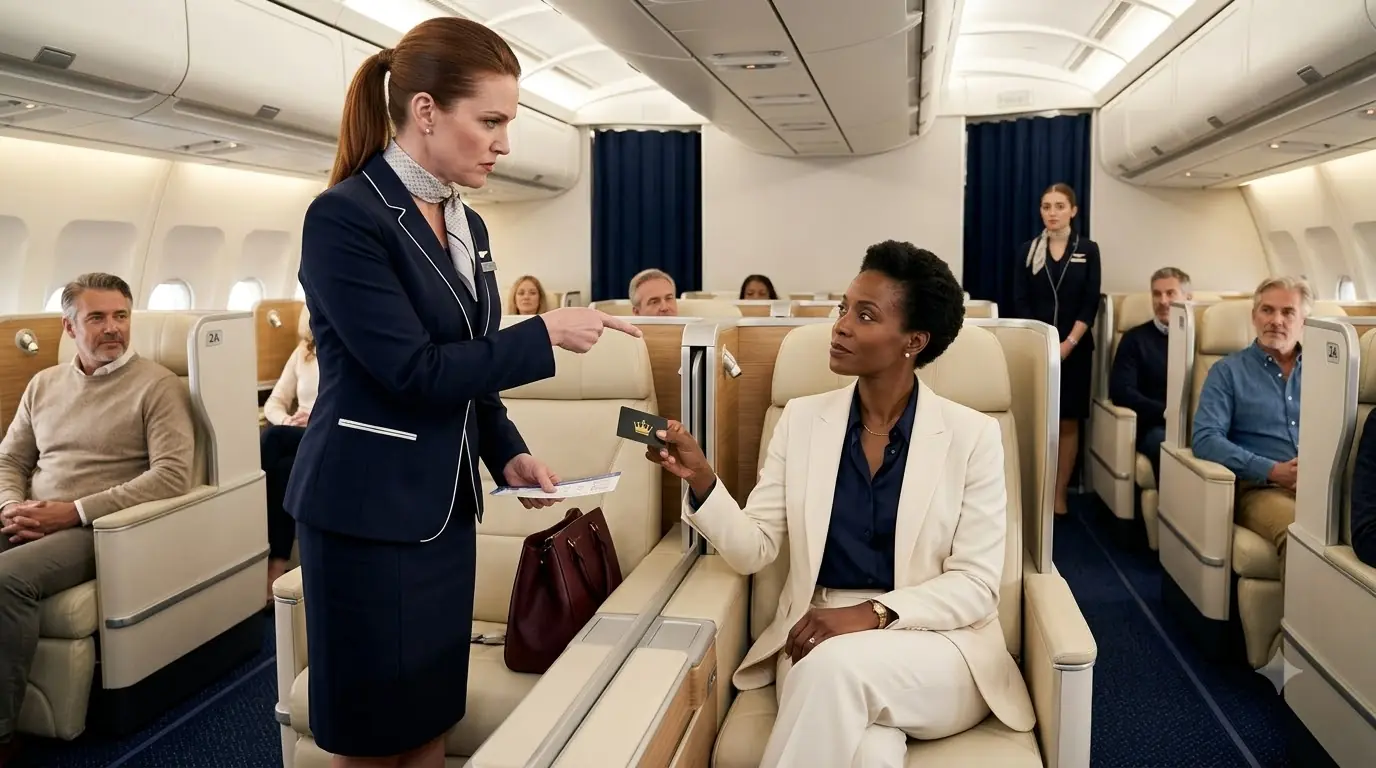
Her midnight-navy uniform was immaculate.
Silver wings.
Pressed collar.
Pale silk scarf.
Not a wrinkle anywhere.
The Airline CEO had spent enough years managing thousands of employees to know that uniforms could create an illusion.
Order did not always mean competence.
A smile did not always mean kindness.
And procedure could become a weapon when someone wanted it badly enough.
The Senior Flight Attendant looked down at the boarding pass again.
“Seat 2A?”
The Airline CEO folded her hands over the burgundy handbag resting beside her.
“Yes.”
The attendant looked at her face.
Then her ivory pantsuit.
Then the handbag.
Then back at the boarding pass.
“Interesting.”
The Airline CEO said nothing.
Across the aisle, an older man lowered his financial newspaper by two inches.
Behind him, a younger passenger removed one wireless earbud.
Nobody knew exactly what was happening yet.
But first-class passengers were very good at sensing disruption.
Especially when the disruption involved somebody else.
The Senior Flight Attendant held out her hand again.
“Identification.”
The Airline CEO looked toward the driver’s license already resting beside the boarding pass.
“You have it.”
“I’m going to need another form.”
“Why?”
The attendant gave the same polished smile.
“Security verification.”
The Airline CEO tilted her head.
Atlantic Crown Airways did not have a secondary identity-verification policy for passengers whose boarding passes had already scanned successfully at the gate.
She knew that because she had approved the policy.
Not generally.
Personally.
Two years earlier, a board member had proposed expanded cabin-level checks after a document-fraud incident in Miami.
The CEO had rejected most of it.
Identity verification belonged at ticketing, security, and controlled boarding.
Not inside the cabin after a passenger had already passed multiple checkpoints.
The Senior Flight Attendant could not have known the woman in seat 2A understood that history better than almost anyone alive.
That was the point.
For four months, the CEO had been traveling anonymously.
No executive assistant.
No airport escort.
No special message to the crew.
No corporate car waiting beside the aircraft.
She booked seats under her legal name because she refused to use aliases, but her name was common enough within company systems that most frontline employees never connected it to the executive suite.
The board believed the trips were operational inspections.
Only three people knew the full purpose.
The CEO wanted to see what happened when nobody was performing for leadership.
She wanted the unpolished version of her airline.
The ordinary version.
The real one.
Most flights had made her proud.
A gate agent in Atlanta helped an elderly passenger repack medication before boarding.
A flight attendant in Chicago carried a sleeping toddler so an exhausted father could fold a stroller.
A baggage supervisor in Seattle personally delivered a wheelchair after a subcontractor misplaced it.
None of those employees knew the CEO had seen them.
They behaved well because that was who they were when nobody important appeared to be watching.
Flight 417 was different.
The Senior Flight Attendant still held the boarding pass.
“Do you understand this is first class?”
The CEO looked toward the brass seat marker beside her.
2A.
“I do.”
The attendant’s smile widened.
“I mean actual first class.”
The older man across the aisle lowered his newspaper another inch.
The CEO’s expression did not change.
“What do you think I believe it is?”
The Senior Flight Attendant gave a soft laugh.
Not loud.
Just enough.
“Passengers occasionally misread upgrades.”
The CEO glanced toward the boarding pass.
“It says seat 2A.”
“Computer errors happen.”
The Junior Flight Attendant had been standing several feet behind her.
She shifted.
“I scanned her pass myself.”