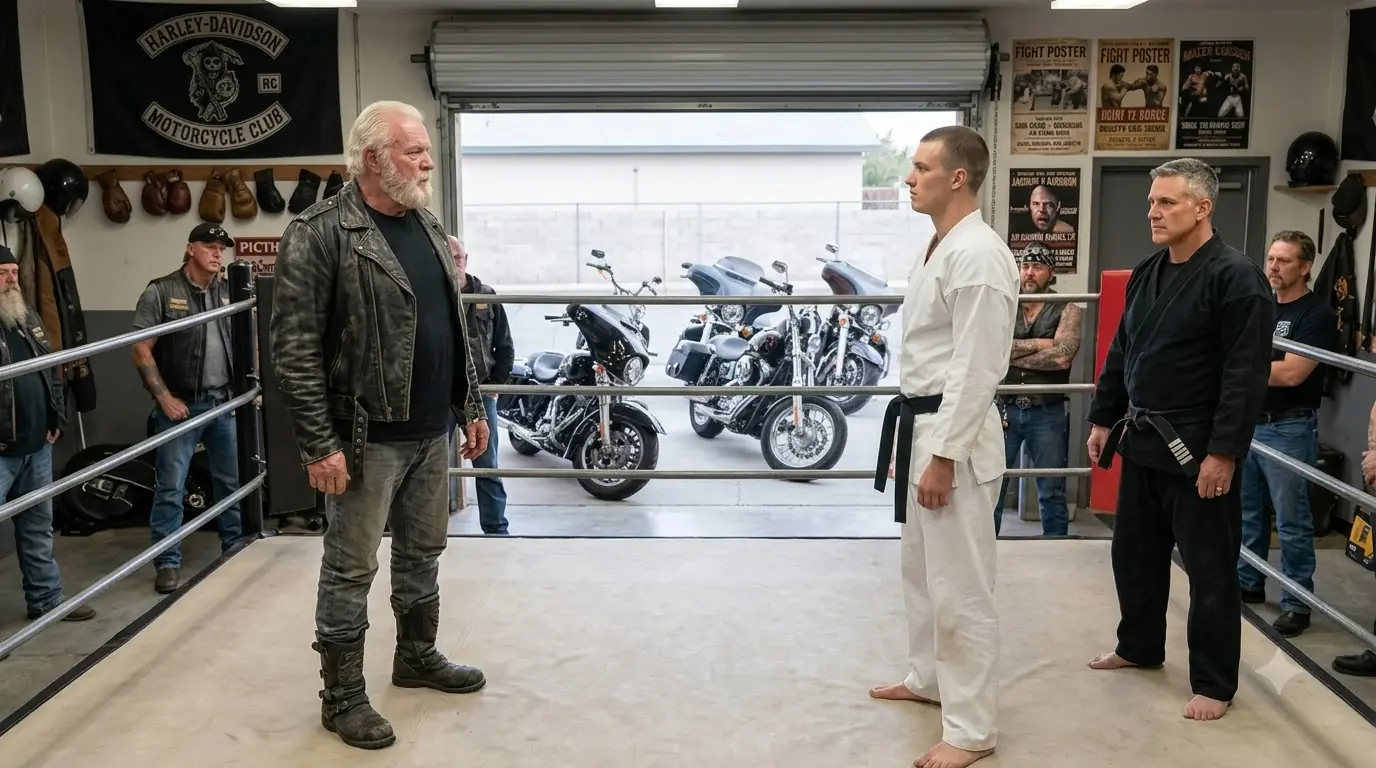
The dojo was completely silent. 40 people stood frozen around the edges of a white tatami mat in the center of Garrison Martial Arts Academy in Ridgecrest, California. The ceiling fans turned slowly overhead. The fluorescent lights hummed.
Nobody moved. Nobody breathed. In the center of that mat stood a young man named Cole Garrison, 24 years old, black belt, chest puffed, jaw tight, the kind of young man who had never once been told no by anyone who mattered. He was bouncing slightly on the balls of his feet, the way young fighters do when they want the room to think they are loose and ready and unafraid.
Across from him stood an old man in a worn leather jacket. The old man was not bouncing. He was not shifting his weight. He was not doing anything at all except standing there with his hands at his sides and his eyes fixed on the young man with the kind of absolute stillness that takes decades to earn.
His hair was white, his beard was white, his face was a map of weather and years and decisions that could not be taken back. His name was "Hank Briggs. " And in the next 90 seconds, everything in that room was going to change. But that is not where this story begins.
This story begins 6 hours earlier on a Tuesday morning in October in a small cabin at the edge of the Mojave Desert with a man standing at a kitchen window and talking to a photograph. The cabin had been built in 1959. It had wood-paneled walls the color of old honey and a stone fireplace that Hank had not lit since the previous winter. The kitchen smelled like coffee and pine and the particular kind of quiet that settles into a house after years of only one person living in it. Hank Briggs stood at the window with a chipped blue mug in both hands and looked out at the desert morning.
The sky was the pale gray of early light, not yet blue, the sun still behind the mountains, the creosote bushes still dark against the pale sand. A jackrabbit moved along the far edge of the property and disappeared behind a boulder. He turned to the photograph on the fireplace mantel. It was a 5x7 in a plain wooden frame. A woman, early 60s, standing in a garden with her hands on her hips and her head thrown back in laughter at something happening behind the camera.
She was wearing a yellow sundress. Her hair was silver blonde. The tomato plants behind her were enormous, the way they only get in a garden that someone really loves. Her name had been June. "Good morning, sweetheart," Hank said.
His voice was low and rough from sleep, and from 9 years of not using it more than necessary. He waited a moment the way he always did, as if somewhere in the fibers of the wood or the light coming through the window, there might be an answer. "Coffee is hot. Sky looks good today. You would have liked it.
" He stood there a moment longer, then set his mug on the mantle beside the frame, just for a second, the same way he might have rested his hand on her shoulder once, and then picked it back up. Same as every morning. Four years of mornings, four years since the spring of his 64th year, when pancreatic cancer had moved through June Briggs, the way a fire moves through dry grass, fast and complete, and leaving nothing behind but the shape of what had been there. They had 92 days from diagnosis to the end. Hank had been with her for every one of them.
He had held her hand in the hospital in Bakersfield on the last morning when the light through the window was the same pale gray. It was right now outside his kitchen. And he had told her things he had never said out loud to anyone because there had never been anyone else he needed to say them to. After the funeral, after the neighbor stopped bringing food, after the cards stopped coming, Hank had done what he had always done when the world became too large and too loud for him to navigate. He had gone to the garage, sat on the workbench, and stared at the motorcycle until the feeling passed.
The motorcycle was a 1997 Harley-Davidson Heritage Softail matte black with a small dent on the left side of the fuel tank from a piece of road debris outside Barstow in 2006. He had never fixed the dent. June had said it gave the bike character, and that had been enough reason to leave it forever. He had taken to calling the motorcycle June after she died. He had never told anyone that either.
He finished his coffee standing at the window. He rinsed the mug in the sink. He put on his leather jacket, the same one he had worn for 31 years, cracked at the elbows and worn smooth at the cuffs with his name stitched in faded red thread on the inside collar and below it the letters USMC. He walked to the garage, checked the oil, checked the tires, checked the chain. He started the engine and let it run for 2 minutes before he pulled out.
He rode the 12 minutes into Ridgerest the way he rode every morning. The same curves, the same loose gravel patch on the bend before the water tower. The same stretch where the road straightened out and you could see 15 mi of desert ahead of you and the Sierra Nevada standing up along the western horizon like old men who had been standing there so long they had forgotten why they started. He parked the Harley in front of Boon's Diner on North China Lake Boulevard between a 2003 Ford pickup and a motorcycle he recognized as belonging to a man named Vince Steel who arrived at the diner every Tuesday before sunrise and always ordered the same thing. The bell above the door rang when he walked in.
The diner was the kind of place that had not changed in 40 years and was not going to start now. Vinyl booths the color of old mustard, a long counter with spinning stools, a coffee machine that made a sound like a sick cat every time it finished a cycle. A jukebox in the corner had not worked since George W. Bush was in office. Nobody had ever seemed bothered by this.
Roy Boon was behind the counter, 70 years old, tall and narrow as a fence post, wearing his permanent uniform of white apron over flannel shirt. He had run this diner for 43 years. He had owned it for 25. His father had opened it and Roy had never once seriously considered doing anything else with his life, which was a kind of clarity that Hank had always respected. Roy pointed at Hank with a coffee pot, the way a man points at something he has been expecting.
"You are late. " "I'm not late, Roy. You are early. " "My diner, my clock. Sit down.