Rain pressed against the tall warehouse windows in silver sheets, blurring the harbor lights beyond the glass. The old ferry terminal had been converted into a training center years ago, but the building still carried traces of its former life: iron beams, salt-stained brick, and a ceiling high enough to swallow every shout that rose from the mats below.
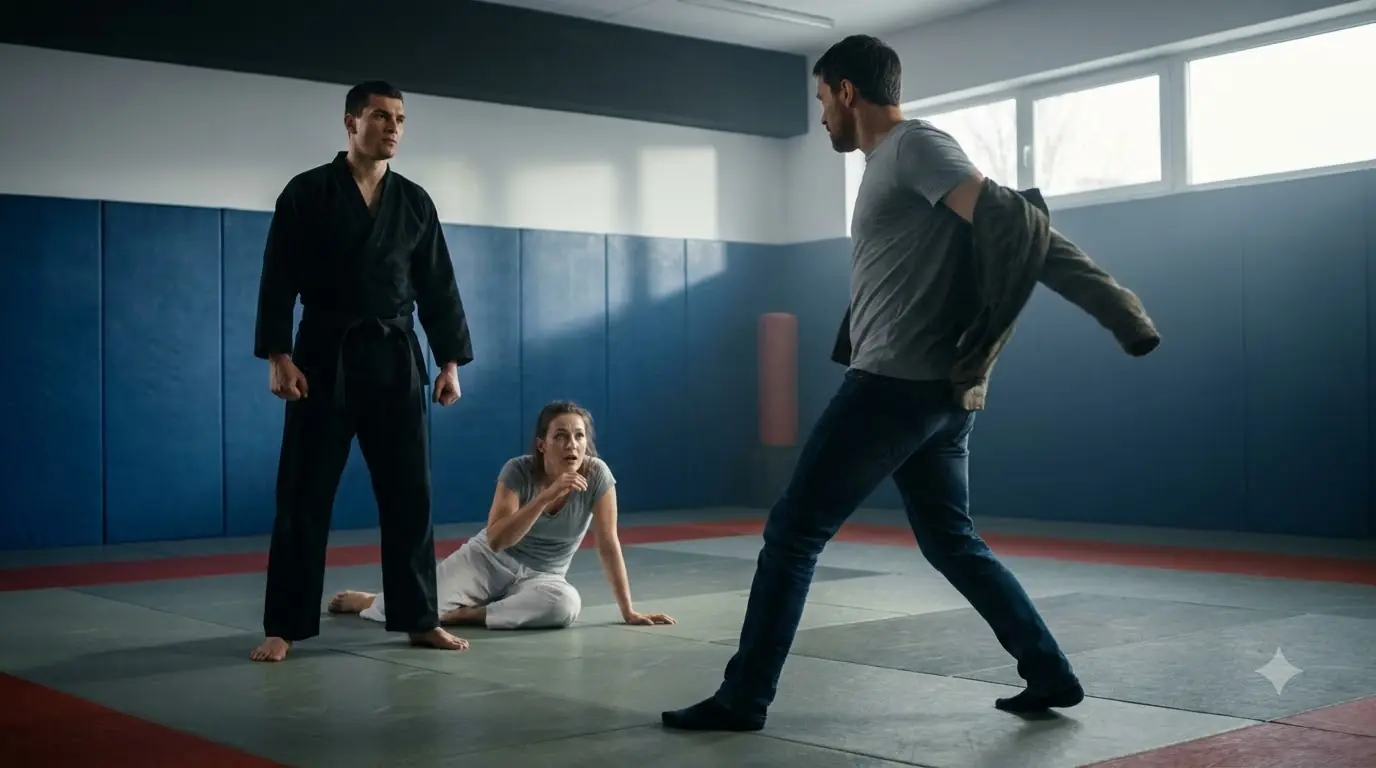
I stood near the edge of the blue training floor with my arms crossed, watching my wife.
Tasha was thirty-nine. Older than most of the beginners at Harborline Combat Club. She managed a busy emergency department, raised our fourteen-year-old daughter who believed every family problem could be solved with noodles and sarcasm, and had knees that complained whenever she climbed more than three flights of stairs. Nobody would have mistaken her for someone chasing medals.
That was not why she trained.
Eight months earlier, a man had followed her from a parking garage elevator to her car. Nothing had happened in the end. A security guard appeared before the man reached her. He changed direction and walked away as if he had never been following her at all.
But the fear stayed.
It sat in her body afterward, small and patient. It made her check reflections in storefront windows. It made her unlock the car only when she was close enough to touch the handle. It made her hate herself for feeling watched even when nobody was there.
So she signed up for Brazilian jiu-jitsu.
Our daughter, Nia, had laughed the first time Tasha came home wearing a white gi.
“You look like a dentist who joined a cult,” Nia said.
Tasha threw a dish towel at her.
The teasing stopped after the first month. Nia noticed the change before I did. Her mother slept better. She carried herself differently. She stopped rehearsing disaster every time she crossed an empty parking lot.
Most of Harborline helped with that.
The gym was rough around the edges but usually kind. Students worked hard. People taught each other. The head coach, Ben Carver, was a former collegiate wrestler with a quiet voice and a habit of correcting people without humiliating them. He liked to say that good training should make a room safer, not meaner.
Then there was Damien Cross.
Damien was thirty-three, a black belt, a regional competitor, and the gym’s most visible star. His face appeared on half the promotional posters near the entrance. He taught two advanced classes a week and ran private sessions for members who wanted to compete.
He was lean rather than huge, with long arms, sharp cheekbones, and the restless confidence of a man who always wanted an audience. His style on the mat matched his personality. Fast. Aggressive. Showy. He liked submissions that made people slap the floor hard enough for everyone to hear.
Beginners admired him from a distance.
Experienced students were more careful.
I had trained long enough to notice the pattern.
Damien was respectful with men who could threaten him. He moved smoothly with other black belts. He joked with strong wrestlers. He complimented athletes who could force him into difficult positions.
With smaller beginners, especially nervous ones, something changed.
He became theatrical.
He corrected people loudly. He held uncomfortable positions longer than necessary. He smiled when they panicked. He called it pressure testing.
“Real stress reveals real technique,” he liked to say.
Ben had warned him more than once to lower the intensity with new students.
Damien always nodded.
Then, a week later, he was back to the same behavior.
That Friday night, Harborline was running an open sparring session. The usual class had ended, but almost thirty people stayed for extra rounds. Music played softly from a speaker near the front counter. Rain hammered the windows. The building smelled of wet jackets, laundry soap, and the rubberized mats warmed by dozens of moving bodies.
Nia sat at a wooden table near the wall with headphones around her neck and algebra homework spread across a notebook. She came to the gym with us every other Friday because we did not like leaving her home alone late at night.
Nia pretended not to watch the training.
She always watched.
The round timer sounded.
People changed partners.
Tasha had just finished a careful round with Mei, a purple belt who worked as a dental hygienist and possessed the irritating ability to sweep larger people with almost no visible effort.
Tasha sat back on her heels, laughing.
“You make that look rude,” she said.
Mei grinned. “It’s only rude if I smile while doing it.”
“You were definitely smiling.”
“Then yes. Very rude.”
They bumped fists and stood.
Tasha reached for her water bottle.
“Reed.”
The voice came from behind her.
She turned.
Damien was standing two steps away.
He had removed his rash guard after class and was wearing a black gi jacket loosely over a gray compression shirt. His belt hung low on his hips, the ends dark with sweat. A thin scratch ran across his left cheek from an earlier round.
“You and me,” he said.
Tasha glanced at the timer.
“I’m sitting this one out.”
Damien smiled as if she had made a joke.
“You’re fine.”
“I know. I’m also tired.”
“That’s when you need to train.”
Tasha looked past him.
Ben was on the far side of the room speaking with a father whose son had just signed up. Other students were pairing off. Nobody seemed to be paying attention.
Tasha had rolled with Damien twice before. Neither round had been pleasant. He had not injured her, but he had treated every movement like a test she had not agreed to take.
“Next week,” she said.
Damien’s smile thinned.
“You keep avoiding hard rounds, you’re going to stay scared forever.”
That landed where he intended it to.
Tasha knew he had heard about the parking garage incident. Most people at Harborline knew. She had talked about it during her first month when Ben asked what brought her in.
Damien had just turned her reason for training into a public weakness.
I felt heat climb into my face from across the mat.
Tasha’s voice stayed even.
“I’m not scared of hard rounds.”
“Good.”
He stepped onto the mat and lowered himself to his knees.
“Show me.”
Tasha should have walked away.
Later, that was the thought that replayed most often. Not because she blamed herself, but because she understood how quickly pride could disguise itself as courage.
She looked toward Nia.
Our daughter was watching over the top edge of her notebook.
Tasha gave her a small smile meant to say, I’m fine.
Then she stepped back onto the mat.
The timer beeped.
Five minutes.
Tasha and Damien touched hands.
For the first thirty seconds, nothing happened that looked unusual.
Damien let her establish grips. Tasha worked to control his sleeve and collar. She tried a simple off-balance she had practiced with Mei. Damien recovered easily.
“Better,” he said.
Tasha did not answer.
She shifted her weight and tried again.
Damien moved suddenly.
He snapped her posture forward, circled behind, and brought her down in one smooth motion. Tasha landed on her side and immediately turned inward, trying to protect her back.
Damien flowed over her with practiced speed.
Within seconds he was controlling her from behind.
Tasha stayed calm.
She had been there before. She tucked her chin, controlled one of his hands, and tried to slide her shoulders toward the mat.
“Don’t hide,” Damien said near her ear.
He tightened his control.
Tasha worked patiently.
She felt his forearm move across the front of her neck.
Not deep enough for a clean choke.
Too much pressure on the throat.
She adjusted.
Damien adjusted faster.
The pressure increased.
Tasha’s breath caught.
She tried to turn her chin toward the opening, but his grip shifted and closed the space.
Her body sent the first sharp warning signal.
She tapped his arm twice.
Nothing changed.
She tapped again, harder.
Damien whispered, “Don’t panic. Solve it.”
Tasha slapped his wrist.
“Tap,” she said.
Her voice came out strained.
Damien’s grip stayed locked.
The round continued around them. Shoes squeaked on the concrete beyond the mats. Someone laughed at the far end of the room. The music changed songs.
Tasha tapped again.
Three hard strikes against his forearm.
“Damien,” she rasped.
He did not release.
The pressure shifted from uncomfortable to frightening.
Tasha’s chest tightened. A strange roaring sound filled her ears.
She tried to pry at his hands, but the angle was wrong and her fingers felt suddenly weak.
Her legs kicked once against the mat.
Across the room, Mei looked up.
“Hey!”
Damien did not react.
Nia stood so fast that her chair scraped backward across the floor.
“Mom?”
Tasha heard our daughter’s voice as if it came from the end of a long hallway.
She tapped again.
This time she slapped the mat.
Once.
Twice.
Three times.
Loud.
Clear.
Mei started moving toward them.
“Damien, let go!”
The pressure continued for another second.
Then two.
Tasha’s vision narrowed.