I bought three acres of scrubland in Harlan County, Kentucky, for five dollars on a Tuesday morning in March 2024.
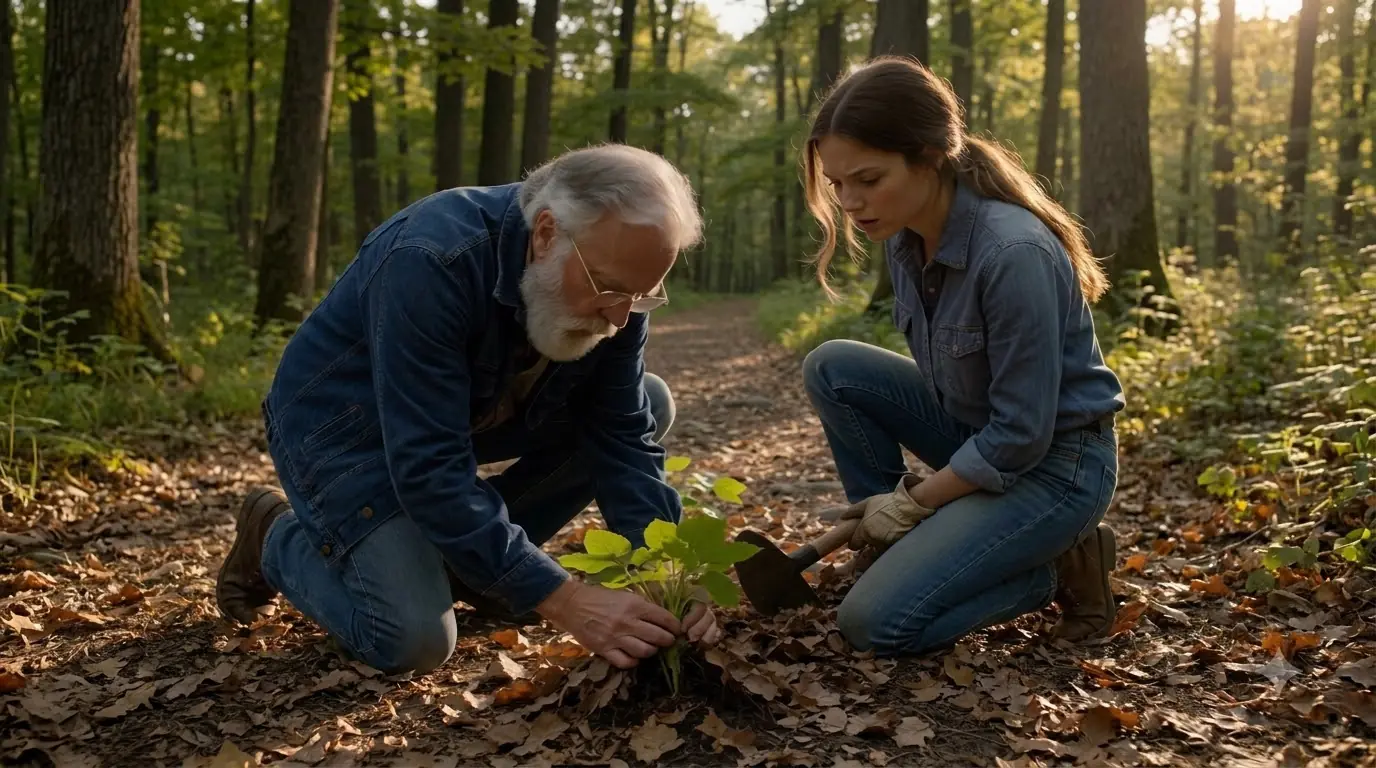
The county clerk looked over the top of her reading glasses and made me repeat the amount even though she had heard it perfectly well the first time.
“Five dollars?” Diane Mercer asked.
I nodded.
She tapped the tax-sale paperwork with one finger.
“You understand there are delinquent taxes, recording costs, and transfer fees beyond your bid?”
I told her I did.
“And there is no maintained public road into this parcel?”
I nodded again.
Diane glanced at my driver’s license, then back at me.
“June Carver, you are nineteen years old.”
“I know, ma’am.”
Two chairs away, Ron Cottle laughed.
Ron was the kind of man who attended every county tax auction whether he needed land or not. He bought abandoned trailers, hillside lots, foreclosure remnants, narrow strips beside roads—anything cheap enough that somebody might eventually pay him more for it. He was forty-eight, wore a golf shirt despite the March cold, and kept his sunglasses pushed onto his head like he expected the fluorescent lights inside the courthouse to become dangerous without warning.
“Let her have it, Diane,” he said. “Five bucks is probably five too many.”
Nobody else bid.
The hammer came down.
By the time the delinquent taxes and fees were settled, I had $217 left in my checking account and legal title to three acres almost everybody in that room considered useless.
The parcel sat twelve miles from our farm on the north side of an old hollow road that had not been maintained since before I was born. The county agricultural description called most of it steep woodland unsuitable for conventional cultivation. Briars crowded the lower slope. Young poplar and sumac filled openings where trees had fallen. There was no barn, no house, no electric service, no well, and no flat ground large enough to justify clearing for a crop.
Ron followed me into the courthouse hallway afterward.
“Serious offer,” he said. “I’ll give you a hundred dollars right now. You make eighty-three bucks before lunch.”
“Why would you buy it if it’s worthless?”
He grinned.
“Because I’m stupid with money.”
“You laughed when I bought it.”
“I laugh at everybody.”
“I’m keeping it.”
Ron shrugged.
“Suit yourself. When you get tired of fighting ticks and briars, call me.”
I never told him that I had already spent six months looking for that exact parcel.
I never told Diane either.
Nobody in the courthouse knew about the dented metal lockbox beneath my bed.
Or the black-and-white photograph inside it.
Or the hand-drawn map.
Or the four words my grandfather had written on the back of an old feed-store receipt.
North hollow field. Ginseng. Don’t let them plow it.
My grandfather, Samuel Carver, died when I was sixteen. For most of my childhood, he was the closest thing I had to a father. My own father disappeared before my sixth birthday, and my mother, Lisa, worked double shifts at a nursing home often enough that there were weeks I saw more of Granddad than I saw of her.
Samuel Carver was not sentimental in a way that photographs capture well. He did not give long speeches. He thought greeting cards were “a conspiracy between paper companies and people too lazy to say something themselves.” If he told you he was proud, you remembered it because he never wasted the phrase.
He taught me how to sharpen a mower blade, mend woven-wire fence, replace a hydraulic hose, identify walnut and hickory by bark, and tell whether soil had been mistreated by looking at how rainwater moved across it.
He also taught me that the mountains remembered things people forgot.
“Land keeps receipts,” he used to say. “Old roads. Old orchards. Old fence lines. Drainage. You learn to read them.”
When Granddad died, he left our forty-two-acre farm to me through a trust that became mine when I turned eighteen. That sounded richer than it was. I inherited land, two old tractors, a small cattle herd, a house needing a roof, equipment debt, and the balance of a farm mortgage Granddad had taken out during his last years to cover repairs and medical bills.
My mother still lived there with me.
I ran twelve cows, cut hay, did small equipment jobs for neighbors, and worked three evenings a week at a feed store.
The farm was ours.
The bank still had enough interest in it to keep me humble.
The first year after I turned eighteen was bad. A drought reduced hay. One cow required emergency veterinary treatment. The clutch went out on our larger tractor. Property insurance rose. By that winter, I owed more than I wanted to admit and had less than three thousand dollars available for spring operating expenses.
Our banker had not threatened foreclosure.
He did not need to.
“June,” he told me in February, “you need a stronger cash position before next winter. I can extend the operating note again, but eventually this place has to support itself.”
I understood the polite version of fear perfectly well.
Then I found Granddad’s journal.
The lockbox had been simple.
He had told me before he died, “Open it after eighteen. Alone.”
Inside were three things: the photograph, the map, and the feed-store receipt.
The photograph showed Granddad at perhaps thirty-five, standing beside a rotted chestnut fence post in heavy woodland. Nothing else about it seemed important.
The map showed a three-acre shape bounded by a creek on one side and a ridge on the other. Small circles appeared beneath handwritten numbers.
I recognized none of it at first.
Then, six months after opening the box, I discovered a journal wrapped in oilcloth inside an attic suitcase.
Granddad had kept farm notebooks his entire life, but this one was different.
The first entry was dated 1978.
North hollow. Good sugar maple, poplar, buckeye. North-east aspect. Soil loose under leaves. Test fifty stratified seed.
Another entry three years later read:
First survival better than expected. Leave berries. Do not disturb.
1985:
Two-prong showing in upper bed. More seed below old fence.
1992:
Harlan says timber company may want ridge. Old Mrs. Wooten says nobody cuts north hollow while she lives. Added 1 lb seed, scattered wide.
1998:
Harvested six old roots only. Replanted all berries. Neck scars excellent. Dealer wanted more. No.
2006:
Upper patch still strong. Never take youngest. Never clean a place out. Ginseng remembers greed longer than people do.
Granddad had spent nearly forty years tending wild-simulated American ginseng on land he did not own.
The property belonged to an elderly widow named Esther Wooten, according to county records. Granddad had repaired her fences, cut firewood, and maintained an old spring line for her. Apparently she had given him permission to plant under the hardwood canopy because nobody used that part of the property.
Esther died in 1989.
Her two children moved away.
The parcel passed through heirs who never paid much attention to it. Taxes eventually stopped being paid altogether.
Granddad continued visiting.
His final north-hollow entry was dated four months before his death.
Leave it. She’ll need it.
I read those words perhaps fifty times.
I did not know whether “she” meant me.
Granddad had a daughter, two granddaughters, and several women in his life whom he loved enough to worry about.
But the map was in my lockbox.
The auction notice appeared six months later.
So I spent five dollars.
The morning after the sale, I loaded a shovel, a hand trowel, a tape measure, Granddad’s map, two bottles of water, and enough poor judgment to qualify as nineteen into my pickup.
My mother watched from the porch.
“You’re going alone?”
“Yes.”
“Cell service?”
“Probably terrible.”
“Snakes?”
“It’s March.”
“That is not an answer.”
“I have boots.”
“Snakes famously respect boots.”
I smiled.
“I’ll be home before dark.”
She looked toward the truck.
“This is about that map.”
I stopped.
Mom knew about the lockbox but had never pressed me to show her what was inside.
“Yes.”
“Your grandfather kept strange things.”
“I know.”
“He once saved forty-seven broken gate hinges because he said steel might become expensive.”
“Did it?”
“Yes.”
“Then maybe strange worked for him.”
She handed me a sandwich wrapped in foil.
“Text me when you get there.”
The old access road was worse than the county file suggested. I parked nearly half a mile from the parcel because two fallen trees blocked the final section.
I walked.
The woods were still mostly winter-gray. Oak leaves covered the ground. Tulip poplars stood straight and pale against the slope. Sugar maple bark broke into long plates. Small patches of maidenhair fern had not yet emerged, but I recognized several places Granddad had marked with tiny crosses on the map.
The photograph mattered more.
I found the old fence line after forty minutes.
Rusting wire disappeared into trees that had grown around it. Several posts had collapsed completely.
Then I saw one still standing.
Barely.
Chestnut, perhaps.
Its top had rotted hollow and leaned toward the creek.
I pulled the photograph from my jacket.
Granddad had stood beside that post.
Behind him was a forked maple.
The maple was enormous now, but the shape matched.
My pulse started climbing.
On the back of the photograph, written so faintly I had missed it when I first opened the lockbox, were three words and a number.
18 east. First mother.
For perhaps a minute I thought Granddad meant dig eighteen inches deep.
Then common sense arrived.
Ginseng roots did not usually sit a foot and a half beneath the surface.
He meant eighteen inches east of the post.
I measured.
The ground looked ordinary.
Leaves.
Dark topsoil.